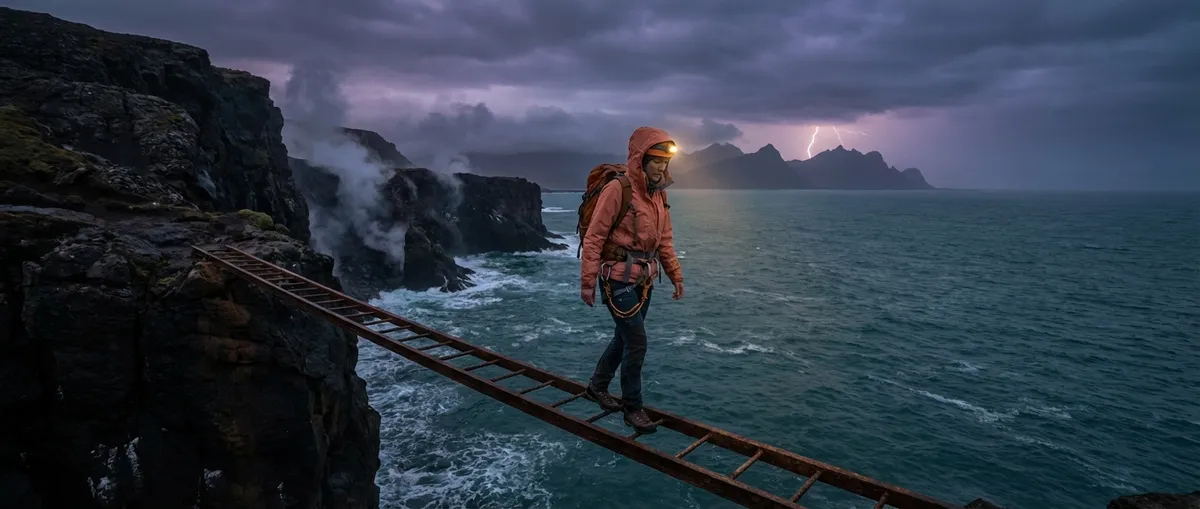
Most people book vacations. You, however, are thinking about interrogating gravity, flirting with hypoxia, and arguing with your own survival instincts. Welcome to the outer edge of travel, where the Wi‑Fi dies, the guidebooks go quiet, and your comfort zone files for divorce.
This isn’t a list of “adrenaline activities” you can book from a hotel lobby. These are five travel discoveries that twist the usual script—places and experiences where the risk feels real, the logistics get weird, and the payoff is the kind of memory your nervous system will never forget.
Riding the Planet’s Pulse in a Volcanic Twilight Zone
Picture this: you’re standing on the lip of an active crater, watching the Earth exhale molten rock, your clothes saturated with the smell of sulfur and burnt adrenaline. Volcano travel isn’t “pretty sunset over distant cone”—it’s walking the fault line between awe and “this might be a stupid idea.”
Extreme volcano chasers head to places like Vanuatu’s Mount Yasur, where you can witness persistent Strombolian eruptions from frighteningly close vantage points, or Iceland’s volcanic highlands, where new fissures can open in landscapes that didn’t exist a decade ago. The real discovery isn’t just lava; it’s how alive the ground feels—rumbling under your boots, vibrating through your bones, making your sense of “solid earth” feel like a polite lie.
But it’s not a casual stroll. Toxic gases, unstable ash fields, and sudden weather shifts turn these destinations into high-stakes chess with geology. Serious operators travel with gas masks, hard hats, and evacuation plans that feel like heist blueprints. If you’re the kind of traveler who secretly wants the planet to feel dangerous again, few experiences match being close enough to an eruption that your brain files it under “this shouldn’t be allowed.”
Chasing the Edge of Breath in Thin-Air Cities
Most people go high for a viewpoint. Extreme travelers go high enough that their lungs file a complaint.
Welcome to the world of high-altitude urbanism: cities like La Paz in Bolivia or Lhasa in Tibet, where just walking up a staircase can feel like sprinting underwater. These aren’t sleepy mountain villages—they’re full-blown cities operating in air so thin that newcomers stumble around in a slow-motion, mildly hallucinogenic fog. The discovery here isn’t just the altitude; it’s the way life has adapted to it.
Local markets sell coca leaves and oxygen canisters side by side. Soccer is still played, but your heart rate—and sense of mortality—skyrockets after a few minutes. Cable cars in La Paz glide over chaotic streets while you quietly negotiate with your red blood cells. You learn, quickly, that “fitness” at sea level is arrogant nonsense up here.
This kind of travel forces you to treat your own body as unfamiliar terrain: hydrating like a camel, walking at half-speed, sleeping like you’ve been unplugged. The risk of altitude sickness is real—headaches, nausea, and worse if you ignore the signals. The reward is that rare feeling of being a true biological outsider in a place where humans have casually figured out how to thrive in air your lungs read as “insufficient.”
Surfing Liquid Fear in Cold-Water Frontiers
Beach brochures sold you on turquoise lagoons and cocktail temperatures. Extreme water junkies go the other way—toward steel-gray seas, black-rock coastlines, and surf sessions where hypothermia is a feature, not a bug.
Cold-water surf and sea expeditions in places like Norway’s Lofoten Islands, Iceland’s Reykjanes Peninsula, or South Africa’s wilder coasts aren’t just about waves; they’re about negotiating with a hostile element. Every duck dive is a brain-freeze assault. Every wipeout comes with the sharp reminder that your wetsuit is a thin negotiation with an ocean that doesn’t care if you finish your session.
The discoveries here are twofold. First: these seascapes are overwhelmingly, aggressively beautiful—snow-dusted peaks dropping straight into stormy surf, or lonely headlands where your only audience is a cluster of seabirds and the occasional, casually enormous swell. Second: you gain a heightened, almost predatory awareness of your environment—wind direction, swell intervals, water temperature, rip currents. Your survival instincts upgrade themselves in real time.
This is not beginner territory. You need serious cold-water gear, local knowledge, and respect for the fact that rescue can be distant or impossible. But if your idea of fun is feeling very small in the best possible way, cold-water frontiers serve that humility ice-cold.
Sleeping in Motion: Extreme Transit as the Main Event
Most travelers treat transit as a necessary evil—airports, bus terminals, and time zones you swat away with melatonin. Extreme travelers turn movement itself into the destination: days and nights spent in motion, crossing landscapes too big for your brain to grasp in a single mental screenshot.
Think multi-day icebreaker voyages slicing through Arctic sea ice, where the “hotel” lurches with every collision and you wake at 3 a.m. to a sun that forgot how to set. Or freight-rail-style journeys (done legally and with permission, not as illegal train-hopping) across continental distances, where each sunrise reveals a new ecosystem sliding by your window. There are desert-crossing convoys, river expeditions where your bed is a hammock lashed to a slow boat, and long-haul overland routes that feel like time travel stretched across a map.
The discovery is psychological: when you stop “arriving” for a while, your brain finally understands the scale of the planet. You feel the distance—in your muscles, in your internal clock, in the way the sky changes thickness and color over days instead of hours. Extreme transit demands resilience—limited privacy, improvised sleep, logistical puzzles—but it gifts you a rare sense that you’ve earned every kilometer.
Somewhere along day three or four, you realize: this isn’t the road to your trip. The road is the trip.
Hunting the World’s Quietest Places
Extreme travel doesn’t always scream—it sometimes erases all sound until you start hearing your own biology. In a world wired with constant noise, chasing true silence is an act of rebellion.
Remote deserts, deep Arctic winters, and far interior highlands can be so quiet that your ears invent phantom sounds. Step into the stillness of an empty salt flat at dawn, or a frozen forest at -30°C, and suddenly you can hear your heart, your breath, the tiny crunch of ice crystals adjusting under your boots. The noise inside your head, normally drowned out by urban chaos, becomes uncomfortably loud.
These places often come with harsh terms: brutal temperatures, total lack of services, and the real possibility that help is days away. You have to carry what you need and deeply respect environmental hazards—whiteouts, dehydration, disorientation. Navigation becomes both a technical challenge and a mental one; in an endless field of white or sand, every direction looks like copy-paste.
The discovery is more existential than scenic. True silence acts like a mirror tilted back at you. Stripped of notifications, engine noise, and casual chatter, you confront how much of your life has been padded by distraction. Some people find that calming; others find it slightly terrifying. Either way, it’s an extreme experience you won’t replicate on any “digital detox” retreat.
Conclusion
Extreme travel isn’t about collecting bragging rights or manufacturing near-death stories for social media. It’s about deliberately walking into environments where your usual settings no longer work—where your lungs, nerves, instincts, and assumptions all have to recalibrate.
Volcanic twilight zones, thin-air cities, cold-water coasts, endless journeys, and weaponized silence all offer the same core reward: they make the world feel big and dangerous and magnificently indifferent again. If that idea scares you and excites you in the same breath, you’re exactly the kind of traveler these places are waiting for.
Just remember: the more extreme the trip, the less room there is for laziness. Do the research, respect local expertise, gear up properly—and then step past the safety rail with your eyes wide open.
Sources
- USGS Volcano Hazards Program - Authoritative information on volcanic activity, hazards, and monitoring, useful for understanding risks around active volcanoes
- Centers for Disease Control and Prevention – High Altitude Travel & Altitude Illness - Medical guidance on traveling and acclimatizing safely at high elevations
- National Oceanic and Atmospheric Administration (NOAA) – Ocean Facts - Background on ocean conditions, cold-water hazards, and marine environments relevant to extreme coastal travel
- International Association of Antarctica Tour Operators (IAATO) – Visitor Guidelines - Insight into best practices, safety, and environmental considerations for extreme polar and icebreaker-style journeys
- National Park Service – Soundscape and Night Sky - Research and explanations on natural soundscapes and the importance of quiet, relevant to seeking extreme silence in remote environments
Key Takeaway
The most important thing to remember from this article is that this information can change how you think about Extreme Travel.