Most people treat cities like slot machines: you feed them money and hope they pay out memories. Wrong game. If you know where to hunt, urban jungles are basically black markets of free experiences—illicit not in law, but in how outrageously underpriced they feel. This isn’t about “visit the free museum on Sunday.” This is about hacking your way into the unofficial side of a place: rooftops nobody lists, festivals you didn’t pay for, and wild little loopholes that turn “I’m broke” into “I’m unstoppable.”
Welcome to the underbelly of budget adventures—where curiosity is currency, and a $10 bill can last three days if you play it right.
The Midnight City Scan: Mining Free Culture After Dark
When the sun clocks out, the city stops pretending to be respectable. This is your hour.
Start with a simple ritual: the “midnight scan.” Before you arrive in a new city, search for local event listings from libraries, universities, and city governments. These are gold mines for free talks, performances, and outdoor screenings that never make it onto glossy travel blogs. Once you’re on the ground, ride late-night public transport and just get off where clusters of people look like they’re going to something, not home from something—street festivals, night markets, impromptu concerts.
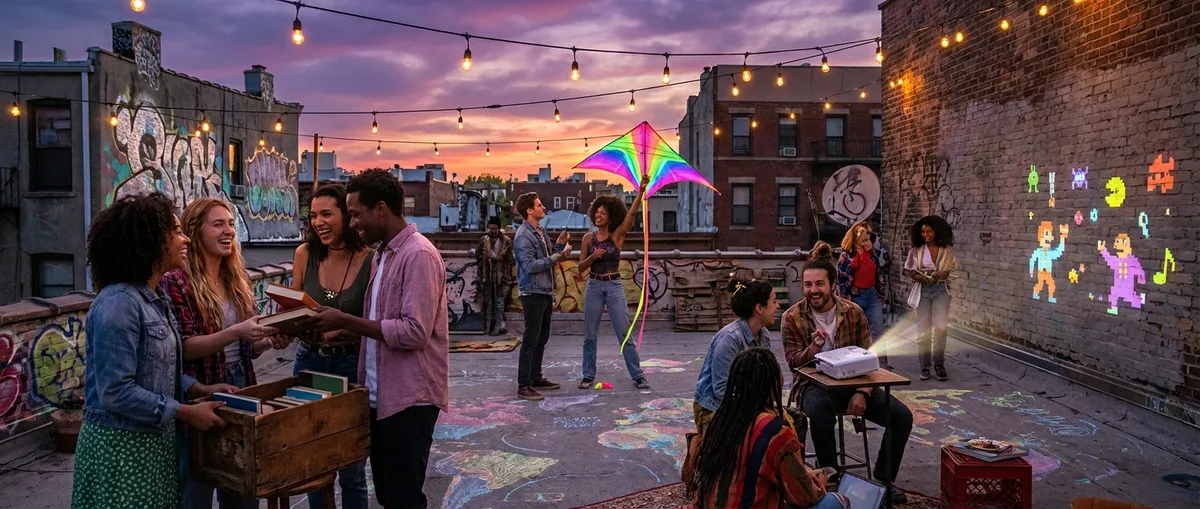
In big cities like New York, Berlin, or Mexico City, neighborhoods have radically different personalities after dark. Follow the music, food smells, and neon instead of your map. Ask street vendors what’s happening “gratis” tonight. Your goal isn’t to see the famous skyline; it’s to catch the city doing something unscripted and free—salsa in a random plaza, an outdoor film projected onto a wall, a neighborhood block party that absolutely wasn’t meant to be an “attraction,” but you’re in it now.
Budget adventure here isn’t about ticking boxes. It’s about treating the city’s nightscape like a living, unpredictable organism—and letting it drag you somewhere your itinerary would never approve.
Discovery #1 – The Rooftop Republic: High Views Without High Prices
Observation decks want $30–$50 so you can press your face against generic glass with 300 other tourists. You’re not here for that. You’re here for the Rooftop Republic—the invisible network of high places that cost you nothing and feel ten times more illicit.
Your toolkit is simple: map apps + curiosity + basic respect. Search for public libraries, university buildings, shopping centers, cultural centers, and municipal buildings with elevators. Many have accessible rooftops, terraces, or top-floor lounges open to the public, especially in Asian and European cities. Some malls in places like Bangkok or Kuala Lumpur have half-forgotten rooftop food courts or viewpoints that feel weirdly abandoned. Hotels often have bars or lounges where you can buy the cheapest drink on the menu and inherit a million-dollar skyline.
The move: go up whenever you see an elevator that doesn’t require a keycard. Highest floor. Exit. Explore. Look for doors marked “terrace,” “viewing deck,” or just… doors that aren’t locked. Never break rules, force entry, or ignore safety signage—you’re here to surf the legal edges, not become a headline. But you’ll be surprised how many buildings are half-open to anyone bold enough to just check.
These moments—eating a convenience-store snack alone on a quiet rooftop while the city screams below—are peak budget luxury. You didn’t buy the view; you hunted it down.
Discovery #2 – The Not-A-Tour Tour: Hijacking Free Local Systems
Official tours can be great—if you like walking in a pod of identical backpacks. If you’re broke and allergic to lanyards, you want the “not-a-tour tour”: following existing public systems as if someone secretly designed them for travelers on hard mode.
Most cities already have free or cheap “routes” built in: tram lines, ferry crossings, community buses, bike-share zones, or even hiking trails that locals use to commute. Instead of paying for a sightseeing cruise, jump on the public ferry route that locals use to cross the river. In Istanbul, for example, the commuter ferries offer front-row Bosphorus views for a fraction of the cost of tourist boats. In Hong Kong, the Star Ferry is practically a moving postcard for pocket change.
Your challenge is to design your own route: pick one tram or bus line that crosses an interesting part of town and ride it end-to-end, hopping off whenever you see something that looks alive—markets, parks, protests, street art. Treat every stop as a potential micro-adventure. Ask the driver or fellow passengers where they would get off “just to wander.”
This hack turns the city’s arteries into your personal scavenger hunt. You’re not following a guide; you’re riding the pulse of the place, zigzagging through the same veins locals use every day—only you’re deliberately getting lost on them.
Discovery #3 – The Food Shadow: Eating Well in the Tourist Afterglow
You don’t need to eat in the popular district; you just need to eat in its shadow.
Tourist zones are surrounded by “spillover neighborhoods”—areas one or two blocks beyond the Instagrammable square, where locals still outnumber daytrippers but prices haven’t fully mutated. The rule: walk until the souvenir shops disappear and menus lose English headlines. That’s where the Food Shadow begins.
Look for:
- Plastic chairs, not curated decor
- Short, focused menus, not 10-page laminated books
- Locals in work clothes, not sunhats
Ask what’s cheapest and most filling, or order the daily special. Street food, hole-in-the-wall canteens, and student districts are your best allies. Many university areas have absurdly cheap bakeries, cafeterias, and late-night food that exist purely to keep broke people alive—and that’s your demographic.
If you really want to play on hard mode, hit up big supermarkets or open-air markets near closing time. Vendors often slash prices to clear stock: bread, fruit, prepared foods, and bakery items can drop to half price or less. Assemble a chaotic picnic and treat a park, riverbank, or scenic stairway as your dining room. You’re not just saving money—you’re refusing to let restaurants decide what “going out to eat” has to look like.
Discovery #4 – The Side-Quest Economy: Volunteer, Crash, Collaborate
Money isn’t the only currency on the road. Time, skills, and audacity can buy you more experiences than your bank app would ever admit.
Plenty of hostels, farms, eco-projects, and community spaces trade food or accommodation for a few hours of daily work. Think hostel reception in exchange for a bed, helping on an organic farm for meals and a place to crash, or volunteering at festivals to get wristband-level access. Sometimes it’s through organized platforms; sometimes it’s as simple as asking at an independent hostel or community center, “Do you ever exchange help for a bed?”
Outside of formal arrangements, micro-collaborations can get you into strange pockets of local life. Offer to photograph a small live music event for free and you’ll likely end up in the afterparty. Ask a local artist if they need help setting up a show. Help a hiking group carry gear and you might get whisked up a mountain path that never appears on tourist maps. These side quests often come with unexpected perks—meals, rides, insider invites—that dissolve traditional “tourist vs. local” boundaries.
Of course, vet everything for safety and fairness. Avoid exploitative setups. But if it feels mutually beneficial and your gut says yes, you’re not just visiting a destination—you’re temporarily plugging into its ecosystem.
Discovery #5 – The City as Game Board: Turning Wandering into Missions
Wandering is nice. Wandering with a mission is chaos in the best way.
Treat each new city as a game board and set yourself low-budget, high-strangeness challenges. No money needed, just rules. Examples:
- Find three pieces of street art in different neighborhoods and trace the artist’s tag across the city
- Navigate one whole day without using your phone map—only verbal directions from strangers
- Pick a river, tram line, or major road and follow it on foot until it ends or becomes boring (then take the first turn that feels wrong)
- Try to find the highest free point you can reach and the lowest free point (riverbank, underpass, basement café) in a single day
- Choose a local word (like “market,” “hill,” or “garden”) and follow signs featuring that word until you land somewhere that feels like a secret
These self-assigned quests force you into side streets, back alleys, and weird dead-ends where the best stories usually live. You’ll stumble across free exhibitions, pop-up performances, small-town parades, or just a neighborhood that feels like it forgot the internet exists. Every city becomes a level to be hacked—not consumed, but decoded.
When you play like this, the cost of entry stays stupidly low, but the return on curiosity goes stratospheric.
Conclusion
Budget travel isn’t a downgrade; it’s an upgrade to a harder, stranger difficulty setting where creativity does the spending. While everyone else queues up to buy the same view, you’re taking freight-elevator chances, riding commuter ferries like they’re private cruises, and eating in the gravitational pull of tourist zones without ever getting trapped inside them.
You’re not here to replicate what the city sells. You’re here to discover what it accidentally gives away for free.
Next time you land somewhere new, try it: climb first, scan after midnight, ride the longest bus route, hunt the Food Shadow, and set yourself one ridiculous mission. Then see how long you can go before your wallet has to speak.
Spoiler: longer than you think.
Sources
- U.S. Department of State – Travel Advisory & Safety Information – Guidance on staying safe while exploring unfamiliar cities and neighborhoods
- UNWTO – International Tourism Highlights – Context on global tourism trends, including urban tourism and traveler behavior
- NYC Department of Transportation – NYC Ferry – Example of how public ferries can double as low-cost sightseeing in major cities
- Hong Kong Tourism Board – Star Ferry – Iconic commuter ferry used as a scenic, budget-friendly harbor crossing
- University of California, Berkeley – Events Calendar – Typical example of how universities list free or low-cost public events travelers can tap into
Key Takeaway
The most important thing to remember from this article is that this information can change how you think about Budget Adventures.