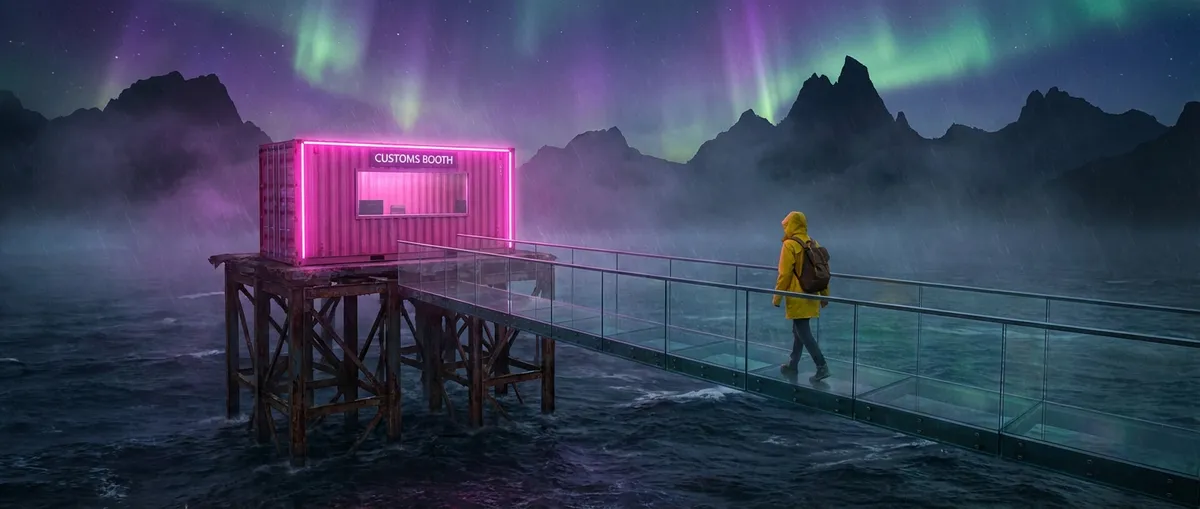
There are places on this planet that feel like they slipped past some cosmic quality-control checkpoint—locations where your camera roll looks photoshopped and your sense of “normal” quietly files for divorce. This isn’t about pretty views or standard bucket lists. These are the kinds of places where you double-check the map, your pulse, and occasionally, your sanity.
Pack your curiosity, your best “this might be a terrible idea” grin, and a willingness to stand somewhere that doesn’t quite feel like it should exist.
The Forest That Eats Light: Black Hallerbos at First Fog, Belgium
Hallerbos is famous for its bluebells every spring. Pretty. Predictable. Instagrammed to death.
But slide in right before sunrise on a cold, fog-laced morning, and the whole place mutates.
The towering beeches form a perfectly spaced cathedral of trunks, and when the fog drops low and dense, the forest feels like it’s absorbing light instead of reflecting it. Everything flattens into gradients of gray and muted green; depth perception goes on strike. Birds sound closer than they are. Footsteps feel too loud. The path looks like it might simply not exist three meters ahead, swallowed by white.
The weird part isn’t the beauty—it’s the sensation that the environment has turned down the contrast on reality. Eyes strain; your brain keeps inventing shapes between the trees that aren’t there. For a few minutes at a time, it’s like walking through a half-rendered video game level.
Go in the off-hours, on a weekday, with fog in the forecast and no flowers to draw crowds. You’re not chasing the postcard—you’re walking into a glitch in the lighting engine of Earth.
The Island That Whispers in Smoke: Ijen’s Blue Fire, Indonesia
On Java’s Ijen volcano, night doesn’t just fall—it burns electric.
Down in the crater, sulfuric gases ignite as they hit oxygen, creating surreally blue flames that spill and flicker like neon lava. It’s not magic; it’s chemistry. But you won’t care when you’re standing in the dark watching liquid-blue fire slither down jagged rocks as if the mountain misplaced its color palette.
The air is brutal—sulfur stings your throat even through a mask, and the wind likes to swing the fumes your way at the exact wrong moment. Local miners shuffle past under absurd loads of sulfur, turning your midnight pilgrimage into something that feels half-mystical, half-industrial horror film.
The weirdness here is the clash: hellish working conditions, poisonous air, and this hypnotic, impossible beauty in a shade of blue your brain associates with LEDs, not lava. It’s nature cosplaying as sci-fi.
You’ll hike up in darkness, stumble down into the crater with a headlamp, stand close enough to feel the heat, and suddenly your idea of what “fire” looks like will be permanently corrupted.
A Town Stuck Between Versions of Itself: Kolmanskop, Namibia
Kolmanskop isn’t just abandoned—it’s mid-transformation.
Once a thriving German colonial diamond town in the Namib Desert, it was abandoned when richer diamond deposits were found elsewhere. The desert, insulted but patient, has been repossessing the town ever since—room by room, floor by floor.
Step through a doorway and find a staircase dissolving into a slope of sand. Bathtubs half-buried. Wallpaper hanging in strips over dunes that shouldn’t exist indoors. Some rooms feel like they’re drowning in slow motion. Others are almost intact, interrupted only by a tongue of sand lapping at the tiles.
You’re walking through a time-lapse in progress, trapped at the halfway frame between “town” and “dune field.” Every gust of desert wind edits the architecture a little more. It’s less like exploring ruins and more like interrupting an ongoing negotiation between gravity and grit.
The uncanny part is how domestic it still feels: kitchens, hallways, windows—just gently swallowed, as if the desert isn’t destroying anything, only repossessing what was always technically its own.
The Cave Where the Ceiling Is an Ocean of Light: Waitomo Glowworm Grotto, New Zealand
In the Waitomo caves, you float under a sky that forgot it’s underground.
A boat slides silently along black water through tunnels with low, jagged ceilings. Then the cave narrows, the lights go out, and suddenly the roof cracks into stars—thousands of pale blue-green pinpricks, each a glowworm larva fishing for dinner with a thread of sticky bioluminescent silk.
The illusion is aggressively convincing. It looks like some designer set the brightness to “cosmic.” The longer you stare, the more strange it gets: this isn’t space, it’s biology. You’re adrift under a swarm of hungry, glowing predators using light as bait.
Your eyes adjust until the darkness between the “stars” gets thicker than any night you’ve stood in. Your body knows you’re indoors. Your brain says you’re lying in a boat under an alien sky. The cave answers by dripping rhythmically, like it’s counting seconds in geological time.
This is the kind of place where silence feels earned. You’re not just sightseeing; you’re trespassing in a darkness that belonged to creatures long before we arrived with helmets and smartphones.
The Mirror That Erases the Horizon: Salar de Uyuni in the Wet Season, Bolivia
Salar de Uyuni during the dry season is already strange—the world’s largest salt flat, a blinding white infinity where depth and distance go missing. But hit it right after the rains, when a film of water turns that salt into a planetary mirror, and the weirdness escalates.
There’s no visible horizon. Sky and ground fuse into a single, seamless reflection. Walk a few steps and you look like you’re pacing across a paused screensaver. Mountains hover, upside down and right-side up at once. Cars cruise by as if they’re driving through the atmosphere, leaving ripples in the clouds under their wheels.
You can’t trust the scale of anything. Your own reflection feels like a stranger walking toward you. A jump for a photo turns into a momentary sensation of zero gravity because your brain can’t find a fixed frame of reference.
It feels less like traveling on Earth and more like visiting the backend of a simulation where someone forgot to toggle “render horizon: ON.”
Conclusion
Weird places aren’t just about shock value or strange trivia. They’re pressure tests for your sense of normal. You show up with assumptions—about forests and fire, towns and caves, deserts and skies—and these locations carefully, almost politely, dismantle them.
If you’re tired of trips that feel like product demos for the tourism industry, start hunting for spots where reality seems misfiled. Go where deserts invade kitchens, fire glows the wrong color, forests dim the world, ceilings pretend to be galaxies, and salt flats decide horizons are optional.
Those are the journeys you replay in your head when everything else goes back to looking ordinary.
Sources
- Visit Flanders – Hallerbos Forest – Official regional tourism info on Hallerbos and seasonal conditions
- Smithsonian Magazine – Indonesia’s Electric-Blue Volcano – Background on Ijen’s blue fire and the chemistry behind it
- National Geographic – Deserted Diamonds: Namibia’s Ghost Town – History and imagery of Kolmanskop and its encroaching dunes
- New Zealand Department of Conservation – Waitomo Caves – Official site with details on the glowworm caves and conservation
- NASA Earth Observatory – Salar de Uyuni – Scientific overview of Salar de Uyuni and its reflective wet-season conditions
Key Takeaway
The most important thing to remember from this article is that this information can change how you think about Weird Places.