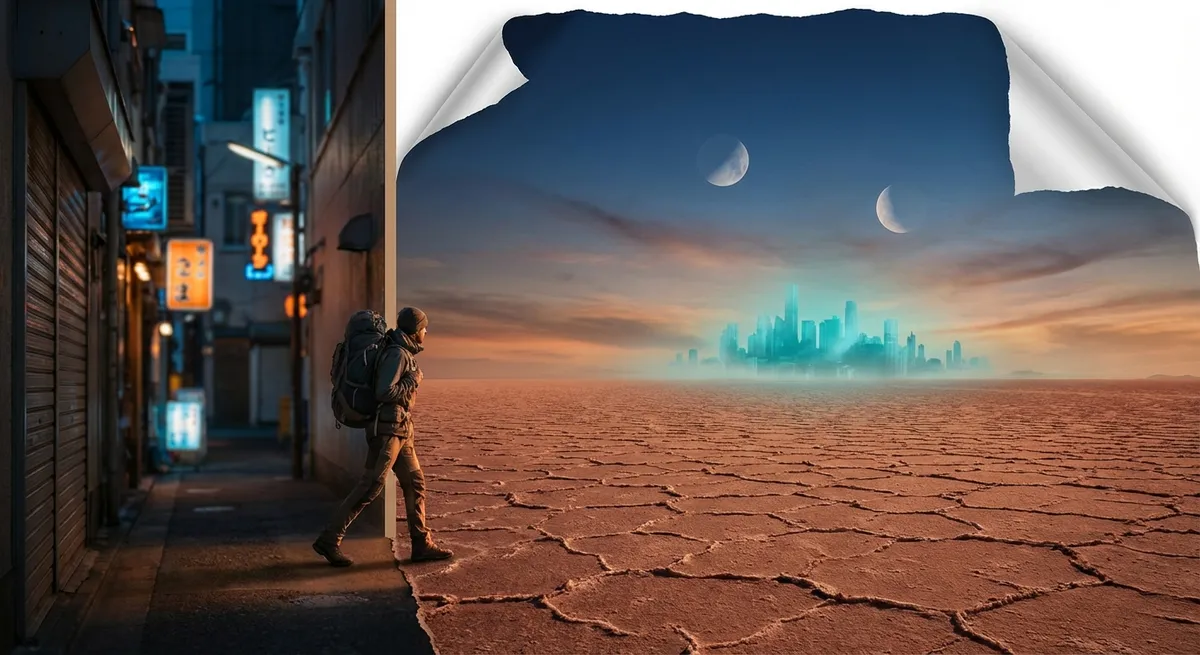
There are trips you can describe, and then there are trips you can only swear actually happened. Extreme travel isn’t just about hanging off cliffs or freezing your eyelashes in a polar storm—it’s about stepping into places where your brain keeps whispering, “This is not how Earth is supposed to work.” This is your invitation to chase five very real destinations that feel illegally fictional, the kind of journeys that leave you wondering if customs just stamped your passport for another dimension.
Why Extreme Travel Isn’t About Adrenaline (Not Really)
Extreme travel has been hijacked by the idea that you have to be dangling from ropes or sprinting away from avalanches to count as “hardcore.” That’s one version, sure. But the real edge lies in psychological whiplash: landscapes that scramble your sense of scale, silence that feels louder than cities, or places where your inner risk manager quietly resigns.
This kind of travel means accepting logistical chaos as part of the ticket price: patchy infrastructure, weather that doesn’t care about your return flight, and routes that exist more as rumor than guarantee. It also means recalibrating your idea of comfort—days without Wi‑Fi, unreliable hot water, and the acute realization that you are very, very far from the nearest pharmacy. But in exchange, you get something ruthless and rare: unmediated reality. No velvet ropes, no viewing platforms, no souvenir stands—just you, your oxygen levels, and the creeping sense that your daily life suddenly looks very small.
If your perfect trip includes mild confusion, controlled discomfort, and the possibility of a story you’ll never be able to tell with a straight face, keep reading.
Discovery #1: The Glowing Edge of the World in Oymyakon, Siberia
If you’ve ever said, “I like cold,” Oymyakon is where that statement gets cross-examined. Known as one of the coldest permanently inhabited places on Earth, this Siberian village sits in the Russian Far East and has recorded temperatures plunging below −60°C (−76°F). At that point, “cold” is the wrong word. This is structural cold. Existential cold.
Here, your breath crystallizes instantly. Eyelashes freeze to each other. Phones die in minutes if not glued to your body heat. Locals leave cars running for hours to avoid the engine turning into an expensive ice sculpture. Dogs grow a kind of snow armor on their fur just walking down the street. The landscape goes silent in a way cities never do—no running water, no rustling leaves, no insects, only the crunch of boots and the occasional groan of frost-stressed metal.
Traveling here is an expedition, not a detour. You’re looking at flights to Yakutsk, then bone-jarring overland travel along the Kolyma Highway (not exactly the “spa road trip” type of route). But if you manage it with a reputable fixer or local operator, you get access to an alien version of life: schoolkids in −50°C like it’s Tuesday, open-air markets where meat doesn’t need refrigeration, and skies so clear at night the stars look closer than your friends back home.
This isn’t a selfie destination. This is a place that makes you reconsider what “liveable” even means.
Discovery #2: Climbing Down the Throat of Erta Ale’s Lava Lake, Ethiopia
In Ethiopia’s Afar Region, the ground is trying very hard to become magma again—and occasionally succeeds. Erta Ale, a persistently active basaltic shield volcano, sits in one of the hottest and lowest places on the planet: the Danakil Depression. This is where the Earth leaks.
Reaching Erta Ale is a heat labyrinth: desert driving, armed escorts in some periods due to regional instability, and dust that infiltrates everything you own, including your memories. Once you arrive at the volcano’s base, the hike to the rim usually begins in the late afternoon or at night to avoid getting torched by the sun. The air smells like the planet exhaling—sulfur, smoke, minerals.
Then you reach the crater and see it: a churning lava lake, a living wound in the crust. The surface cracks, glows, hardens, and shatters over and over in slow motion. Every few seconds, a wave of heat slams into you like you’ve opened an oven door attached to hell. The sound is a low, constant roar, like an endless bonfire inside a cathedral.
Nothing in a city prepares you for that color—hyperreal orange-red, brighter than fire, almost wrong to look at. You realize you’re standing a few hundred meters above liquid rock, on a planet that is still, inconveniently, under construction. This is geology with the safety barriers ripped out.
Safety here is logistical, not absolute. You go with experienced local guides, you watch wind direction, you don’t play daredevil on the rim. But if you’ve ever wanted to know, physically, what “the Earth’s mantle wants a word with you” feels like—Erta Ale answers.
Discovery #3: Sleeping on the Vertical in Patagonia’s Granite Kingdom
There’s extreme, and then there’s choosing to sleep in a bed that hangs off a cliff. Patagonia—split between Chile and Argentina—might be famous for hiking icons like Torres del Paine, but its true alter-reality lives in its big walls, especially in places like El Chaltén and the Fitz Roy massif.
Here’s the premise: hike in with climbing guides and gear, ascend vertical granite like you’re auditioning for gravity’s least-favorite human, and then set up a portaledge—a kind of fabric and metal cot—bolted into the rock hundreds of meters above the ground. It’s basically a floating balcony for people with unresolved issues with normal hotels.
The first time you clip into a portaledge and lean back, every survival instinct screams. There’s rock at your back, void at your feet, and wind that treats you like a conversation piece. As night falls, the valley lights (if any) fade, and you’re suspended between stars above and glacier glow below. Cooking noodles on a tiny stove, harness still on, becomes both mundane and surreal.
Patagonia’s weather is theatrically chaotic. Gusts arrive sideways, clouds stack up like spilled ink, and sometimes you wake up to ice crystals on your sleeping bag even in “summer.” You have to train, go with certified guides, and respect forecasts like they’re law. But if you’ve ever looked at a mountain and thought, “I want to be part of that outline,” this is how you literally enter the skyline.
Discovery #4: Kayaking the Ice Labyrinth of Greenland’s Ilulissat Icefjord
Greenland’s west coast doesn’t just show you climate change; it lets you paddle through its moving sculpture garden. The Ilulissat Icefjord, a UNESCO World Heritage site, is fed by one of the fastest and most productive glaciers in the Northern Hemisphere—Sermeq Kujalleq. Translation: endless icebergs, constantly being born and dying in slow motion.
Picture this: you slide a sea kayak into frigid, glassy water tinted a faint Arctic blue. Ahead of you, icebergs the size of buildings drift and pivot, carved into bizarre symmetry by melt and sea. Some are striped with ancient dust, others glow an almost radioactive turquoise where they’ve flipped and exposed compacted glacial ice.
You paddle in silence broken only by your strokes and the occasional rifle-crack sound of ice calving in the distance. Every now and then, you hear a deep internal boom from an iceberg shifting its weight—like distant thunder underwater. Seals surface to stare at you, apparently offended by your presence. The air smells of salt, cold, and nothing else.
This is not a place for solo cowboy trips. Local outfitters obsess over weather, tides, and safe distances from unstable ice. You learn to respect “icefall radius”—the invisible danger zone around active bergs that can roll, fracture, or collapse with zero notice. But that tension is precisely what makes it so vivid: you’re threading a maze built by a planet in flux.
By the time you make it back to shore, cheeks numb and camera full, the icefield you just paddled through has already changed shape. It’s like exploring a cathedral that quietly rebuilds itself every hour.
Discovery #5: Crossing the Salt Horizon of Bolivia’s Uyuni After the Rains
Most people think of Bolivia’s Salar de Uyuni as a giant, dry salt pan—thousands of square kilometers of cracked white crust, like hiking across a shattered moon. That’s already strange enough. But catch it right after the rains and it becomes something else: a perfect mirror that erases the difference between ground and sky.
You drive out in a 4x4 and, at some point, lose all normal reference points. The horizon dissolves. The clouds above are duplicated beneath you so cleanly it feels like your vehicle is levitating between two skies. Step out, and your footsteps send ripples through the shallow water. You’re technically walking on Earth, but visually you could be anywhere the laws of physics have been downgraded to “suggestion.”
Perspective plays tricks: people look like they’re floating, mountains drift as if they’re on a separate dimension, and distance becomes impossible to read. You turn a slow circle and there is no obvious “up” or “down” anymore—just reflections, light, and the occasional lonely cactus island poking through the illusion.
Conditions here are extreme by stealth. At 3,600+ meters (nearly 12,000 feet) above sea level, the altitude can hit harder than the beauty. Sunlight reflects off the water and the salt, turning the UV index into a full-contact sport. Winds can go from gentle to sandblasting in minutes. Intelligent travelers show up with altitude meds (after talking to a doctor), absurd amounts of sunscreen, sunglasses that mean business, and more water than they think they need.
The reward is brutal and precise: a day in a world that looks fake even in person. Your photos will look Photoshopped. They’re not. Reality just decides to cosplay as digital art here.
Conclusion
Extreme travel isn’t about chasing danger for bragging rights; it’s about agreeing to be small again. It’s stepping into zones where humans are a recent experiment and the environment is not particularly invested in your survival. From Siberian cold that bullies electronics into submission, to Greenland’s cracking ice cathedrals, to a salt desert that briefly forgets which way is up—these journeys strip out the noise and leave only you and the elements.
If your comfort zone has started to feel like a padded cell, these five edges of the world are your escape hatch. Plan obsessively, respect local expertise, overpack humility, and then go stand in places that make city skylines look like toy sets. The world is still weirder, harsher, and more magnificent than any feed will ever admit.
Now close your tabs and start plotting routes. Reality is misbehaving out there—and that’s exactly where you belong.
Sources
- World Meteorological Organization – Coldest Places on Earth – Overview of record low temperatures and how they’re measured, including regions like Siberia.
- UNESCO World Heritage Centre – Ilulissat Icefjord – Official description of Greenland’s Icefjord, its glaciology, and global significance.
- UNESCO World Heritage Centre – Salar de Uyuni (Tentative Listing) – Background on Bolivia’s salt flats and their cultural and geological importance.
- Smithsonian Magazine – Inside the Danakil Depression – Field report on Ethiopia’s Danakil Depression and volcanic activity, including Erta Ale.
- National Park Service (USA) – High Altitude and Your Health – Practical information on altitude sickness, symptoms, and prevention relevant for high-elevation travel.
Key Takeaway
The most important thing to remember from this article is that this information can change how you think about Extreme Travel.