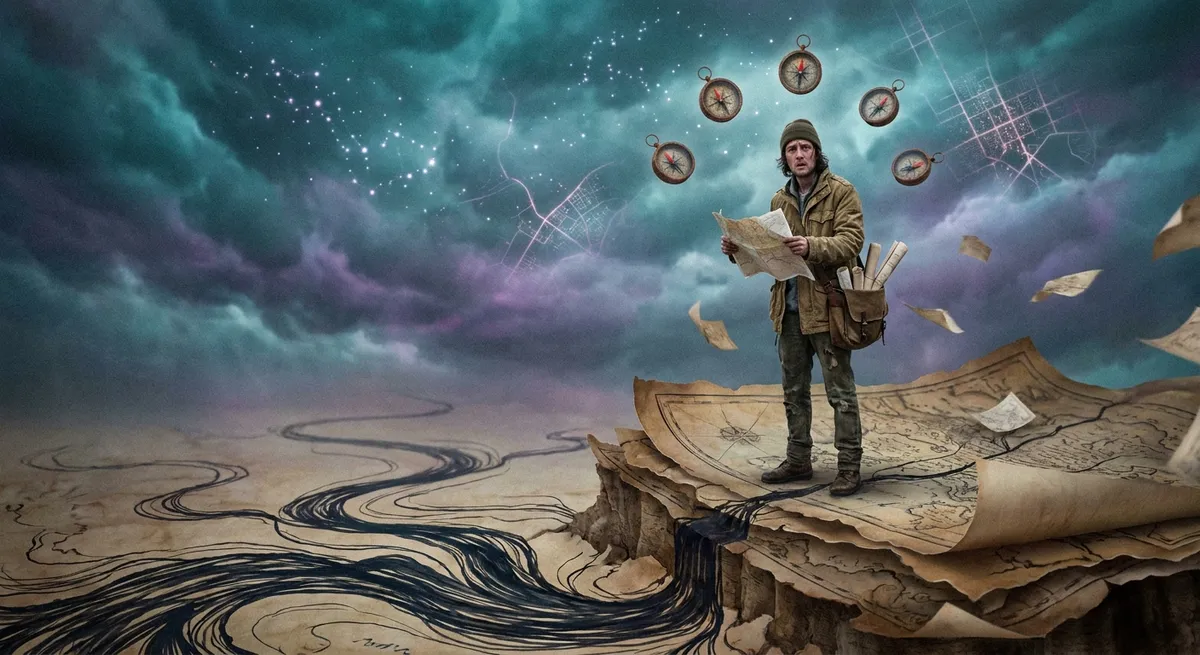
The planet is mostly mapped, measured, and monetized—until you stumble into one of the places that feels like the Earth hit a glitch and decided to keep it. These aren’t your typical “hidden gems” or Instagrammable overlooks. These are the spots where compasses get moody, time feels wrong, and you start questioning whether the travel gods are trolling you personally.
This is your unofficial briefing on five weird travel discoveries that don’t just change your route—they change your brain.
The Singing Dunes That Sound Like a Distant Engine
Out in the emptier reaches of Kazakhstan’s Altyn-Emel National Park, there’s a dune that hums. Not a cute little whistle. A full-body, low-frequency moan that sounds like a cargo ship grinding through fog—or a plane idling somewhere you can’t see.
The “singing” (technically booming) starts when the sand avalanches under the right conditions: dry, uniform grains sliding down a steep enough slope. When it goes off, the entire dune becomes a vibrating instrument. You feel it in your ribs more than you hear it in your ears.
What makes this particularly unnerving is how un-magical it looks. It’s just a big pale dune, 150 meters high, lazing in the desert. No neon lights, no cracks in reality—until someone slides down the face and the whole thing roars like an invisible engine. You’ll want to record it. Your phone will pick up the noise. Your brain will insist it still shouldn’t be possible.
Adventurous travelers treat it like a weird desert playground: climb, slide, listen. The hike in is dusty and unforgiving, and the wind can shut down the “song” without warning, so you work for your moment. It’s half geophysics experiment, half spiritual prank. The best kind of weird: scientifically explainable, experientially unsettling.
The Forest That Eats a River and Spits It Out Elsewhere
In Slovenia, the Rakov Škocjan valley looks normal enough at first glance: forest, karst cliffs, a clear river minding its own business. Then the river just… disappears underground. Not a gentle sink into a marsh—gone, swallowed by the rock. You hike a little more and it’s back again somewhere else, like a natural teleportation system for water that refuses to obey surface geography.
This is karst country, where soluble limestone turns the landscape into Swiss cheese over geological time. The result: rivers that vanish into caves, reemerge as springs, or run for kilometers beneath your feet in total darkness. Walking the trails here is like watching a magic trick in slow motion, except the magician is gravity and the show took a million years to rehearse.
What makes Rakov Škocjan feel extra alien are the collapsed cave ceilings, which form enormous natural bridges and stone arches. You’re essentially trekking across the ruins of an underground world that partially fell in. Look down from above and you see the river threading through a chasm. Drop into the chasm and you realize you’re standing in a dead cave, open to the sky by accident.
It’s not hardcore mountaineering, but it’s not a casual stroll either: slick rocks, narrow paths, sudden drops, and the constant whisper that the solid ground you trust is, historically speaking, temporary. If you like the idea of hiking over ghosts of past landscapes, this forest will absolutely haunt you.
The Island Where the Ocean Draws Crop Circles in Stone
On Jeju Island in South Korea, the sea has been quietly engraving the shoreline into something that looks suspiciously like alien art. At Jusangjeolli Cliff, hexagonal basalt columns stand shoulder to shoulder in improbable perfection, as if the ocean was caught mid-Tetris game and forgot to unpause.
These columns are volcanic geometry: lava cooled slowly, contracted, and cracked into near-perfect hexagons and polygons. You’ve probably seen pictures of similar formations in Ireland or Iceland, but seeing them in person unlocks a different level of “the Earth is weirder than we deserve.” The ocean slams into them in rhythmic bursts, sending spray over rock that looks more engineered than natural.
What elevates Jusangjeolli from “cool rock formation” to “mind-bending travel stop” is the contrast. The columns feel mechanical and precise; the water is pure chaos. Stand at the railing long enough and you’ll start thinking of it as a conversation: raw geology playing defense against liquid entropy.
Jeju has its share of tourist gloss—cafes, viewpoints, obligatory photo zones—but if you wander the edges, find the quieter viewpoints, and actually watch the waves slam into this volcanic spreadsheet of stone, it stops being just a stopover and starts feeling like a live, slow-motion experiment in how landscapes get carved.
The Cave Where Your Sense of Time Short-Circuits
In southern France, deep under the limestone hills near Vallon-Pont-d’Arc, the Chauvet Cave holds some of the oldest known figurative art on Earth. You, however, are not getting in. It’s sealed to protect those 30,000–36,000-year-old paintings from your warm, humid, selfie-seeking breath.
Instead, you visit Chauvet 2 (also called Grotte Chauvet 2–Ardèche), a full-scale recreation built to micrometer-level accuracy. That sounds like a downgrade, until you step inside. Temperature drops. Light fades to a flicker. Lions, rhinos, and horses leap across the walls in charcoal lines so alive you forget they’ve outlived entire civilizations.
The weirdness here isn’t some obvious physical anomaly. It’s psychological whiplash. You’re in a brand-new constructed space, staring at artwork that predates writing, agriculture, and most of what you take for granted as “human.” Your guide talks about carbon dating and pigments; your brain quietly breaks under the weight of time.
Unlike flashy modern museums, there’s an intentional restraint: low lighting, simple walkways, and minimal digital distraction. The effect is that you don’t quite feel like a tourist anymore. You feel like an accidental time trespasser, standing in a room that proves people were obsessing over movement, animals, and storytelling long before there were nations or cities or passports.
If your idea of adventure includes having your place in the universe gently shattered, this cave replica does it in under an hour—and somehow feels more real than a lot of “authentic” attractions.
The Town Where the Ground Is on Fire (and No One’s Really Left)
There’s a stretch of Pennsylvania that looks like a normal rural hillside until you notice the vents in the ground coughing smoke. Centralia used to be a mining town; now it’s essentially a surface-level warning label that reads: “Do not set your fossil fuels on fire directly under your house.”
In 1962, a coal seam caught fire underground and never stopped. The mine fire spread beneath the town, warping roads, belching toxic gases, and making the soil hot enough in places to burn through shoes. The government eventually relocated most residents and condemned buildings. What’s left feels like urban planning’s bad dream: streets to nowhere, fragments of infrastructure, and a literal inferno still muttering beneath your feet.
The main visible weirdness today is subtle compared to its more apocalyptic years: wisps of steam in cold weather, odd smells, sinkholes, and disintegrating pavement. The state removed the famously graffitied “Graffiti Highway” in 2020, but the area around Centralia still radiates that surreal, ghostly aftertaste of a town that never fully finished dying.
For an adventurous traveler, the strange draw is the collision of invisible danger and everyday normality. Trees still grow. Grass still waves. The fire is mostly out of sight, but the story clings to everything. You’re not here to trespass or treat it as a theme park—you’re here to feel how profoundly wrong it is for the ground itself to be unreliable.
It’s the rare place where the horror isn’t sensational; it’s slow, bureaucratic, and geologic. A cautionary tale you can literally stand on, so long as you watch your footing and stay respectful of the people and land that are still navigating the aftermath.
Conclusion
The world’s weirdest places aren’t necessarily the most remote or the most dangerous—they’re the ones that hijack your expectations. A singing dune. A river that ghost-walks underground. Volcanic stone laid out like a game board. An ancient painted universe hiding in a new concrete shell. A town that proved “permanent settlement” is just optimistic branding.
If your comfort zone is starting to itch, that’s the point. These aren’t destinations you tick off a list; they’re disruptions. Go to them with curiosity, caution, and a willingness to feel slightly, gloriously wrong about how you thought the planet worked.
There’s no guarantee you’ll come back with the perfect photo. But you will come back with something better: the distinct, addictive discomfort of realizing the map in your head was never the final version.
Sources
- UNESCO – Petroglyphs and Archaeological Landscapes of Northern Kazakhstan – Background on Kazakhstan’s protected landscapes and geological features, including dune regions in and around Altyn-Emel National Park.
- U.S. National Park Service – Geology of Sand Dunes – Explains the science behind sand dunes, including booming/singing dune phenomena.
- Slovenian Environment Agency – Karst and Caves – Overview of Slovenia’s karst landscapes and hydrology, relevant to the disappearing rivers of Rakov Škocjan.
- UNESCO World Heritage Centre – Decorated Cave of Pont d’Arc, known as Grotte Chauvet-Pont d’Arc, Ardèche – Official information on the Chauvet cave, its age, and the replica site open to visitors.
- U.S. Environmental Protection Agency – Centralia Mine Fire – Government documentation on the Centralia coal mine fire, relocation efforts, and ongoing environmental issues.
Key Takeaway
The most important thing to remember from this article is that this information can change how you think about Weird Places.