If you think the world’s been “discovered,” you’re hanging out in all the wrong corners. The planet still hides places that feel like they were sketched by a distracted god, edited by a bored hacker, and then accidentally left in the final version. These aren’t your “hidden gems” or Instagram-famous lookouts. These are the places where your brain goes, “Wait… that’s allowed?”
Below are five travel discoveries for people who are bored of normal. Bring curiosity. Leave expectations.
The Singing Desert That Roars Back at You (Badain Jaran, China)
Most deserts whisper. This one growls.
Deep in Inner Mongolia, the Badain Jaran Desert stacks some of the world’s tallest stationary dunes—up to 500 meters high—around surreal blue-green lakes that shouldn’t logically exist. The real glitch, though, is the sound. Slide or run down certain dunes and you’ll trigger an eerie, low-frequency “booming” that sounds like a far-off engine, chanting monks, or an angry didgeridoo buried under sand.
Scientists blame layers of different grain sizes, trapped air, and dry conditions. Travelers tend to blame “ancient desert spirits.” Both explanations feel correct when the ground itself starts humming.
You won’t find massive resort chains here. Reaching the good stuff usually means cross-desert 4×4 trips, camel treks, or multi-day expeditions arranged from Zhangye or Jinchang. By day, you’re climbing golden skyscrapers of sand; by night, you’re camped between star-punched skies and dunes that feel taller than your courage.
If you go, remember: this is serious wilderness. Bring a guide who actually knows the desert, not some guy whose qualifications are a drone and an Instagram handle. Conditions shift, navigation is tricky, and dehydration doesn’t care how adventurous your captions are.
The Forest That Eats Light and Bends Time (Crooked Forest, Poland)
On the outskirts of Gryfino in northwestern Poland, there’s a pocket of pine trees that look like they lost an argument with gravity. Each trunk curves at the base into a smooth, almost identical 90-degree hook before shooting straight up toward the sky, like a parade of question marks frozen mid-thought.
No one really knows why.
Theories range from heavy snow damage in their early growth years to intentional bending by foresters to produce curved timber for boats or furniture. There’s also the “maybe this forest is just haunted” hypothesis, which is scientifically questionable but emotionally accurate when you’re alone there at dusk and the wind starts rehearsing ghost stories through the branches.
What makes the Crooked Forest so addictive is its scale: it’s not one freak tree, it’s a whole squad of them, all twisted in the same strange choreography. Walk between them and you feel like you’ve stepped into a glitching video game level, or the set of a surrealist film that never made it out of someone’s dreams.
The site itself is small and relatively quiet—no giant visitor center, no theme park vibe—just a short trail off a local road. Go early or late if you want the full “why is this allowed to exist?” effect.
The Town That Swaps Night for Neon Day (Harbin Ice City, China)
Forget beach sunsets and tropical cocktails. Try walking through a frozen cathedral made of ice blocks taller than your apartment building, glowing radioactive blue under subarctic air that bites harder than any hangover.
Every winter, Harbin in northeastern China becomes less a city and more a science-fiction hallucination known as the Harbin International Ice and Snow Sculpture Festival. Entire streets morph into icy replicas of temples, castles, and imaginary cities built from blocks carved out of the frozen Songhua River. At night, the sculptures explode with color as LEDs buried in the ice turn the entire landscape into a neon hallucination.
It feels less like “winter wonderland” and more like stumbling into a parallel timeline where humans decided that the best use of engineering talent was to build temporary frozen megastructures and then let them melt.
The cold is no joke here. -20°C (-4°F) is normal, and it can dip far lower, which means you’re layering up like you’re going to space. But the payoff is a city that doesn’t just tolerate winter—it weaponizes it. You can slide down ice chutes that look like crystal highways, wander through ice palaces, and watch builders sculpt details with the same focus usually reserved for surgery.
If your travel style is “sweaty beaches and smoothie bowls,” Harbin will feel like a hard reset button. If you secretly think winter should be more metal, this is your pilgrimage.
The Cave That’s Its Own Weather System (Son Doong, Vietnam)
Most caves: cool rocks, a bat, maybe a drip. Son Doong: an underground world with its own freakin’ clouds.
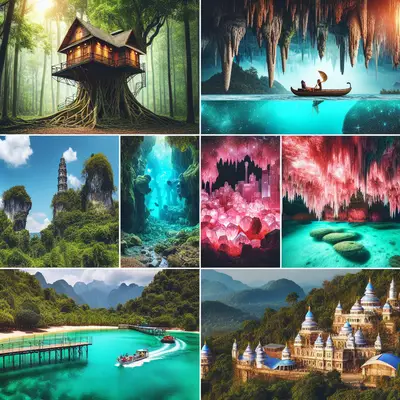
Hidden in Vietnam’s Phong Nha-Ke Bang National Park and only first properly explored in the 2000s, Son Doong is one of the largest cave systems on the planet. Parts of it are so vast that a New York City block could fit comfortably inside, skyscrapers and all. Sections of the ceiling have collapsed, letting jungle crash through the roof and creating underground forests where mist curls lazily around trees like it’s rehearsing for a movie deal.
Inside, you walk along rivers, past massive calcite formations, and under skylights where sunbeams slice through the dark. The scale is so ridiculous your brain gives up trying to measure it and just starts quietly screaming “NO WAY” on loop.
Access is heavily controlled; only a limited number of visitors are allowed each year, and you need to go with authorized expedition operators. This is not a “wander in with a flashlight, we’ll be fine” scenario. Multi-day treks usually include jungle hiking, river crossings, underground camping, and an ongoing negotiation between your survival instincts and your sense of wonder.
Son Doong doesn’t feel like a cave. It feels like the audition tape for an alien planet that somehow crashed into Earth and got stuck underground.
The Island That Glows When You Touch the Sea (Vaadhoo & Other Atolls, Maldives)
Picture wading into black ocean water at night and watching the waves ignite with electric-blue light wherever they break. Every step, every splash, every ripple: glowing.
In certain conditions, especially around islands like Vaadhoo in the Maldives, the shoreline turns into what looks like a live-action sci-fi film thanks to bioluminescent plankton—tiny organisms that produce light when disturbed. Millions of them blinking on and off with each wave turns the beach into a “Sea of Stars,” a nickname that for once is not an exaggeration.
You don’t control the show. The bloom depends on season, water temperature, and currents, and even then, nature doesn’t run on a tourist schedule. But when it hits, it hits hard. Footsteps burn temporarily into the shore like blue comets. The wake behind a kayak draws neon symbols on the dark water. Toss a stone and it lands in a splash of electric light.
There’s a temptation to turn this into content and nothing else, but the real magic is what it does to your sense of scale. Here you are, one primate on one beach on one planet, watching microscopic life-forms throw a better light show than any LED rig humanity’s ever engineered.
The Maldives are famous for overwater bungalows and honeymoon clichés. Chasing bioluminescence flips the script. Go looking not for the infinity pool, but the nights when the entire ocean decides to become one.
Conclusion
The world didn’t run out of mystery; we just got lazy about where we point our curiosity. Deserts that sing back, forests that kink their own trunks, cities built from ice, caves with secret weather, oceans that light up like they’re on stage—none of this is theoretical. It’s all there, right now, humming away whether humans show up or not.
If your travels have started to feel like different angles of the same postcard, it’s time to aim for the glitches: the places that make maps nervous and algorithms confused. Go where the ground booms, the trees bend, the ice glows, the cave breathes, and the sea catches fire in the dark.
The planet is still weirder than your imagination. Prove it to yourself.
Sources
- UNESCO – Phong Nha-Ke Bang National Park - Official information on the park that contains Son Doong Cave, including geology and conservation details
- National Geographic – Inside Vietnam’s Son Doong, the World’s Largest Cave - In-depth exploration of Son Doong’s size, ecosystem, and guided expeditions
- NASA Earth Observatory – Booming Dunes - Scientific overview of “singing” or “booming” dunes in deserts like Badain Jaran
- BBC – The Mystery of Poland’s Crooked Forest - Background, theories, and travel context for the Crooked Forest in Poland
- Smithsonian Magazine – The Glowing Beaches of the Maldives - Explanation of bioluminescent plankton and the glowing “Sea of Stars” phenomenon in the Maldives
Key Takeaway
The most important thing to remember from this article is that this information can change how you think about Weird Places.