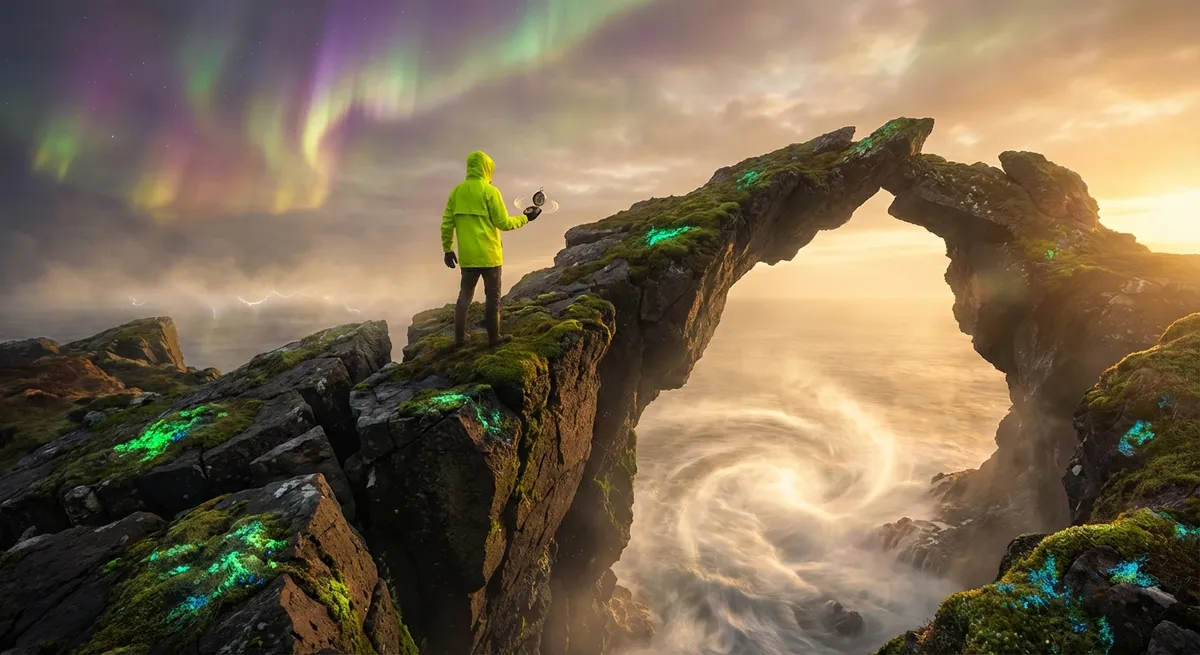
There are places on this planet that don’t want to be “visited” so much as survived with style. They’re not on your aunt’s cruise itinerary, they don’t come with daily yoga, and nobody hands you a welcome drink with a pineapple on top. These are the coordinates for travelers who feel itchy in all-inclusive resorts and suspicious around infinity pools.
If your ideal vacation involves rethinking what “safe,” “normal,” and “possible” even mean—keep reading. These five discoveries aren’t just destinations; they’re reality glitches you can physically walk into.
Latitude: Nowhere — Chasing Storms on Purpose in Tornado Alley, USA
Most travelers avoid severe weather like it’s a budget airline with no legroom. Storm chasers, on the other hand, sprint straight into the teeth of the sky.
In the central United States—Kansas, Oklahoma, Texas, Nebraska—spring and early summer mean one thing: the atmosphere rolls a loaded dice every afternoon. Instead of watching sanitized weather reports from your couch, you can ride with professional storm-chasing outfits that track supercells in real time, racing down rural highways as the sky mutates from postcard blue to apocalyptic green.
You’ll learn to read radar like a second language, study wind shear, and feel the temperature drop like a mood swing moments before a storm launches into full cinematic chaos. The adrenaline isn’t just the wind; it’s the knowledge that these systems can morph in minutes, and you are right there, respectfully dancing at the edge of their path.
This isn’t disaster tourism—it’s a crash course in atmospheric physics, with a front-row seat to rotating mesocyclones, lightning barrages, and storm structure so vast you forget where the horizon is. You won’t touch the tornado; you’ll learn to fear it correctly. And when the storm dies and the sky cracks open into a neon sunset, you’ll realize you’ve just watched the planet exhale.
The Ice That Moves: Living on a Drifting World in Greenland’s Winter Silence
Most people see snow and think “ski resort.” You’re not most people.
Greenland in winter is a master class in minimalism. It’s a place where your world shrinks to ice, sky, and whether your eyelashes have frozen shut yet. Base yourself in a coastal settlement like Ilulissat or Sisimiut, then leave anything resembling “regular” behind.
Out on the sea ice, the ground you’re standing on isn’t really ground; it’s a frozen lid over an ocean that still swells and shifts beneath you. Cracks appear and disappear, new ice forms overnight, and you’re forced to remember this planet is not as solid as it pretends to be. With local guides, you travel by dogsled under constellations that look surgically sharp, and you hear sound differently: the scrape of runners on ice, distant dog barks, the occasional thunder of calving icebergs.
Night is when the rules finally disintegrate. The aurora can erupt without warning—curtains, spirals, sheets of electric green and violet tearing across the sky so fast your brain can’t categorize it as “weather.” It feels more like the universe pulling up its mask for a second to say, “You have no idea what’s going on, do you?” And you don’t. That’s the point.
Vertical Fever: Sleeping in the Sky on a Cliff Face in Peru or the Alps
Hotel room? No. Try “aluminum-and-fabric cocoon bolted to pure vertical.”
Cliffside capsule stays—like those at Peru’s Sacred Valley or multi-day big wall missions in the Alps—flip the idea of accommodation inside out. You don’t go to your room; you climb to it. Via ferrata routes or technical ascents haul you up hundreds of meters of rock until the ground is more theory than reality.
Your bed hangs from the wall. Literally. You clip in before you unclip your fear. At night, the world folds into shapes you’ve never seen from this angle: headlights far below become wandering fireflies, the wind becomes a personality, and you finally grasp how much of human life normally happens flat and horizontal.
There’s no stumbling to the bathroom half-asleep; every movement is intentional. You wake up above birds, watching the sunrise skim over the curvature of the valley. Gravity isn’t background physics anymore; it’s the third traveler in your pod. This kind of night rewires what your brain labels as “home.”
The World Under the World: Lava Tubes and Alien Caves in Iceland & Vietnam
The surface of Earth is the polite version. Below it? That’s where the weird lives.
In Iceland, you can walk inside cooled lava tubes—long, echoing tunnels carved by ancient rivers of fire. Dripping ice, mineral-streaked walls, and total, crushing darkness if the guide kills the lights. It’s like stepping into the memory of a volcano mid-sentence.
Fly across the world to Vietnam’s Phong Nha–Ke Bang, and the underworld levels up. Cave systems like Son Doong and Hang En feel wrong in scale—jungles inside caves, misty skylights, underground rivers, campfires that look like match flames swallowed by the dark. Your brain struggles with the idea that you’re inside a mountain, yet hiking through sandbanks and forests that should logically be on the surface.
Down here, you move differently. Sound warps, time dilates, and your everyday reference points evaporate. There is no “north” while you wade through black water or scramble over boulders guided only by the dim glow of your headlamp. The earth stops being a background object and becomes a labyrinth you’re temporarily allowed to infiltrate.
The Edge of Breath: Freediving with the Deep in Dahab or the Philippines
Most people think “ocean” and picture snorkeling above cartoon-colored fish. Freedivers think “ocean” and picture silence, pressure, and the razor-thin line between calm and panic.
In places like Dahab’s Blue Hole in Egypt or the deep walls of the Philippines, you can train with instructors to descend on a single breath. No tanks, no bubbles, just you, a line, and the sound of your heartbeat turning into a metronome for your survival.
The real extremity isn’t depth—it’s surrender. You’re asking your body to trust you as you slide into increasing pressure, ears equalizing, mind slowing. Light thins. Colors vanish. Time dissolves. The surface becomes an abstract rumor somewhere above your head.
But then something strange happens: if you train properly and respect your limits, the fear loosens its grip. You feel heavy instead of floaty, held by the water instead of fighting it. Fish glide by, uninterested in your existential crisis. When you return to the surface and the air rips back into your lungs, you realize you weren’t just underwater; you were trespassing in a world that operates on a completely different definition of “normal.”
Conclusion
Extreme travel isn’t about bragging rights or collecting scars like souvenirs. It’s about stepping into environments that refuse to bend to human convenience—and letting them change your internal settings.
Storms that outrun highways, ice that drifts, beds that dangle over nothing, caves that swallow daylight, oceans that crush and cradle at the same time: none of these places care that you showed up. That’s exactly why you should.
If comfort is your compass, these routes will look wrong. But if curiosity and controlled risk are your north star, these chaos-friendly coordinates might be the first trip that finally feels honest.
Sources
- NOAA National Severe Storms Laboratory – Storm Chasing & Research - Background on severe thunderstorms, supercells, and why Tornado Alley is so volatile
- Visit Greenland – Winter Travel & Arctic Conditions - Official information on Greenland’s winter environment, ice conditions, and travel realities
- SkyLodge Adventure Suites (Peru) – Official Site - Example of commercial cliffside capsule lodging and via ferrata access in the Sacred Valley
- UNESCO – Phong Nha–Ke Bang National Park - Overview of Vietnam’s massive cave systems and their geological significance
- AIDA International – Freediving Education & Safety - Safety standards, training structure, and physiological background for freediving
Key Takeaway
The most important thing to remember from this article is that this information can change how you think about Extreme Travel.