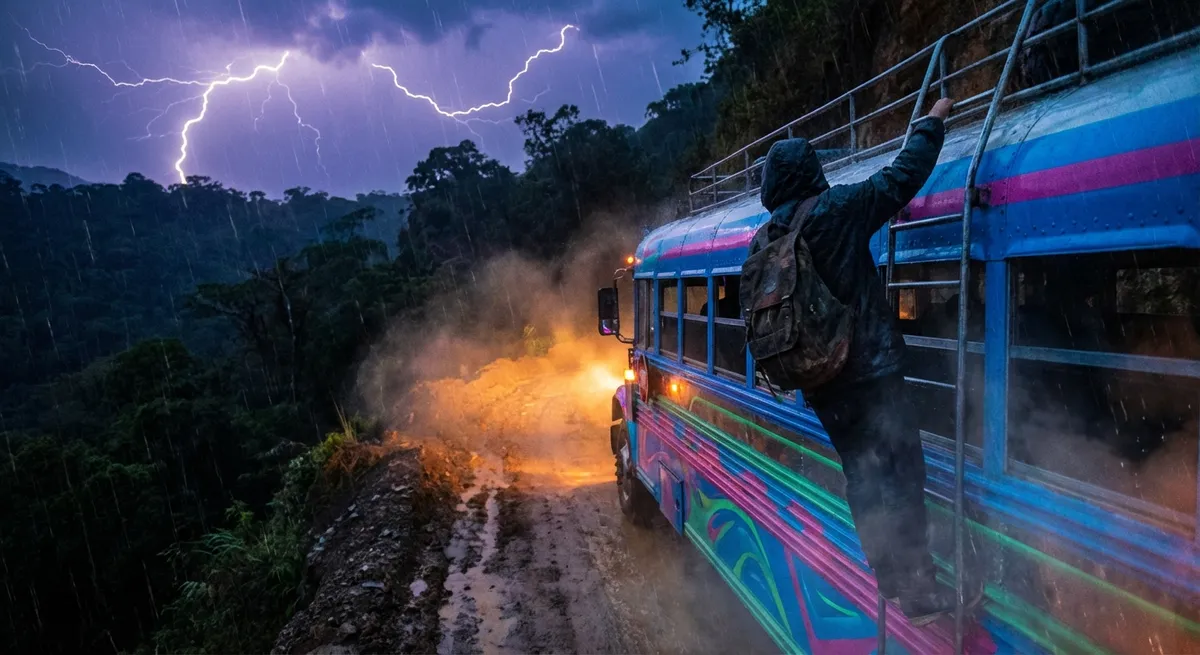
Most people collect fridge magnets. You’re here because you collect bad decisions with excellent views. Extreme travel isn’t just about ticking off “scary” destinations; it’s about saying yes to the kind of trips that make your group chat think you’ve joined a cult, a circus, or a very enthusiastic disaster movie.
This is your unofficial permission slip to chase the kinds of journeys that aren’t in the glossy brochures—places where the Wi‑Fi is terrible, the risk is real, and the stories will haunt your friends into booking their own questionable flights.
Riding the Edge of the World’s Abandoned Highways
There’s something unhinged about choosing a road trip where the road itself has basically quit. Across parts of Central Asia, Eastern Europe, and remote South America, rusting highways and half-finished motorways slice through mountains, deserts, and empty plains like forgotten promises. These are the asphalt ghost stories: cracked bridges with missing guardrails, tunnels that drip like caves, and overpasses that end in mid-air because the budget ran out or the regime changed. For extreme travelers, this is a playground of controlled chaos—hiring a battered local 4x4 and following a road that no tourist agency will acknowledge still exists. You’ll pass villages that haven’t seen strangers in months, roadside Soviet mosaics crumbling into dust, and truck stops where the menu is “whatever is still alive or recently not alive.” It’s not about danger for danger’s sake; it’s about moving through the in-between spaces where progress stalled and nature is slowly reclaiming the blueprint. The reward? That eerie combination of total freedom and the creeping sense that if something goes wrong, Google Maps will just shrug and close the app.
Sleeping Inside the Storm: Wild Weather Expeditions
Beach sunsets are cute. Have you ever tried napping in a tent while the sky sounds like it’s tearing itself in half? All over the planet, there are corners where the weather isn’t “bad,” it’s the main event—coastal regions where storms slam in with violent regularity, high plateaus where lightning hunts the ridgeline, frozen coastlines that scream under polar winds. Extreme travelers are starting to chase these weather theaters the way people chase festivals. Think staying in a remote lighthouse during winter swell, watching 15-meter waves detonate against rock while the building shudders. Or joining seasoned local guides who track supercells and monsoon walls not for selfies, but for the sheer terror-joy of watching the atmosphere go feral. The logistics are tricky: you need guides who respect the line between spectacle and stupidity, gear that assumes you might get very wet and very cold, and the mental acceptance that your “plan” will almost certainly be canceled, delayed, or dramatically upgraded by the sky. But when you stand on a ridge watching a storm roll toward you like a moving mountain, your old life—emails, traffic, polite weather apps—feels embarrassingly two-dimensional.
Underground Frontiers: Descending Into the Deep Silence
If the surface world feels overexposed, there’s an entire reality beneath it where your most used phrase becomes, “Is my headlamp actually on?” Extreme caving and underground exploration are still wildly under-rated by mainstream travelers, which is perfect for anyone who prefers their experiences dark, damp, and questionably sane. In remote karst regions, volcanic fields, and glacier zones, there are vertical shafts and cave systems that almost no one outside the local climbing and scientific communities has ever seen. Imagine clipping into a rope and rappelling straight down into a chamber the size of a stadium, with calcite formations older than your understanding of time. Or crawling along a narrow passage that suddenly opens into a crystal-clear underground lake that reflects your light like a galaxy. This isn’t the tourist cave with handrails and colored LEDs—this is helmet, harness, rope training, and local experts who know which rocks lie and which ones move. The silence underground is a different species of quiet: heavy, total, almost predatory. When you come back to the surface, car horns and phone notifications feel like primitive technology after you’ve temporarily borrowed the planet’s basement.
Frontier Sleeper Trains: Boarding the Last Night Lines
There is a peculiar, addictive madness in buying a train ticket whose schedule looks like an urban legend. In the borderlands of continents—across Siberia’s side arteries, deep West Africa corridors, parts of the Balkans and Central Asia—there are still sleeper trains that connect places with more rumors than reviews. These aren’t the romantic luxury carriages of Instagram; they are steel tubes of shared humanity, grinding through forest, desert, or steppe, where everyone is going somewhere complicated. The thrill starts at the station: no clear signage in your language, carriages that may or may not match your ticket, vendors selling food that might be the best or worst thing you eat all year. Once aboard, it becomes a moving village—plastic bags of snacks passed around, strong tea in chipped glasses, bootleg music on someone’s phone, and cross-lingual conversations powered by hand gestures and chaotic translation apps. The landscapes are not curated; you’ll trundle past scrapyards, wild rivers, military zones, and towns that don’t bother advertising themselves to visitors. Delays are inevitable, reroutes are common, and sometimes the train just stops in the middle of nowhere for reasons nobody can—or wants to—explain. The payoff is waking up in a new world, stepping off the carriage into a station that feels like a secret portal, knowing your journey there is a story only fellow chaos-riders will understand.
Exploring Alive Volcano Slopes Without the Postcard Filter
Lots of people hike “volcanoes.” Fewer willingly spend time in the messy, living outskirts of active volcanic zones where the earth is visibly not done yet. Across certain island arcs and rift zones, there are inhabited slopes where soil steams, doors crack from micro-quakes, and locals casually mention which direction to run if the mountain starts “acting weird.” Hardcore travelers are drawn not just to the big fiery craters, but to the fringe ecosystems around them: villages built on lava flows that are younger than the elders, geothermal fields where mud boils and vents breathe sulfur, forests that regrew over old scars with an attitude. You might soak in an off-map hot stream while distant rumbles roll through the ground like a bass track. Or hike with guides who can point at old eruption paths like a history teacher circling battle routes. This kind of trip demands a stubborn respect for risk management: checking real geological alerts, traveling with locals who understand the mountain’s moods, and accepting that an eruption could change your itinerary—or the entire landscape—forever. But standing on warm rock with the air shimmering, you realize you’re not looking at scenery; you’re looking at the planet mid-sentence.
Conclusion
Extreme travel isn’t about proving how fearless you are. It’s about willingly stepping into places where control slips, comfort cracks, and the world shows you its unedited version. The abandoned highway, the storm coast, the deep cave, the frontier train, the living volcano—each one is a reminder that Earth is still wildly untamed if you know where to wander.
If your gut is buzzing and your brain is whispering, “This is a bad idea we should absolutely research,” you’re our kind of traveler. Screenshot this, send it to the one friend who never says no, and start planning the trip that future you will call your favorite terrible decision.
Key Takeaway
The most important thing to remember from this article is that this information can change how you think about Extreme Travel.