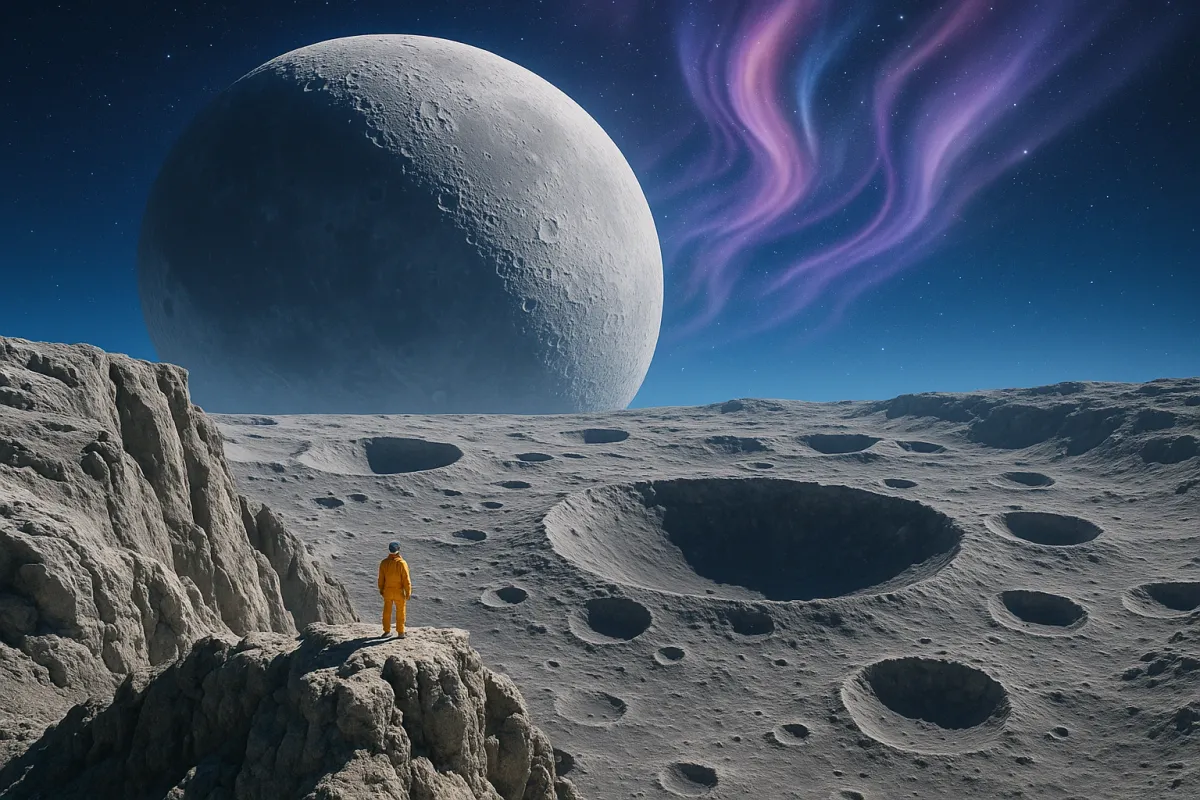
If you spent this morning staring at photos from that “Not Photoshopped: Photographer Uses Only Lens To Make The Moon Look Supersized” article, wondering how to yeet yourself off‑planet… welcome home. You’re officially the kind of traveler No Way Travel was built for.
While photographer wizards are out there turning the moon into a cinematic monster using nothing but a ridiculous telephoto lens and good timing, the rest of us mere mortals can still chase that same lunar, otherworldly awe—on Earth. The trick? Go to places so extreme they feel like you fell out of orbit.
These aren’t “nice view, cute café” trips. These are “tell your boss you might not have signal for a week” trips. Real landscapes, real risk, and very real “am I actually still on this planet?” moments.
Below are five extreme travel discoveries that scratch the same itch as a supersized moonrise: bigger, weirder, and just far enough beyond common sense.
1. Hunt Moonrise Over Active Lava in Vanuatu
If that viral oversized-moon photography proves anything, it’s this: our planet looks wild when you mess with scale. So let’s put your tiny human body on the rim of a volcano and see how that feels.
On Ambrym and Tanna islands in Vanuatu, travelers brave night hikes up to active volcano craters where molten lava pulses like a living thing. Instead of watching a telephoto illusion on Instagram, you’re watching the real horizon glow red while the actual moon drags itself up behind the ash plumes. Guides on Tanna run night trips toward Mount Yasur’s crater edge, where you pitch up in the dark, feel the mountain rumble, and watch incandescent rock shot into the sky. Everything in your life—your to‑do list, your inbox, your rent—shrinks to the size of dust floating in the volcanic haze. Bring sturdy boots, a face mask, and an exit strategy for your fear of heights; the only “zoom lens” here is your eyeballs.
2. Sleep Under Alien Moons in Chile’s Atacama Desert
Astro‑photographers are currently losing their minds over perfect, supersized moon shots, but the real power move is to go where the sky doesn’t need a filter: the Atacama Desert. High up on the Chilean altiplano, this Martian‑looking desert is dry, thin‑aired, and violently clear—exactly why so many of the world’s observatories are planted here.
In San Pedro de Atacama, local operators run night tours that feel more space mission than sightseeing. You get bundled up in Arctic‑level layers, driven out of town to a pitch‑black plateau, and handed a giant telescope pointed at a moon so sharp you can see craters like someone scraped them with a spoon. Between viewings, you lie flat on the freezing sand while the Milky Way smears overhead like a time‑lapse you forgot to fast‑forward. The landscape—salt flats, jagged Valle de la Luna (yes, “Valley of the Moon”), and empty altiplano lagoons—looks like it was built as a film set for “We left Earth, oops.” The catch: altitude headaches, bone‑dry air, and temperatures that nosedive the second the sun drops. Hydrate or hallucinate—your choice.
3. Ride the Tide at the World’s Fastest Tidal Rapids in Canada
Photographers making the moon look comically huge is one thing. Nature making an entire ocean flip directions twice a day is another. Head to the narrow inlets between British Columbia’s islands (like Skookumchuck Narrows or the rapids near the Bay of Fundy) and you’ll find tidal rapids that turn calm channels into oceanic blenders.
Adventure operators here run extreme whitewater and tidal‑bore experiences where your job is to strap into a kayak or Zodiac and point yourself directly at standing waves the size of buildings. If conditions line up, the water surges so hard it forms permanent waves and whirlpools that surfers literally ride in the middle of nowhere, sandwiched by forest, granite cliffs, and sea lions that look at you like you’ve lost your mind. Timetables are everything: slack tide equals flat water; peak tide equals “we maybe tell your family you loved them.” It’s the same logic photographers use to nail that huge moon—wait for the right moment, then pounce. Only you’re the pixel that might get rearranged.
4. Go “Lunar Caving” Under Europe’s Ice and Lava
The photographer from that moon article stood on Earth and made the sky look alien. You’re going to do the reverse: go inside the Earth until it feels like another planet. Iceland and northern Spain’s Basque Country have exploded in popularity for their underground lava tubes and ice caves—massive, echoing tunnels carved by ancient eruptions or glacial melt.
Ice caves near Vatnajökull in Iceland shift and reform every winter. You sign up with a glacier guide, ride a monster‑tired Super Jeep to the ice, then clamp crampons onto your boots and shuffle into a glassy blue tunnel that glows like someone installed an LED strip in a frozen throat. The roof creaks. Water drips. The whole universe shrinks to 50 meters of alien blue. Meanwhile, lava tubes like Leidarendi or Spain’s Cueva de los Verdes are the dark, stone‑ribbed skeletons of old eruptions—no light, no sound, just your headlamp and the knowledge that everything around you used to be liquid fire. These are not places you wander solo; one misstep, one collapsed ceiling, and the only moon you’ll see is the one on other people’s memorial posts.
5. Chase “Earthrise” From a Remote Arctic Sea Kayak
That supersized moon photo trend is all about perspective—get the right distance, line up the horizon, suddenly everything looks impossible. Now imagine that same trick, but with you paddling below a cliff of ice, watching the sun barely set and then change its mind. Welcome to high‑latitude sea kayaking.
In places like Svalbard (Norway) or Greenland’s fjords, expedition companies offer multi‑day trips where you paddle between icebergs that sound like distant gunfire as they crack, camp on rocky beaches, and dodge curious seals that surface like wet punctuation marks. During polar summer, the sun never truly goes away; it just slides around the sky, dropping low enough to splash gold over the ice and water in a slow‑motion “earthrise” that feels like a glitch in time. You’re permanently damp, your hands are raw, and that splash you just heard might be a whale or just a wave but your brain spikes anyway. This isn’t resort‑Arctic; this is “carry a flare, know your bear protocols, and triple‑check your dry bags” Arctic. The pay‑off: a front‑row seat to a planet that still thinks in extremes.
Conclusion
That viral “giant moon” photography trend is a reminder that our sense of scale is mostly a lie. The world feels normal until someone changes the angle—and suddenly everything looks huge, fragile, and a little bit unreal.
Extreme travel does the same thing to your life. It zooms out, then zooms in. One week you’re doom‑scrolling, the next you’re watching lava fountains, paddling past icebergs at 2 a.m., or lying under a sky so bright with stars that your old life starts to look… edited.
You don’t need a ticket to the moon to feel off‑planet. You just need to pick a place that scares you a little, pack like you mean it, go with people who know what they’re doing—and let Earth show you its raw, unfiltered, not‑Photoshopped extremes.
Key Takeaway
The most important thing to remember from this article is that this information can change how you think about Extreme Travel.