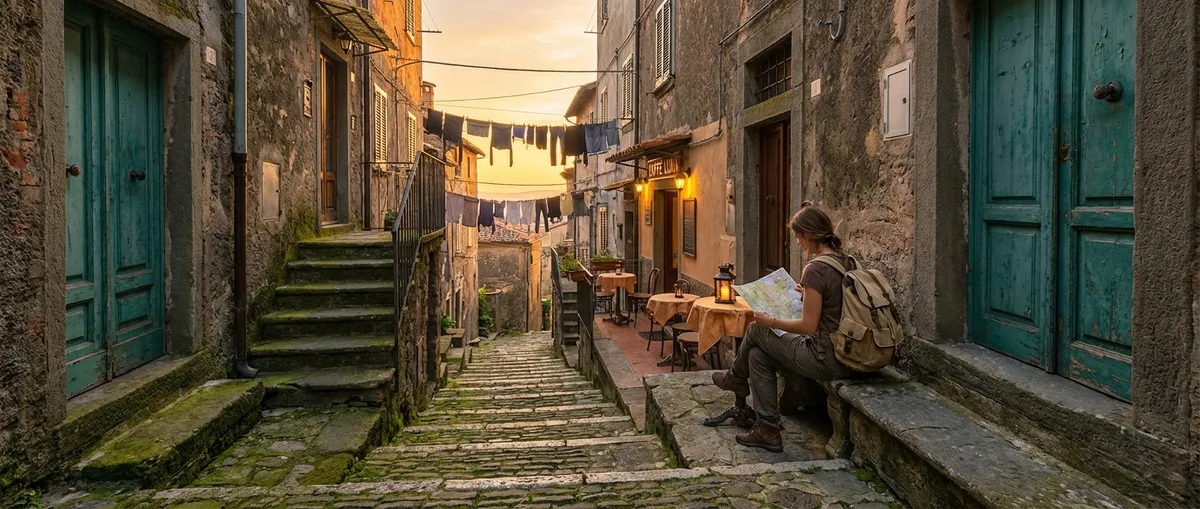
There’s a point on every trip where the main attraction starts to feel like a waiting room: same selfies, same crowds, same “authentic” souvenirs made in a factory three countries away. That’s your cue. That’s when you step sideways—off the itinerary, into the weird, the quiet, the almost-secret. That’s where the real stories live.
These are the places you only find by following a half-heard rumor, a hand‑drawn map, or a badly translated sign that looks like a dare. None of them are “famous.” All of them are the kind of spots you’ll still be talking about when your passport has expired and your backpack smells like nostalgia.
The Cliff Village With No Front Doors (Meteora’s Forgotten Neighbor, Greece)
Everyone knows the monasteries of Meteora balanced on pillars of rock like a video game level. Almost no one keeps driving another half hour to the tiny cliff village clinging to the edge of the same sandstone madness, where houses open sideways instead of out. From the narrow lane, it feels like the buildings have turned their backs on the world; “front doors” face the drop, looking straight into a sea of mist and stone. You climb through sideways alleys and rear entrances, the town folding around you like a maze designed by a stonemason who drank too much raki.
Wake up before sunrise and the village is mostly silent—just the scrape of a chair, the hiss of a kettle, and the distant clang of a goat bell echoing off the cliffs. Your guesthouse balcony isn’t a balcony so much as a ledge held together by stubbornness and old nails, hanging above a valley that catches cloud shadows like nets. In the evening, a handful of locals gather in a tiny taverna with no sign, trading gossip in low voices while travelers are politely ignored until they prove they’re staying the night, not just passing through.
There’s no “Top 10 Things To Do” here. You walk, you listen, you let the rock walls compress and then suddenly release into open sky. GPS loses its mind in the switchback roads, so you navigate by church bells and the smell of woodsmoke. It’s not dangerous, but it feels like you’ve slipped into a side-level of Greece that wasn’t meant to be unlocked yet, and that’s exactly the point.
The Jungle Pier That Only Exists At Low Tide (Pacific Coast, Colombia)
On the edge of Colombia’s wild Pacific, there’s a village where the main “road” is not a road at all but a skeletal wooden pier that emerges from the mud when the tide retreats. At high tide, the whole thing disappears under brown-green water, like it never existed. At low tide, it becomes the heartbeat of the town: fishermen, kids chasing mangrove crabs, grandmothers carrying bags of plantains with the precision of tightrope walkers.
Getting here is its own small adventure: a propeller plane that looks like it came out of a museum, then a riverboat that weaves through mangroves like it’s evading taxes. The jungle presses in from all sides, and the humidity hits you like warm soup. There’s no separation between land and sea, just a shifting agreement, renegotiated every six hours. Your backpack smells like salt within minutes; your phone signal gives up before you even land.
The village is stitched together from wood, dreams, and stubbornness. Baby pelicans squat on railings like grumpy old landlords. Kids dive from the last stable beam of the pier into the incoming tide, timing their jumps with a precision that says they’ve done this more times than you’ve opened Google Maps. When the sun drops, generators growl to life, casting a thin strip of electric light over the wet boards, while the sky behind them burns orange and violet over an ocean that won’t sit still.
This isn’t a place for spotless shoes or rigid itineraries. It’s for travelers who don’t mind that their bedroom window rumbles with boat engines at dawn, and that their shower is a bucket. In return, you get a front-row seat to a village whose entire existence is built on understanding that the ground you stand on isn’t permanent—and treating each low tide as borrowed time.
The Stairway Inside the Volcano (A Quiet Crater in Central America)
Most volcano trips are about the view from the top: black rock, sulfur smoke, maybe a lake if you’re lucky. This one flips the script. Tucked away in Central America is a dormant crater where the main adventure is not the rim, but the staircase inside—a narrow concrete spine that spirals you down into the earth like you’re ignoring every warning sign from every disaster movie you’ve ever seen.
From the outside, the volcano looks like a friendly green hill. Families picnic on the slopes, kids kick footballs, and you think: this? Really? Then you find the rusted gate and the lonely ranger who shrugs in a way that clearly means, “Sure, go ahead, if you’re strange enough to want this.” The air cools as you descend, and your phone screen fogs slightly; daylight narrows above you into a shrinking circle. Halfway down, the chatter of the surface disappears, replaced by your footsteps and the occasional drip of unseen water.
At the bottom waits a lake the color of bad decisions—opaque turquoise, perfectly still, ringed by walls of rock that look like they were poured yesterday and left to harden. Dip a hand in at the edge and it’s mildly warm, reminding you that “dormant” is not the same as “dead.” Echos come back slower than they should, like the crater wants to think about what you said before returning it.
There’s no snack bar, no postcards, and no cable car shortcut back up; your return to daylight is powered by your quads and your questionable life choices. The climb rewards you with a slow reintroduction to the outside world: faint birdsong, a smudge of blue that becomes sky, the smell of grass after the mineral tang below. It’s not an adrenaline rush. It’s quieter, stranger—a walk into the planet’s throat and back out again, feeling small in exactly the right way.
The Desert Village That Sleeps On Its Roofs (Somewhere Between Sand and Sky, North Africa)
In a sliver of North African desert where the dunes nibble at the edge of an old oasis town, the real life of the village happens on top of the houses, not inside them. When the sun finally surrenders, every flat roof becomes a room: mattresses dragged out, blankets unfolded, stars switched on with annoying inconsideration for your capacity to process beauty. People talk between rooftops like neighbors chatting over fences, except the fences are constellations.
By day, you’d swear this place was half-abandoned. Doors stay half-closed against the heat, alleys are empty, and the only movement is a lizard doing pushups on a sun-baked wall. Then the sky turns the color of burnt apricots, the call to prayer slides across the sand, and everything tilts. Kids race up stairwells carrying pillows bigger than they are. Someone somewhere starts a slow, looping song on an old radio. Smoke from rooftop stoves rolls lazily through the air, fragranced with cumin, dust, and the promise of something fried.
Sleep doesn’t happen at a set time; it just arrives gradually, claiming one roof at a time. First the kids, sprawled out and knocked out. Then the adults, stretched under a blanket of Milky Way that looks too bright to be legal. Dogs patrol the alleys below like they’re watching over the stage crew, while the main cast rests above. You lie there feeling equal parts exposed and protected, grounded and airborne.
There are no hotels in the formal sense, just family homes that agree to adopt you for a few nights if you arrive with the right introduction and a flexible idea of comfort. Instead of air-con, there’s the desert wind tickling your nose at 3 a.m. Instead of blackout curtains, the dawn slowly erases Orion from your ceiling. On paper, it’s just a village at the edge of the sand. On the roof at midnight, it feels like the world has been reduced to three things: your thin mattress, the warm hum of conversations you can’t fully understand, and an overhead infinity that makes your daily worries look hilariously, refreshingly small.
The Island Where The Roads Just… Stop (Remote Archipelago, North Atlantic)
Some islands ease you into their remoteness. This one doesn’t bother. You drive until there is simply no more. Not a loop, not a neat turnoff—just a sudden end of asphalt that dissolves into raw rock and wind. A lonely yellow sign stands at the edge like it forgot what it was supposed to warn you about, so it just warns you about everything.
Behind you, a scattering of turf-roof houses and a church that looks like a toy left on a windowsill. In front of you, the North Atlantic throws itself at cliffs high enough to make your stomach do a slow backflip if you look down too long. The wind here is not a breeze; it’s a personality. It shoves at your jacket, tugs at your hood strings, and occasionally reminds you of your mortality with a well-timed gust.
Walking beyond the end of the road feels like trespassing into the weather’s private office. Sheep stare like you’re the afternoon’s entertainment. The path dissolves into faint boot marks and wild grass, making you choose your steps carefully. There’s cell signal if you stand in that one specific spot by the broken fence post and hold your phone at a weird angle, but it feels almost rude to try.
This island doesn’t sell itself. There are no neon “Welcome!” signs, no big-ticket attractions. The café (singular) opens when the owner decides the storm isn’t interesting enough to watch. The older locals talk about shipwrecks the way city people talk about traffic jams. If you stay a few days, you learn the rhythm: mist, sudden sunlight, five minutes of calm, then a slap of horizontal rain. It’s not “Instagram pretty” every second, but when the clouds part and a brutal shaft of light hits some forgotten sea stack, it feels like the planet is showing you a private performance that most people never buy a ticket for.
Conclusion
The world’s best hidden gems aren’t guarded by fences; they’re hidden behind inconvenience, ambiguity, and the kind of directions that start with “keep going even when you’re sure you’ve missed it.” They’re not built for tourists, which is exactly why they’re worth your time.
If you chase only the “must-sees,” you get the version of the world that’s been edited for mass consumption. Step sideways—to cliff villages without front doors, vanishing piers, volcano staircases, rooftop bedrooms, and dead‑end roads—and suddenly you’re dealing with the unedited cut. It’s weirder, quieter, occasionally uncomfortable, and absolutely more alive.
Pack light. Trust bad maps. Follow the road until it stops, and then give the unknown another 500 meters. That’s usually where the “No way” part begins.
Key Takeaway
The most important thing to remember from this article is that this information can change how you think about Hidden Gems.