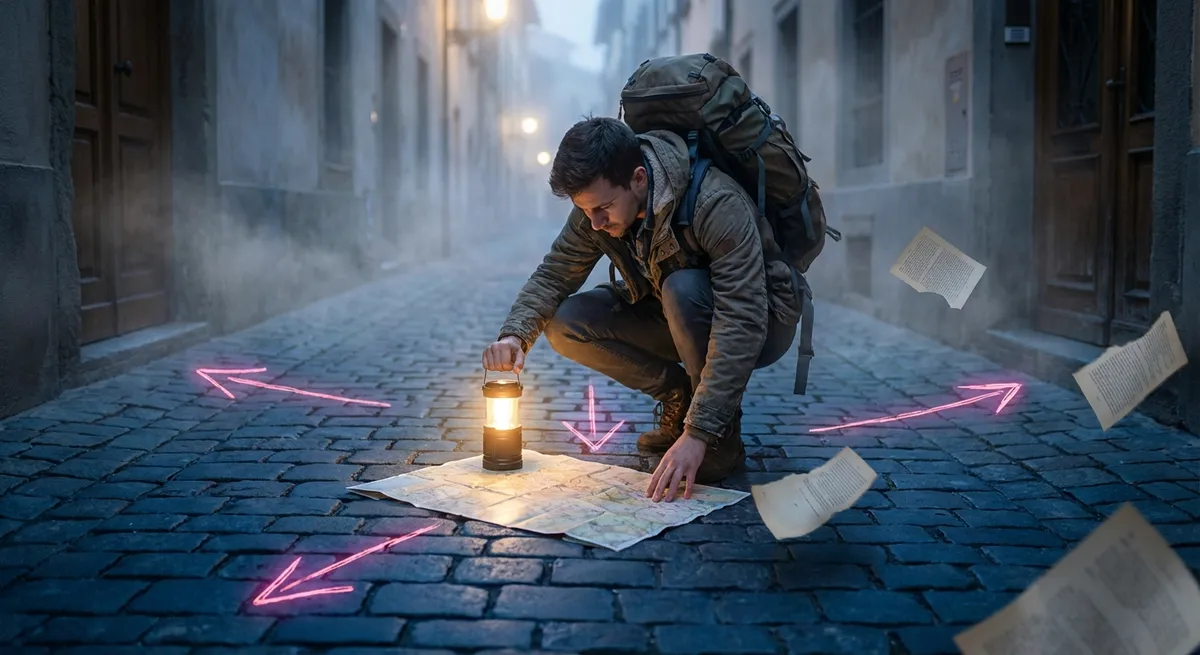
Most travelers follow the neon arrows: “Top 10,” “Must‑See,” “Don’t Miss.” You’re here because you’re wired differently. You want the places that don’t show up until you zoom in three times on the map and wonder, “Wait—what is that?”
This is your unofficial manifest for ghost‑map travel: five places that aren’t exactly “secret,” but feel like you’ve slipped through a tear in the standard itinerary. No infinity pools. No curated selfie spots. Just raw, weird, unforgettable.
How to Hunt for Places That Don’t Want to Be Found
Hidden gems aren’t always remote; they’re usually just ignored.
To find them, you have to read maps like a conspiracy theorist. Scan satellite view for odd shapes. Zoom in on dead‑end roads. Follow the thin, pale lines on topographical maps that tourism boards never photograph because they don’t look “pretty” from space.
Then, cross‑reference with reality: official park websites, local bus schedules, obscure hostel noticeboards, and that one grizzled hiker in the corner of the bar. You’re not looking for “attractions.” You’re looking for friction: places that take one extra bus, one wrong turn, or one “are you sure?” from the local café owner.
That friction is your filter. If it’s too easy, it’s probably already on someone’s Top 10 list.
Discovery #1: The Underground River You Can Hear Before You See
In a corner of Central Europe, there’s a karst region where rivers pull a vanishing act.
You’re walking through unremarkable farmland—patchy fields, stone walls, not a postcard in sight—when the sound hits first: a low roar, like a subway train that never arrives. Follow it through scrub and sinkholes and suddenly the earth opens into a jagged mouth of rock. A river dives straight into the limestone underworld, swallowed whole.
This isn’t a “lighted cave experience.” There might be a rope, or there might just be common sense and a wet path that says, “Don’t.” The air cools fast, the rock walls sweat, and you realize this river spends most of its life in the dark, resurfacing kilometers away like nothing happened.
You stand on the lip of the void, shoes muddy, phone signal gone, watching water choose the underground route. No railings. No ticket booth. Just gravity and geology doing what they want.
How to think like a ghost‑map traveler here:
Look beyond the famous show caves. Karst regions (like Slovenia’s or parts of the Balkans) are spiderwebbed with unmarked sinkholes, disappearing streams, and half‑forgotten cave mouths that locals know as “that hole where goats sometimes vanish.” Ask about those.
Discovery #2: The Train Station That Feels Like a Time Anomaly
Somewhere along a secondary train line in Asia, there’s a station that may as well be a pocket universe.
No one would plan a trip to this place. It’s the kind of stop conductors mumble under their breath. The platform lights buzz. The vending machines are half‑stocked with drinks advertising sports you’ve never heard of. The timetable shows three trains a day, and you’re not 100% sure you’re on one of them.
You get off on a whim because the landscape outside looked like a painting—terraced fields curling around misty hills, a cluster of wooden houses balancing on the slope. Within minutes, the train pulls away and the silence arrives like weather. Just you, a bench, a rusty bicycle chained to nothing, and a cat that clearly runs this place.
Follow the faint sound of voices down a narrow lane and the town slowly assembles itself: a soba shop or noodle stall, one bar with two regulars who’ve occupied the same stools since the 90s, and a guesthouse that isn’t online but has three handwritten rooms available “if you don’t mind cold mornings.”
You spend 24 hours here. Nothing “happens,” except you watch clouds roll in over the valley, share a drink with someone who’s never left, and suddenly the rest of your life feels noisy and ridiculous.
How to engineer this accident:
Pick a country with solid rail infrastructure—Japan, Taiwan, parts of Europe. Take a local line, not the bullet or express. Get off one or two stops before or after any place that has a famous name. Plan nothing. Accept the risk of mildly freezing on a platform at 11 p.m.
Discovery #3: The Abandoned Resort Being Reclaimed by the Jungle
Tourism has a graveyard, and it’s deep in the trees.
You hike in along a crumbling access road that map apps still optimistically call a “street.” The jungle grips anything metal. Vines run surveillance along balconies. A faded sign in a language you barely read promises “luxury bungalows,” but luxury left a long time ago.
Rooms hang open, curtains rotted into algae‑colored streamers. The pool is now a murky amphibian metropolis, dragonflies patrolling over lily pads that were never invited. In the lobby, a single plastic chair survives like a punchline.
The weirdness isn’t in the decay—it’s in the leftover details that insist people were here recently in the timeline of the earth: pencils with logos, menus with prices, a guestbook with careful handwriting from a honeymoon 17 years ago. You’re walking through someone else’s dream that got canceled halfway through season one.
There’s no ticket gate, but there might be a caretaker, a farmer, or a family that unofficially adopted the ruins. If they wave you away, you go. If they shrug and offer tea, you’ve just leveled up the experience.
Ghost‑map rules for ruin exploration:
- Check local laws—trespassing and safety rules differ; some places are absolutely off‑limits.
- Wear real shoes, not flip‑flops; floors and roofs can be unstable.
- Never enter if you see signs of active construction, security, or clear “keep out” notices. The best urban exploration is the kind that doesn’t get anyone arrested or hurt.
Discovery #4: The Border Town That Exists Between Languages
Most travelers breeze through borders. You, however, decide to stay.
On the map, it’s just a crossing between two countries you’ve only read about. On the ground, it’s a linguistic blender. Street vendors switch between three languages mid‑sentence. Signs layer three alphabets. The local radio station might play punk from one side and folk music from the other with zero explanation.
You check into a guesthouse where the owner speaks the neighboring country’s language with their grandparents, the national language with the police, and English with you—and changes names depending on which ID they’re showing. Breakfast is a political statement: coffee from one side, bread from the other, and a cheese recipe that both countries claim.
Walk the backstreets and you’ll find two churches facing each other like mirror images in different denominations, or a mosque and chapel sharing the same street, bells and calls to prayer overlapping. Flags fade in the sun. New ones appear overnight. No tour groups, just truck drivers, smugglers of legal goods (and maybe some not), and kids who grow up with three passports and four histories to memorize.
Border towns are where identity stops being neat. You’re not just a tourist; you’re a witness to the mess.
How to drop into this in‑between world:
Study border regions with layered histories—think between Spain and France, along the Balkans, or in the Caucasus. Look for towns with multiple official languages and contested histories. Take the slow bus instead of the direct city‑to‑city route and get off where most people don’t.
Discovery #5: The Night‑Only Market That Disappears by Dawn
There’s a market that never appears in the daylight.
You head out at midnight, following rumors and the faint glow at the edge of town. The “entrance” is nothing—just a gap between stalls and tarps where someone’s decided commerce should temporarily exist. No gates, no branding, no influencer‑friendly sign. By 5 a.m., it will all be gone.
Here, headlamps and naked bulbs create islands of brightness in a sea of shadow. You pass piles of vegetables that only make sense if you cook at 4 in the morning, fishermen selling catch that still twitches, and farmers who’ve walked for hours to sell produce before their day jobs. Kids sleep under stalls. Tea boils nonstop.
No one is selling keychains with the city’s name on them. This market isn’t for you; it’s for the city’s nervous system—restaurant owners, street vendors, people living on margins too thin for normal hours. You’re eavesdropping on the supply chain that makes travel “authentic” by the time it hits your brunch plate.
You walk through with pockets closed and eyes open. Maybe you buy a coffee from an old man with a thermos and a stack of mismatched cups. Maybe you just watch as the whole thing packs itself into motorbikes and pickups, dissolving into the sunrise like it never happened.
How to find these temporal glitches:
Search for “wholesale vegetable market,” “fish auction,” or “dawn market” in the languages of the country you’re visiting. Ask street food vendors where they get their ingredients. Go with respect—don’t block anyone’s path for photos, and remember you’re stepping into someone else’s workday, not a show.
Conclusion
Hidden gems aren’t a list; they’re a way of moving.
You find them in the extra stop you don’t need to make, the road that looks too ordinary to bother with, the market that smells a little too real. They reveal themselves to travelers who accept uncertainty as part of the ticket price and don’t panic when the last bus leaves without them.
The world is full of ghost‑map locations—abandoned plans, in‑between towns, midnight economies, and geological oddities that never made it to the brochure. You don’t need coordinates for all of them. You just need to start saying “yes” one turn earlier than everyone else.
Then, when you’re back online, you’ll look at the standard “Top 10” lists and think: We were not on the same planet.
Sources
- UN World Tourism Organization (UNWTO) - Global tourism data and insights on lesser-known destinations and travel patterns
- UNESCO World Heritage Centre - Information on karst landscapes, caves, and culturally complex border regions
- Japan Railways Group Official Site - Example of regional and local train networks ideal for offbeat station exploration
- National Park Service – Cave and Karst Resources - Background on karst systems, sinkholes, and underground rivers
- FAO – Rural Markets and Food Systems - Context on informal and wholesale markets that often operate at night or pre‑dawn
Key Takeaway
The most important thing to remember from this article is that this information can change how you think about Hidden Gems.