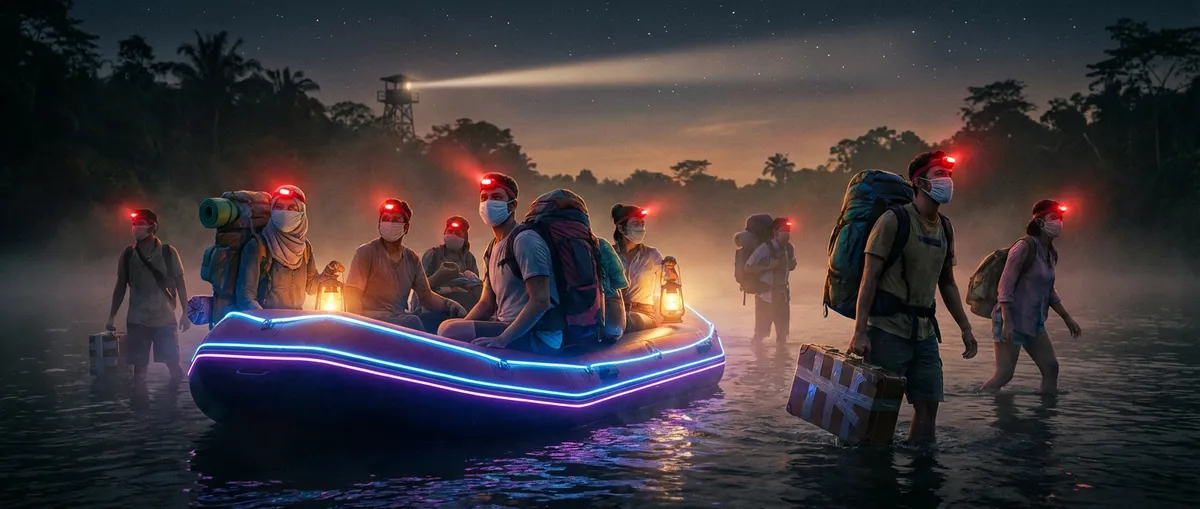
Most people travel to “relax.” You are not most people.
You’re here for trips that make your group chat go silent for a full minute, then blow up with: “You’re actually doing that?”
This isn’t about bungee jumping where they hand you a GoPro and a waiver the size of a menu. This is about the edges: places that are perfectly legal to visit (or just barely), but feel like you slipped through a crack in the script. Expect risk, remoteness, bureaucracy, and the possibility that your mom will forward you a news article about why you shouldn’t go.
Let’s get irresponsible in responsible ways.
Where Travel Becomes an Expedition (And the Paperwork Becomes a Boss Fight)
Extreme travel isn’t just about danger; it’s about friction.
Most destinations are built to be consumed. Extreme destinations make you work: forms you don’t understand, maps that lie, weather that doesn’t care about your plans, and infrastructure that’s more suggestion than guarantee.
What separates this kind of travel from straight-up recklessness is intent and preparation. You’re not going “because it’s crazy”; you’re going because you want to understand what life looks like at the fringes: high altitude, deep cold, political borders, volcanic ground, and landscapes that could erase you if you stop paying attention.
Before we dive into five very-real rabbit holes, accept three truths:
- You are not the main character. Locals are. You’re entering systems and ecosystems that existed long before your passport did.
- Red tape is part of the adventure. Permits, guides, insurance, and “no, you actually need a second stamp” are features, not bugs.
- A good exit plan is sexier than a good Instagram. Satellite messengers, evacuation coverage, trusted local contacts—these are non-negotiable flexes.
Ready? Let’s open some doors that don’t hold themselves open for tourists.
Discovery #1: Riding the World’s Loneliest Roads for Days Without a Town
If you’ve ever stared at a map and thought, “What if I just kept going until there was nothing,” this one’s for you: crossing regions where the road itself is the only proof humans passed through recently.
We’re talking routes like:
- Chile’s Ruta 7 (Carretera Austral) dissolving into ferry crossings, gravel, and glacial rivers.
- Australia’s Nullarbor Plain, where you can drive a straight line so long your sense of distance gets weird.
- Sections of Central Asian highways that seem specifically designed to test suspension systems and existential stability.
This kind of road travel isn’t a scenic detour; it’s an endurance test in logistics. Fuel stops might be 400–600 km apart. A punctured tire can turn into an overnight roadside camp. Sometimes the “town” on your map is just a gas pump, a dog, and a guy who can fix anything with a wrench and a cigarette.
You’ll need:
- A vehicle you know intimately. If you don’t know what a serpentine belt is, either learn or bring someone who does.
- Water like you’re crossing a minor planet. Think 4–6 liters per person per day, minimum, plus a buffer.
- Spare tires, tools, and a paper map. The cell signal will ghost you when it’s funniest.
What makes it extreme isn’t speed or stunts—it’s commitment. Once you’re a day or two between settlements, turning back is almost as hard as pushing on. The reward: sky so dark you can see the Milky Way in full spinal detail, silence that physically presses on your ears, and a reset button for your sense of scale.
Discovery #2: Volcanic Front-Row Seats Where the Earth is Actively Misbehaving
Some people like beaches. Others prefer standing close enough to the planet’s molten core that their eyebrows re-evaluate their contract.
Volcano travel sits at the intersection of science field trip and controlled insanity. You’re entering dynamic terrain: gas emissions, ash, unstable slopes, and the possibility that your chosen mountain decides it’s done being picturesque.
Legendary volcanic zones include:
- Iceland’s ever-shifting eruption sites, where new lava fields sometimes open within hiking distance of paved roads—but demand up-to-the-second safety updates and respect for closures.
- Indonesia’s hyperactive volcanic chain, where sulfur miners, crater lakes, and sunrise viewpoints exist in the shadow of very real eruption histories.
- Italy’s Campania and Sicilian systems (think Etna, Stromboli, Vesuvius), where towns and vineyards coexist with active vents like it’s no big deal.
Extreme travelers here don’t just chase the glow—they chase context:
- Learn how alert levels and exclusion zones actually work.
- Understand that “mild eruption” is a phrase invented by optimists.
- Accept that conditions can change in hours, and official guidance outranks your bucket list.
Gear is less about hero shots and more about staying functional: proper boots, layers that handle freezing wind and volcanic grit, a mask for ash or sulfur gases, and trek operators who care more about geology than your Instagram reel.
When you’re standing near a caldera and the ground rumbles, it hits: this whole thing we call “solid earth” is basically a temporary crust. Few feelings reboot your sense of being small this effectively.
Discovery #3: Borderland Cities Where Two Worlds Collide in Real Time
If you want adrenaline without cliffs or lava, go where political, cultural, and economic tectonic plates grind against each other: big, complicated border cities.
Here, the intensity isn’t physical; it’s human. Think:
- Major crossings between wealthy and less-wealthy nations, where daily life involves queues, inspections, hustles, and stories moving in both directions.
- Cities split by history or treaties, with one foot in one system and one in another: different currencies, languages, and rules within tram distance.
- Special economic zones where regulations bend and money, goods, and people move in ways that confuse outsiders.
These are places of:
- Smugglers and commuters using the same infrastructure.
- Residents who navigate two legal systems before breakfast.
- Constant low-level tension mixed with cross-border friendships, families, and businesses.
Extreme travel here is psychological and ethical:
- You’ll see inequality close enough to count.
- Your own passport may act like a force field or a spotlight.
- Laws might shift dramatically over a single bridge.
This is not a playground for poverty tourism or “edgy” photos. You go to listen, to understand how borders actually function on the ground, and to see how people survive and adapt in liminal zones that headlines oversimplify.
Your risk management shifts from avalanche reports to situational awareness: local news, political developments, demonstrations, and crime trends, plus a hard rule that your curiosity never outruns your respect.
Discovery #4: Deep-Cold Towns Where Winter is a Personality, Not a Season
For most people, winter is “something that happens between Netflix episodes.” For a select few cities and towns above certain latitudes, it’s a full-contact lifestyle—and visiting them in the deepest dark or cold is its own kind of extreme.
Think of communities in:
- The Arctic Circle in Scandinavia or North America, where the sun doesn’t show for weeks or months.
- Subarctic Russia and Northern Asia, where “cold” stops being a temperature and becomes a design problem for buildings, cars, and lungs.
- Harsh winter interior towns in Canada or Alaska, where the highway can feel like a frozen conveyor belt to the void.
The thrill here is quiet and relentless:
- Your breath crystallizes on your scarf within seconds.
- Eyelashes freeze together; you learn to blink differently.
- Locals have entire toolkits for starting cars at -30°C and below.
- “Going outside”—even for 10 minutes—becomes an expedition with layers, planning, and backup gear.
You’ll discover entire micro-cultures built around coping: heated bus stops, underground shopping tunnels, festivals in temperatures that would cancel school anywhere else, and kids who treat -20°C like a slightly brisk day.
Risks are not dramatic; they’re sneaky:
- Frostbite in exposed skin.
- Phones dying instantly from the cold.
- Roads turning deadly with black ice and whiteouts.
Extreme doesn’t always mean high-speed; sometimes it’s about existing—safely, respectfully—in a place where your normal instincts (about how long you can stand still, how far you can walk, how quickly help arrives) are all wrong.
Discovery #5: Ship Trails Through Oceanic Nowhere, Days from the Nearest Shore
Air travel has made the planet feel small. Long-distance sea travel rudely corrects that illusion.
Boarding a working vessel or long-haul ship route that spends days far from shoreline is a different genre of extreme: maritime isolation. This can look like:
- Passenger-accessible cargo or research vessels that occasionally take civilians.
- Remote ferry routes in archipelagos and polar regions where “ports” are glorified scars in the coastline.
- Long blue-water crossings where your last sight of land is also your last easy exit.
Once you’re truly out there, the world shrinks to floating steel, a small cast of crew and travelers, and the constant low-level rumble of engines. No quick evacuations, no stepping off to “take a break,” no ride-shares, no Uber Eats—just waves and the knowledge that the nearest humans not on your ship might be hundreds of kilometers away.
Your extreme challenges here are:
- Mental: slow time, repetition, being trapped in a finite social ecosystem.
- Physical: seasickness that ignores your pride, storms that make walking a tactical decision.
- Logistical: strict safety drills, maritime rules, and the humbling reality that an evacuation at sea is a serious undertaking.
But the trade-off: nights so dark and clean you can see stars down to the horizon, bioluminescent wakes, albatrosses following you for days, and the rare sensation of being very, very far from the algorithm’s reach. Internet, if it exists, is slow and rationed. Conversations deepen because there’s nowhere else to scroll to.
Sea is the original extreme travel medium. Reuniting with it on its terms—and not as a background to a resort—is a reminder that the planet is mostly water, and it does not care about your schedule.
Conclusion
Extreme travel isn’t about flirting with disaster; it’s about stepping far enough outside your comfort infrastructure that your brain has to reboot its assumptions.
Whether you’re barreling down a road with no towns for 600 km, standing near a volcano that might cough at any moment, decoding a border city’s invisible lines, learning how not to freeze your face off in a polar night, or sharing a deck with steel and storm in the open ocean—the throughline is the same:
You’re traveling not to “get away from it all,” but to meet more of it head-on.
These journeys demand more from you: more preparation, more humility, more respect for forces bigger than you. In return, they give something regular travel rarely does: a sharp, clear sense of being very small, very alive, and very much in the world instead of just passing through it.
If that sounds like the kind of trouble you want in your life, you’re exactly who extreme travel is for.
Sources
- U.S. National Park Service – Volcano Hazards - USGS overview of volcanic hazards, alert levels, and safety considerations for active volcanic regions
- Icelandic Meteorological Office – Volcanic Activity - Up-to-date monitoring, alerts, and scientific information on eruptions and volcanic systems in Iceland
- National Snow and Ice Data Center (NSIDC) - Educational resources on polar and cold-region environments, including sea ice dynamics and climate impacts
- Centers for Disease Control and Prevention – Travelers’ Health - Official health guidance, vaccines, and risk assessments for travelers heading to remote or high-risk regions
- International Maritime Organization (IMO) - Information on maritime safety regulations, shipboard emergency procedures, and international standards for sea travel
Key Takeaway
The most important thing to remember from this article is that this information can change how you think about Extreme Travel.