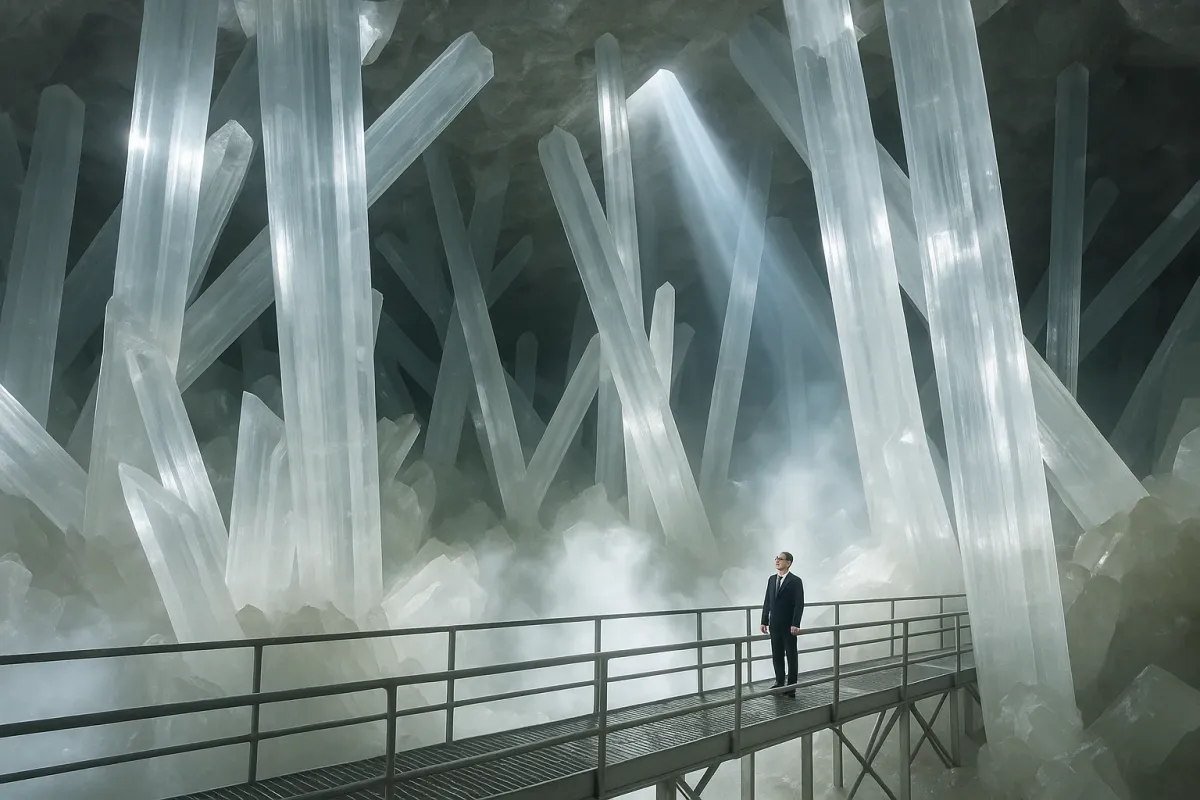
Deep under an old mining town in northern Mexico, scientists just walked into what looks like the lair of an ice dragon: a natural chamber filled with translucent crystals the size of buses, glowing under headlamps like frozen lightning. The Cave of Crystals below Naica in Chihuahua has been famous among geologists for years—but a wave of new research, temperature data, and eerie photos is all over today’s science feeds again, dragging this place back into the spotlight. And honestly? It might be the most extreme “nope-but-also-yes-please” destination on the planet.
You can’t casually stroll into Naica’s crystal underworld—step inside unprotected and your lungs cook in minutes. But the story behind it is very real, very current, and a giant warning label that Earth is still hiding dungeons we barely understand. So let’s ride the shockwave of Naica’s renewed fame and dive into other real-world spots that feel less like “travel destinations” and more like DLC levels accidentally installed on our planet.
Below are five very real, very weird travel discoveries you can actually visit (or at least orbit) if your comfort zone died a long time ago.
1. Naica’s Cave of Crystals, Mexico – The Death Trap That Looks Like a Final Fantasy Save Room
Right now, science outlets are re-obsessing over Naica’s Cueva de los Cristales—thanks to fresh analyses of the enormous selenite columns and how quickly they might degrade now that mining operations have changed the cave’s conditions. The cave sits nearly 300 meters below the Naica Mine in Chihuahua, where miners in 2000 accidentally broke through the rock and found what looked like a boss arena made of glass. Some crystals stretch over 11 meters long and weigh more than a jet, formed in a slow-motion alchemy of mineral-rich water and volcanic heat over hundreds of thousands of years.
Here’s the catch: it’s basically a sauna designed by a supervillain. Temperatures hover around 45–50°C (113–122°F) with humidity near 100%. Explorers from teams like Naica Project and researchers working with Mexico’s National Institute of Anthropology and History have had to wear refrigerated suits and carry cooled breathing gear, and even then they could only stay for minutes. Tourists can’t currently enter the main crystal chamber—and with the mine’s pumps turned off in recent years, parts of the cave are reflooding, making access even more complex. But Naica’s surge back into the news is your reminder that northern Mexico has an underground world beyond Instagram cenotes: sulfur caves, ghost-mining towns, and other Naica-adjacent geology worth chasing if you’re into landscapes that feel illegal.
If you go: Base yourself in Chihuahua City or Hidalgo del Parral and dig into regional tours focused on mining history, lesser-known caverns, and volcanic landscapes. Don’t trust any operator promising a casual stroll through the actual Cave of Crystals—if it doesn’t come with a science team and life-support gear, it’s fiction.
2. Turkmenistan’s “Door to Hell” – A Desert Crater That’s Been On Fire Longer Than Your Career
While Naica boils you from the inside, Turkmenistan just went “what if the portal to the underworld was outdoors?” Welcome to the Darvaza gas crater, where the ground collapsed in the Karakum Desert in the early 1970s during Soviet drilling. Engineers set the leaking methane on fire to prevent a toxic gas cloud, assuming it would burn out in a few days. It has been burning for over fifty years.
Every few months, photos of this place trend again on X and TikTok—especially nighttime drone shots that make the crater look like a glowing wound in the planet. The Turkmen government has even talked (again) about trying to extinguish it for environmental reasons, which means this absurd flame pit might not be permanent. The site itself is haunting: a 70-meter-wide bowl of fire roaring in the middle of silence, with sand dunes and stars for company. There are no themed safety rails, no water park, just the sun by day and a demon campfire by night.
If you go: Most travelers launch from Ashgabat with a guide and 4x4, camping near the crater. This is not a DIY scooter daytrip—think remote desert, minimal infrastructure, and a regime that doesn’t play around with paperwork. But if the Naica headlines have you craving more “Earth is not okay” energy, watching the Door to Hell roar in the dark is a solid sequel.
3. The Boiling Lake of Dominica – A Volcano’s Infinity Pool For People With Questionable Judgment
While volcanologists track Naica’s geothermal history, another hotspot is bubbling away in the Caribbean: Dominica’s Boiling Lake. It’s one of the largest hot lakes on Earth, hiding in the Morne Trois Pitons National Park, an active volcanic region that feels like someone cranked the jungle to “steampunk.” The lake sits in a flooded fumarole, constantly heated from below by volcanic gases. The result: a 60-meter-wide cauldron of gray-blue water simmering, steaming, and occasionally going full witch’s brew.
Recent seismic jitters and gas monitoring in the Lesser Antilles volcanic arc keep scientists—and local authorities—on alert. The Boiling Lake has even mysteriously drained and refilled in the past, likely due to shifting underground plumbing. Hike there and you’ll weave past vents, sulfur springs, and mud pools that smell like bad decisions. It’s an all-day slog, slippery and steep, and the shore areas can shift from “warm mist” to “skin-scorching” if you wander where you shouldn’t. This isn’t a spa; it’s a reminder that the Caribbean rests on a live wire.
If you go: Hire a local guide out of Roseau who’s tuned into the latest volcanic advisories—conditions change. Bring proper shoes, rain gear, and the humility not to lean over a lake literally called “Boiling.” Combine it with nearby hot springs for the safer version of the same vibe.
4. Chernobyl’s Overgrown Exclusion Zone – The Abandoned Theme Park Nobody Meant To Build
Naica shows what happens when humans drill down; Chernobyl shows what happens when humans walk away. Since the 1986 nuclear disaster in northern Ukraine, the 30-kilometer exclusion zone around the plant has turned into a surreal open-air laboratory. Today’s news cycle keeps yanking Chernobyl back into conversation—between ongoing decommissioning updates, lingering worries after Russia’s 2022 invasion, and new documentaries on platforms like Netflix and HBO that won’t let this ghost town rest.
Pripyat’s decaying apartment blocks, mossy amusement park, and schoolrooms still lined with dusty gas masks make it feel like time froze mid-escape. Yet the surrounding forests are hyper-alive: wolves, boars, and even wild horses roam through the radiation-blurred cityscape, starring in fresh scientific papers about how ecosystems rebound when humans vanish. Officially guided visits resumed and paused multiple times over the past few years depending on war, safety, and politics. It remains one of the strangest “tourist zones” in the world—a place where your Geiger counter is basically your ticket.
If you go: Watch current advisories like a hawk—Ukraine’s security situation, radiation zones, and local regulations are in constant flux. Only book with licensed operators running trips out of Kyiv, and read the fine print on what’s allowed (and what you absolutely must not touch, steal, or Instagram while climbing on). This is not urbex for clout; it’s a living scar.
5. Japan’s Okunoshima – The Chemical Weapons Island Now Ruled By Bunnies
Naica’s crystals look unreal; Japan’s Okunoshima feels like a glitch. During World War II, this tiny island in the Inland Sea hosted a secret chemical weapons facility producing mustard gas. The factories and storage sites were erased from maps, and workers sworn to silence. Today, the war is gone, the maps are corrected—and the island has been overrun by feral rabbits. Hundreds of them. The internet’s been obsessing over “Rabbit Island” for years, but it keeps resurfacing in viral travel clips: people stepping off ferries and immediately getting mobbed by fluff demanding snacks.
The island is small enough to walk in a day, and as you wander between decaying bunkers and rusted foundations, the contrast hits hard: lethal history, hyper-cute present. Japan’s Ministry of the Environment and peace museums on the island keep the chemical-warfare story alive, while tourism boards wrestle with balancing rabbit appeal and ecological realities (yes, overfeeding is a problem). The result is a place that feels adorable and unsettling at the same time, a soft-focus lens over a very sharp past.
If you go: Catch a ferry from Tadanoumi or Omishima. Respect the posted guidelines: don’t chase or grab rabbits, don’t overfeed them junk, don’t wander off signed trails into unstable ruins. Visit the Poison Gas Museum first, then let the bunnies swarm you—history, then chaos.
Conclusion
The renewed buzz around Naica’s Cave of Crystals is a reminder that Earth is not a finished product; it’s still beta-testing levels we haven’t unlocked. From a Mexican death-sauna of selenite to a Soviet fire crater, a Caribbean cauldron, a radioactive forest city, and a bunny-infested nerve-gas island, the weirdest places on the planet are very real—and very much part of the news cycle right now.
If your idea of travel is ticking off countries, these spots will break your list. If your idea of travel is breaking your idea of reality, start plotting routes while you still can. Some of these wonders are temporary—Naica is reflooding, the Door to Hell might be extinguished, and political lines are shifting. Get curious, get informed, and then go stand in the places that prove the world is stranger, harsher, and far more astonishing than any brochure will admit.
Key Takeaway
The most important thing to remember from this article is that this information can change how you think about Weird Places.