Most trips are built around postcards: the Eiffel Tower, that one blue Greek door, a “hidden gem” 2.5 million people tagged last summer. This is not that trip.
This is for the traveler who snacks on oddities and gets bored if a place makes too much sense. Below are five travel discoveries that feel like the world accidentally glitched in public—places that aren’t quite magical, not quite cursed, but definitely not normal. You won’t find them in your airline’s in-flight magazine. You will find yourself wondering: “Who approved this reality patch?”
The Town That Wears Its Bones: Ná́guardas of the Ossuaries
There are churches with stained glass, and then there are churches decorated in femurs.
Across Europe, “ossuary chapels” quietly exist like medieval metal album covers that no one took away from the architect. Places like the Sedlec Ossuary in Kutná Hora, Czech Republic, and the Capuchin Crypt in Rome use human bones as chandeliers, wall art, and full-on interior design. These chapels weren’t built to shock Instagram—they solved a practical problem: too many bodies, not enough ground. So the dead were rearranged with unsettling creativity.
Stepping inside, the temperature seems to drop a degree. The silence is oddly respectful, but your brain is doing backflips: you’re inside the physical archive of thousands of lives, arranged like décor. It’s not horror-movie gruesome; it’s ritualized weird, a cultural logic from centuries ago that still radiates through the present.
For travelers, this is more than a macabre stop: it’s a crash course in how another time treated death as something intimate, visible, and literally built into daily space. It’s hard to walk out and still pretend that travel is just sunshine and cocktails.
How to approach it:
Go early, be quiet, and leave the selfie stick at the door. Read the plaques; these are not haunted houses, they’re history lessons in bone.
The Island That’s Really Just a Root System: The Living Bridges World
In the misty hills of Meghalaya, India, roads don’t just curve—they grow.
Here, in the Cherrapunji and Mawlynnong regions, locals have spent generations training the roots of rubber fig trees into living bridges that cross rivers and ravines. No concrete. No steel. Just patient hands, gravity, and time. Over decades, tangled roots stretch and weave across gaps, thickening into walkable, living structures that can support dozens of people at once.
It’s one of those places where you realize that “infrastructure” doesn’t have to look like a parking garage. These bridges shrug off monsoon floods that would obliterate normal footpaths. Some are double-deckers. Many are older than the country you’re from.
Walking across, you feel a subtle bounce—not unsafe, just alive. Moss creeps along the handrails, water roars beneath you, and you’re literally held up by a tree that learned to be architecture. It’s the opposite of instant gratification: every bridge is a time capsule of long attention spans, built for relatives you’ll never meet.
How to approach it:
Respect that these are local pathways, not theme park rides. Go with a local guide, stay on the established routes, and don’t carve your initials into anything that’s been growing longer than your entire family tree.
A Doorway to Space in the Middle of Nowhere: Radio Silence Zones
Picture this: a sleepy town where your phone becomes a useless brick not by choice, but by law.
Welcome to places like Green Bank, West Virginia, inside the U.S. National Radio Quiet Zone. The community lives in enforced low-tech mode to protect massive radio telescopes listening for whispers from the universe. No cell towers. Strict limits on Wi-Fi, microwaves, even some car electronics. It’s not a digital detox retreat—it’s physics.
You drive in, and the bars on your phone just… vanish. Locals communicate like it’s 1993: landlines, face-to-face chats, notes on doors. Meanwhile, above you looms the Green Bank Telescope, a vast metal ear aimed at the sky, tracking pulsars and cosmic radio signals so faint a cheap wireless router could drown them out.
Staying here feels uncanny. You keep reaching for your phone and hitting a void. Instead of doomscrolling, you end up reading actual paper, talking to strangers, staring at the Milky Way without a screen in between. The uncanny part is realizing how much of your brain was outsourced to a small glowing rectangle—and how differently a place feels when that link is cut.
How to approach it:
Download offline maps and info before you arrive. Bring a notebook. Don’t try to sneak in signal-boosting gadgets—interference teams literally track down rogue frequencies. Out here, your hot spot is contraband.
The Cave That Thinks It’s a Cathedral: Underground Worlds With Their Own Weather
Some caves are cramped little holes. Others are full-blown alternate planets.
Enter places like Vietnam’s Sơn Đoòng Cave or Slovenia’s vast Postojna system—subterranean worlds with rivers, jungles of stalagmites, and in the case of Sơn Đoòng, its own ecosystem and localized weather patterns. Clouds form inside. It rains underground. Your internal compass file-errors the whole time.
Moving through these places feels like walking through the Earth’s private backstage. One minute you’re in dense forest, the next you’re shrinking into a tiny human inside a geological stadium. Light knifes through collapsed ceilings, illuminating ferns growing in places that should logically be dead and dark. Your steps crunch on limestone that took millions of years to become that exact texture under your boots.
This kind of travel isn’t about “seeing the sights.” It’s about feeling time stack up around you—dripping, mineral-rich, and completely unimpressed by your itinerary. You’re a temporary glitch in a space that runs on a much slower clock.
How to approach it:
Go with licensed guides only; these are fragile environments, and some are highly restricted. Follow every safety rule like it’s gospel: caves are beautiful, but they are utterly indifferent to your sense of adventure.
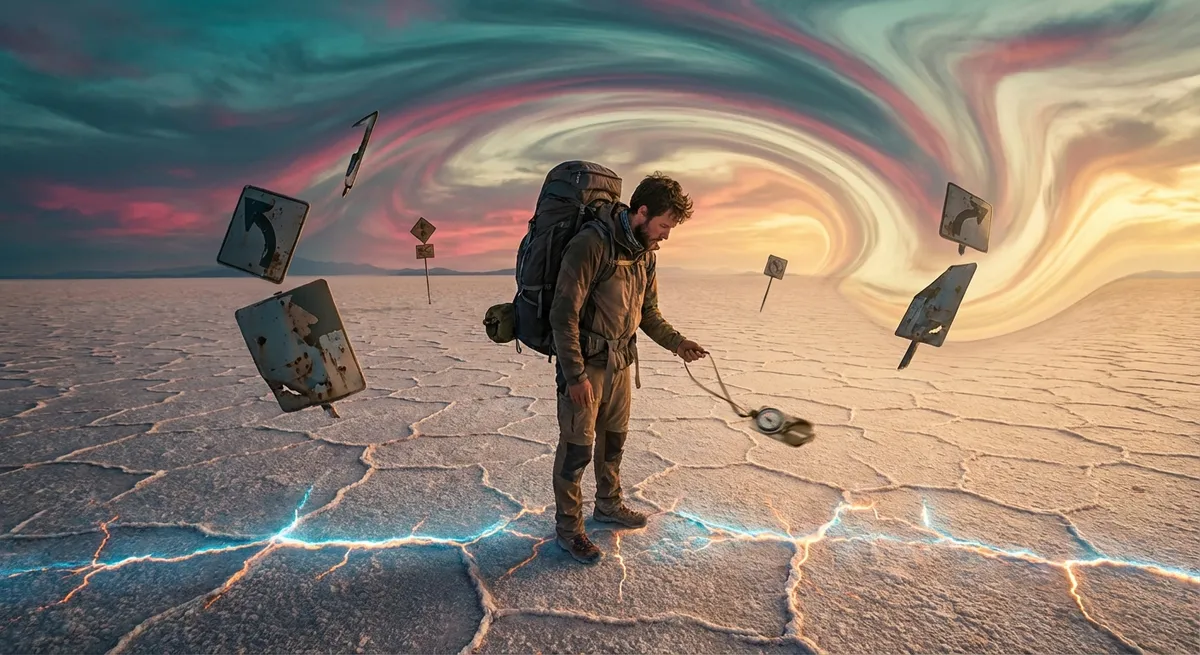
The Border Where Gravity Forgets Its Job: Optical-Illusion Landscapes
Then there are the places where your eyes flat-out lie to you.
All over the world, you’ll find “gravity hills” and bizarre landscapes that make cars appear to roll uphill and rivers seem to flow the wrong way. Spots like Spook Hill in Florida or Magnetic Hill in New Brunswick are essentially natural optical illusions—the slope of the horizon, lack of visible landmarks, and warped perspective trick your brain into misreading which way is really down.
Sitting in a vehicle that “rolls uphill” short-circuits the smug little part of your mind that thinks it understands physics. Your senses declare one thing, your rational brain yells another, and for a precious few seconds you get to sit inside that contradiction. It’s like the world is winking and saying, “You sure about that?”
Some of these places lean into the weird with roadside kitsch; others sit quietly on the edges of small towns, barely marked. The best ones are the low-key versions—just a stretch of road, a confusing horizon, and the chance to feel your own perception betray you in real time.
How to approach it:
Check local traffic rules before experimenting. If you’re on a public road, use hazard lights, stay fully off the main lane, and don’t block anyone. Let the illusion work on you—but not at the cost of a fender-bender.
Conclusion
Weird places are not side quests; they’re the antidote to formula travel. They’re the corners of the planet where our tidy mental map fails—where churches are made of bones, bridges are made of roots, towns go quiet to hear galaxies, caves grow their own weather, and roads argue with gravity.
If you chase these latitude glitches, you’re signing up for something better than bragging rights: you’re giving yourself proof that the world is less finished, less explained, and far stranger than the brochures admit. And once you’ve seen how much reality bends in these spots, it gets harder to accept a vacation that doesn’t at least try to surprise you.
Pack curiosity. Pack respect. And leave a little room in your carry-on for the feeling that maybe, just maybe, the map is still being written.
Sources
- Sedlec Ossuary – Czech Tourism - Background on the famous bone church in Kutná Hora and its history
- Meghalaya’s Living Root Bridges – UNESCO Tentative List - Official overview of the living root bridge traditions in India
- National Radio Quiet Zone – Green Bank Observatory - Explanation of radio silence regulations and scientific purpose in Green Bank, West Virginia
- Sơn Đoòng Cave – National Geographic - In-depth article on the world’s largest cave and its unique environment
- Optical Illusions and Gravity Hills – Smithsonian Magazine - Exploration of the science and perception behind gravity hills worldwide
Key Takeaway
The most important thing to remember from this article is that this information can change how you think about Weird Places.