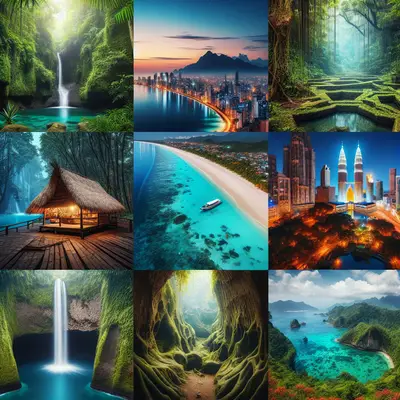
Some trips beg you to post them. These ones… don’t. They’re the stubborn corners of the planet that refuse to become “content,” the places that still feel like you’ve stumbled somewhere you maybe weren’t supposed to. No choreographed sunsets, no smoothie bowls—just landscapes that bite back a little and communities that never auditioned for your bucket list.
This is your invitation to five travel discoveries that feel like glitches in the tourism matrix. They’re not “undiscovered” (nothing truly is), but they are gloriously uninterested in playing nice with crowds. Bring curiosity, humility, and a willingness to leave the algorithm behind.
1. The Desert That Blooms Like It Forgot It Was a Desert (Atacama, Chile)
Most deserts are dry. The Atacama looks like it’s been actively rejecting the concept of water for millions of years. Astronauts test Mars rovers here because it’s one of the driest places on Earth. Then, once in a while, it pulls a plot twist: it explodes into a carpet of wildflowers.
This rare event, known as the desierto florido (flowering desert), happens only in years when El Niño–linked weather brings unusually high rainfall. For a few fleeting weeks, parts of the Atacama trade their cracked moonscapes for surreal waves of purple, pink, yellow, and white flowers. It feels fake. It isn’t.
Base yourself in lesser-known towns like Vallenar or Copiapó instead of only hitting San Pedro de Atacama, and seek out local guides who know the valleys and timing of blooms. Outside the flower years, the Atacama is still pure science-fiction travel: salt flats that shimmer like broken mirrors, high-altitude lagoons haunted by flamingos, and night skies so clear you swear the Milky Way has volume.
This is not a “quick photo and go” destination. Altitude, dryness, and temperature swings demand slow travel and respect for your body. Hydrate, move gradually higher, and don’t treat the landscape like a backdrop—it’s a living, fragile system that owes you nothing.
2. The City That Lives in the Past Without Pretending It’s a Museum (Tbilisi, Georgia)
Tbilisi feels like someone shuffled three centuries, four empires, and two design schools into the same deck and dealt them all at once. Yes, it’s getting trendier every year, but walk three streets off the glossy wine bars and the city still hums with a kind of beautiful, uncurated chaos.
You get crumbling balconies leaning at improbable angles over courtyards where kids play football, Art Nouveau stairwells that look like they’re disintegrating in slow motion, and experimental modern architecture smashed up against 5th-century churches. There’s no single “old town” bubble—history spills everywhere.
Tbilisi’s real magic is how public bathing, feasting, and storytelling are still just… life. Hit the sulfur baths in Abanotubani not as a spa day but as a cultural reset—locals gossip, scrub, steam, and argue in a tradition that’s survived Mongol invasions, Soviet planners, and Instagram. Then chase it with a supra (Georgian feast) hosted by a family-run guesthouse or tiny countryside inn, where the tamada (toastmaster) will drag you into long, emotional toasts that function as both performance and group therapy.
This isn’t a “hidden” gem, but it is a place where the tourist performance and the local reality still overlap awkwardly—and that’s the charm. Come ready to listen, toasts included.
3. A Jungle Ruin That Feels Like It’s Still Negotiating with the Forest (Calakmul, Mexico)
Skip the beaten-path pyramid bingo for one ancient city that still makes you work to meet it. Deep in the Calakmul Biosphere Reserve in Mexico’s Campeche state, the ruins of Calakmul rise like stone islands out of a green ocean that hasn’t fully agreed to give them up.
The journey itself is a filter: long drives, minimal signal, no resort strip in sight. As you walk the site, you climb steep temples that pierce above the canopy—at the top, it’s nothing but jungle to the horizon and a wall of sound: howler monkeys, birds, insects executing their daily opera. Arrive early enough and fog still wraps the treetops, making the pyramids feel like they’re surfacing from another era.
Unlike more famous sites, here the silence between other visitors is huge. You’re surrounded by one of the largest tropical forests in Mesoamerica, a refuge for jaguars, tapirs, and spider monkeys. The ruins are only one layer; the biosphere is the real giant.
Treat this place like both an archaeological site and a living habitat. Stay in eco-lodges or small family accommodations on the buffer zone, bring out absolutely everything you bring in, and remember that the animals aren’t performers on your schedule—they’re residents, and you’re the temporary glitch.
4. The Village That Built Its Own Arctic Fantasy from Wood and Sheer Will (Henningsvær, Norway)
Henningsvær in Norway’s Lofoten Islands looks like someone zoomed way in on a postcard and then refused to zoom out again. It’s a fishing village scattered across tiny islands, stitched together by bridges and bracketed by jagged, snow-dusted peaks that rise straight out of the sea.
Yes, the Lofoten archipelago has firmly entered the “photographed to death” era, but Henningsvær still feels like a functioning village that just happens to live inside everyone’s Nordic fever dream. You get fish racks towering like skeletal cathedrals, bright wooden houses bracing against the wind, and one completely absurd football pitch perched at the edge of the ocean on its own rocky island—no stadium seats, just cliffs and sky.
Travel here in shoulder seasons or winter, when the tourist crush thins and the weather gets dramatically real. The sea is not decorative; it’s work. Cod fisheries still dictate the rhythm of life, and storms can shut down your plans without apology. On those days, you sit in cafes, watch the weather throw punches at the windows, and talk to the people who choose to live at the edge of everything.
This is a gem not because it’s unknown, but because it hasn’t rewritten itself entirely for visitors. It’s still very much a working stage, not a set-piece.
5. The Country That Turns “Remote Island” into a Full Personality Trait (Comoros)
Between Madagascar and Mozambique lie the Comoros Islands—volcanic, fragrant with ylang-ylang and cloves, and mostly bypassed by the Indian Ocean resort circuit. There are beaches here, sure, but they aren’t lined with infinity pools and day passes. This archipelago feels like it missed the memo on standardized tropical tourism—and is better for it.
On Grande Comore, lava fields run straight into the sea and the cone of Mount Karthala looms, one of the world’s largest active volcanoes. Hikes up its slopes are serious undertakings, not curated volcano “experiences.” On Mohéli, a marine park shelters sea turtles and humpback whales; nights can mean watching turtles nest on quiet beaches under a sky unpolluted by big-resort uplighting.
The Comoros is overwhelmingly Muslim, deeply community-oriented, and proudly itself. Infrastructure can be inconsistent; power cuts and limited transport are part of the deal. But if your idea of luxury is authenticity over polish, a shared plate of spiced rice, fresh fish, and stories under a corrugated metal roof arguably beats a buffet line.
This is not an “all-inclusive” destination—it is very much “somewhat-included, mostly-on-you.” That’s the thrill.
Conclusion
Hidden gems aren’t defined by how few people have geo-tagged them. They’re defined by how stubbornly themselves they remain once you arrive. The desert that forgets its own dryness, the city that refuses to pose, the ruins still half-claimed by jungle, the Arctic village that works harder than your camera, the volcanic islands that never signed up to be “the next Maldives”—they’re all invitations to travel without a script.
If you go, go light, stay longer than is convenient, and spend more on people than on upgrades. The world doesn’t owe you a secret spot—but if you listen closely, it still has places that whisper instead of shout.
Sources
- UNESCO World Heritage Centre – Ancient Maya City and Protected Tropical Forests of Calakmul, Campeche - Background on Calakmul’s archaeological significance and surrounding biosphere reserve
- NASA Earth Observatory – Atacama Desert - Scientific context on the Atacama’s extreme dryness and environment
- Visit Norway – Henningsvær - Official tourism information on Henningsvær and its setting in the Lofoten Islands
- UNESCO World Heritage Centre – Historic Monuments of Mtskheta (Georgia) - Context for Georgia’s historical and architectural heritage, relevant to understanding Tbilisi’s cultural backdrop
- UN Environment Programme – Mohéli Marine Park, Comoros - Overview of marine conservation and wildlife in the Comoros, especially Mohéli Marine Park
Key Takeaway
The most important thing to remember from this article is that this information can change how you think about Hidden Gems.