You can keep your infinity pools and queue-for-a-selfie viewpoints. The world still hides places that don’t care about your Instagram, your itinerary, or your comfort level—and that’s exactly why they’re worth chasing. These are the spots where the wi-fi dies, the map goes vague, and you remember that travel is supposed to feel a little unhinged.
This is your unofficial briefing on five travel discoveries that still feel feral—places to reach before the algorithms do.
1. The Island That Vanishes: Tides, Quick Decisions, and No Second Chances
Off the coast of northern France, there’s a fortified island that treats the ocean like a drawbridge. When the tide comes in, the road disappears—literally sinks under the sea—and if you mistime your crossing, you’re either stranded on a medieval outpost or watching your car slowly become modern art.
Welcome to Île de Noirmoutier’s Passage du Gois, a 4.3 km tidal roadway that is only drivable for a few hours around low tide. There are warning signs. There are emergency platforms if you miscalculate. And there’s something electric about driving a road the ocean casually steals twice a day.
This isn’t just about the gimmick of a disappearing road. The island itself is quietly wild once you leave the main town: empty dunes where the wind does all the talking, salt marshes that glow pink at sunset, and low-key Atlantic beaches where the loudest thing around is the gulls arguing over shellfish. It feels like a place that accidentally slipped through the tourism net—and then stayed there on purpose.
If you go, tide charts are your sacred text. Don’t treat them like “guidelines.” Also, assume nothing: the Atlantic doesn’t negotiate. That thin line of asphalt is an invitation and a dare.
2. The Cave of Eternal Twilight: Where a River Forgets the Sun Exists
Some rivers take the easy route. Others tunnel under entire mountain ranges like they’re trying to escape the daylight. Deep in the Balkans, one river disappears into rock and re-emerges miles later, carving a chain of underground cathedrals along the way.
In Slovenia’s Škocjan Caves, the Reka River roars through a canyon so enormous it feels like you’ve walked into the backstage of the planet. Bridges cross the void hundreds of feet above the water, and mist rises from below like the Earth is exhaling. This isn’t the polite, handrail-heavy cave wander you did on a childhood holiday; this feels like wandering into an unfinished world.
What makes this place a gem isn’t just the size. It’s the combination of raw geology, near-darkness, and the fact that the river is still actively sculpting the whole thing. You hear the water before you see it—somewhere in the black, reshaping rock grain by grain.
Above ground, the Karst plateau is all sinkholes, cliffs, and sleepy villages with more stone than people. Hike the surface trails after the cave and you realize: that innocent field you’re walking across might be the roof of a massive underground canyon. It’s a gentle, unnerving shift in perspective—exactly what travel is supposed to do.
3. The Abandoned Mountain Road Turned Surreal Jungle Walk
Lost infrastructure is travel gold. Somewhere between “official route” and “overgrown rumor” lives an entire category of places that nature is reclaiming with suspicious enthusiasm. Northern Italy has a masterpiece: a dead road that’s better as a hike than it ever was as a highway.
The Strada delle 52 Gallerie (“Road of 52 Tunnels”) cuts into the cliffs of Monte Pasubio, a relic of World War I carved by soldiers who apparently didn’t believe in switchbacks or safety. The road was eventually abandoned to vehicles, and now the only traffic is hikers and the occasional mountain goat with better balance than you.
Walk it, and you’ll pass through dozens of hand-hewn tunnels, each leading to a jaw-drop of a view: jagged Dolomitic peaks, green valleys, clouds drifting at eye level. Some tunnels twist and rise so sharply that sunlight vanishes and temperatures drop in a single step. It feels more like infiltrating a fortress than hiking a scenic route.
There’s history baked into every bend: old fortifications, plaques, and the eerie knowledge that human desperation once carved this improbable path. It’s the opposite of a polished alpine resort—raw, slightly hazardous, and defiantly analog. Bring a headlamp, a jacket, and respect for the people who created a road where no road should logically exist.
4. The Village Hanging Over a Frozen Sea of Grass
Not all hidden gems are remote islands and underground worlds. Some are villages that look boring on paper—“agricultural, small population, remote”—then ambush you with a landscape that feels like a glitch in the simulation.
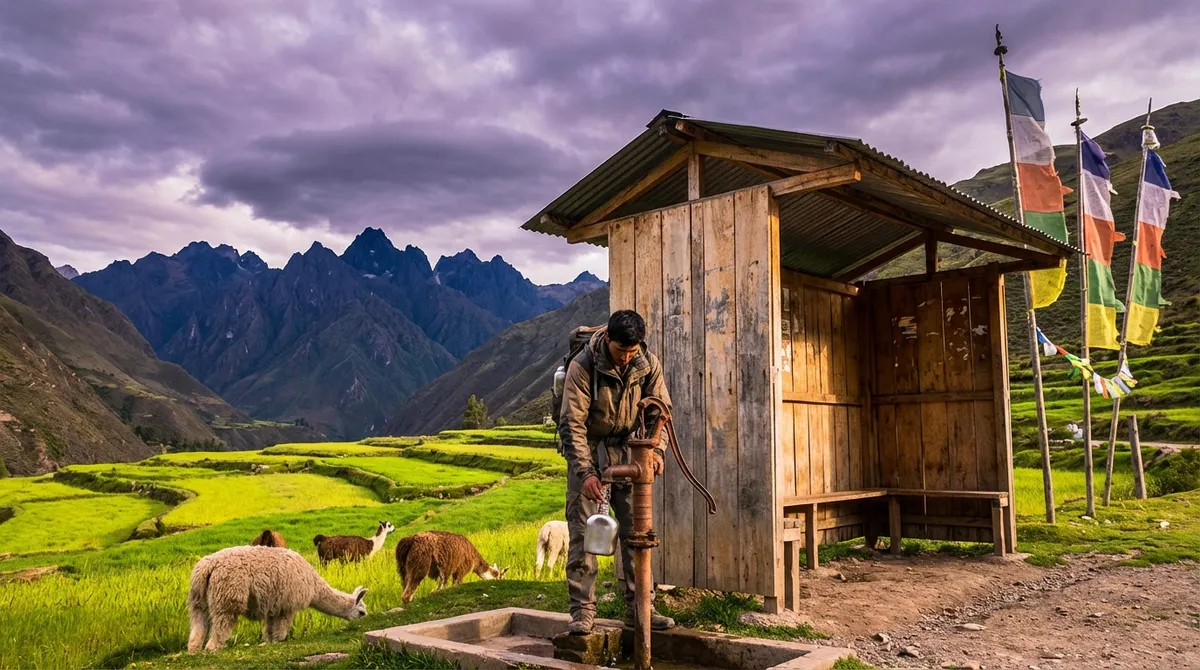
On the Tibetan Plateau, towns like Langmusi or Xiahe (in Gansu and Sichuan/Qinghai regions of China) sit on the thin line where human settlement finally gives up and lets high-altitude wilderness take over. The air is light on oxygen and heavy on silence. Monasteries cling to hillsides; prayer flags snap in winds that have no intention of calming down just because you’re tired.
Step just outside town and the world opens into high grasslands that roll endlessly toward distant mountain walls. In summer, wildflowers riot across the plateau in improbable neon. In winter, snow and fog flatten everything into a minimalist painting. Either way, the scale messes with your brain: distances are deceptive, and the sky feels way too close.
These aren’t “curated” destinations. You might find a cozy guesthouse with yak-butter tea and Wi-Fi that works when it feels like it. You might also find power cuts, unpredictable buses, and altitude headaches. But when a herd of yaks drifts across the horizon like a slow-motion storm cloud, you’ll quietly forgive all of it.
5. The Desert Where the Stars Stage a Mutiny
Deserts have a reputation for being empty. That’s lazy thinking. The good ones aren’t empty; they’re just very strict about what they allow to exist. South Australia’s outback feels like that: a minimalistic, slightly hostile canvas where the night sky launches a full-scale sensory takeover.
Base yourself somewhere like the town of Coober Pedy or the nearby Breakaways Reserve and wait for the sun to tap out. The daytime heat drains away, the horizon hardens into a silhouette, and then—lights out for Earth, lights up for the universe. With almost no light pollution and big-sky flatness in every direction, the Milky Way doesn’t just appear; it shouts.
Meteor streaks, satellites, and cold, sharp constellations crowd the dark. It feels less like stargazing and more like accidental attendance at a cosmic riot. You start to understand why ancient cultures turned the sky into a storybook—doing nothing but looking up here rewires your sense of scale.
By day, the Breakaways’ eroded mesas glow in colors that seem Photoshopped: white caps, red slopes, and bruised-purple shadows. The land looks scorched and alien, but life hides in the cracks—lizards, hardy shrubs, people who decided “middle of nowhere” sounded like a good permanent address. It’s not for everyone, which is precisely the point.
Conclusion
The best-hidden gems aren’t just “places without crowds.” They’re locations that demand participation: read the tides or get wet, climb the tunnels or miss the view, trust the altitude or turn back, sit with the dark or never really see the stars.
You don’t visit these places to collect them. You let them rearrange you a little.
If your passport is bored and your comfort zone is getting smug, pick one of these corners of the world and go let the unfamiliar win for a while.
Sources
- UNESCO World Heritage Centre – Škocjan Caves - Official overview of the Škocjan Caves, their geology, and cultural significance
- Office de Tourisme de Noirmoutier – Passage du Gois - Practical details and safety information about the tidal road to Île de Noirmoutier
- Parco Nazionale della Pace – Strada delle 52 Gallerie - Historical background and hiking info for the Road of 52 Tunnels on Monte Pasubio (Italian; use translation tools if needed)
- NASA – Light Pollution and Dark Skies - Context on light pollution and why remote deserts offer exceptional night-sky visibility
- UNDP – Tibetan Plateau Environment and Climate - Environmental and geographic overview of the Tibetan Plateau region
Key Takeaway
The most important thing to remember from this article is that this information can change how you think about Hidden Gems.