There’s travel, and then there’s stepping into places that make your nervous system ask for a manager. Extreme travel isn’t about Instagrammable “views” or sipping cocktails after a light hike. It’s about feeling your pulse in your teeth, rewriting your internal definition of “too far,” and coming home with stories you can’t tell at polite dinner parties. This is your unofficial map to some of the planet’s most outrageous, rule-bending experiences—where the stakes are high, the terrain is hostile, and your comfort zone is left whimpering at the departure gate.
The Ocean’s Midnight Zone: Diving Where Light Gives Up
Push past the cheerful coral reefs and suddenly you’re dropping into the liquid void—black water, bone-crushing pressure, and creatures that look like rejected sci-fi props. Deep and technical diving in places like the Red Sea, the Philippines’ Tubbataha Reefs, or the drop-offs of Egypt’s Blue Hole isn’t beach-holiday material; it’s physics, psychology, and survival fused into one.
At depth, your gear is your life support system and your brain is your last line of defense. Nitrogen narcosis can turn your judgment into mush, decompression stops become sacred rituals, and every move is slow, deliberate, rehearsed. The payoff? Bioluminescent organisms that ignite the darkness like underwater galaxies, shipwrecks frozen in time, and that eerie, humbling feeling of hanging in infinite black water with only your dive light keeping the abyss at bay.
Extreme divers chase vertical walls that drop thousands of meters, unexplored cave systems, and wrecks sitting way past recreational limits. This is exploration with receipts: dive computers logging your every breath, redundancy in your tanks, and meticulous planning that starts weeks before you touch the water. No souvenir shop at the end—just the knowledge that you went somewhere most humans will never physically experience, and came back with your own heartbeat as the only proof.
Volcanic Front Row: Living Lava and Toxic Air
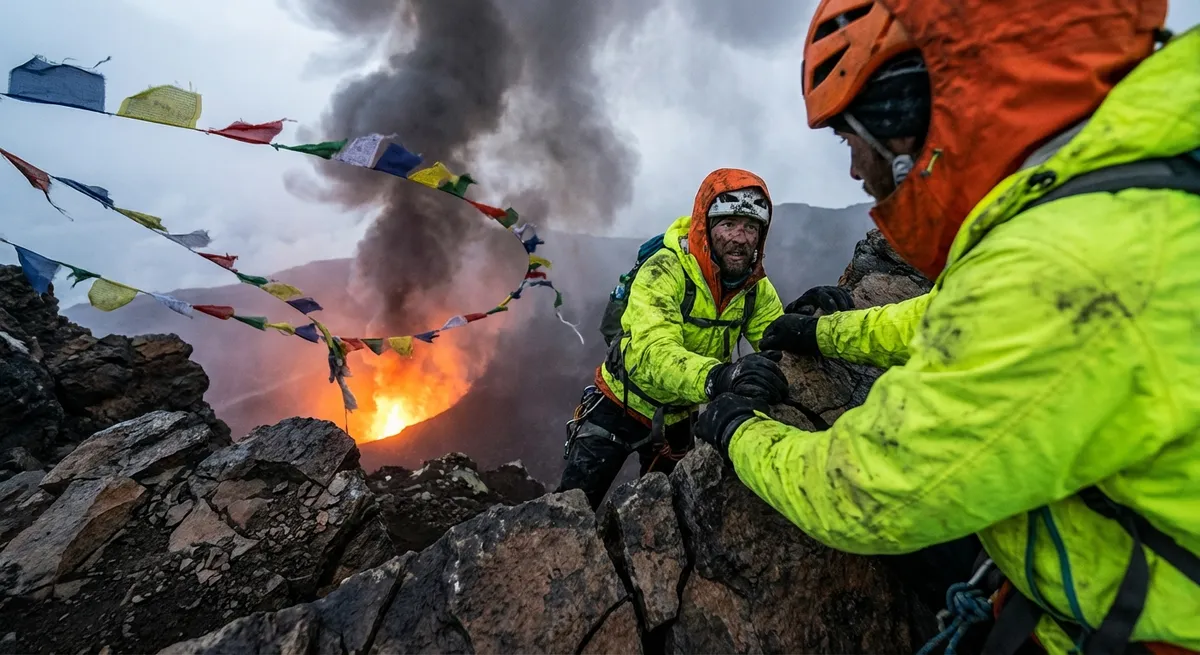
Forget “volcano viewpoint” platforms with gift shops. Some travelers head straight for the living arteries of the Earth—lava lakes, acid craters, and trembling slopes that mutter in seismic code. Places like Vanuatu’s Mount Yasur, Indonesia’s Mount Ijen, or the surreal lava flows of Hawaiʻi’s Kīlauea remind you quickly that the ground is not a stable idea, just a temporary agreement.
Here, your opponents are sulfur dioxide, razor-sharp volcanic rock, and the fact that the planet is literally venting rage beneath your boots. Gas masks aren’t a quirky photo prop; they are the difference between a brutal coughing fit and a controlled retreat. Guides watch wind direction like hawks, read the tremor data, and may turn you around five minutes from the crater because the volcano “feels wrong” that day.
Standing on the rim of an active crater, with ash stinging your skin and a low roar rising from below, is a hard reset for your sense of scale. Lava fountains, glowing vents, or neon-green acid lakes at Ijen (thanks to dissolved metals) don’t care about your bucket list. This is Earth in real time—building, destroying, recycling. You’re not the protagonist; you’re lucky background noise.
Cold-Edge Expeditions: Where Ice Decides the Itinerary
There’s cold, and then there’s expedition cold—the kind that turns water bottles into grenades and turns your phone into an expensive ice cube. Crossing Arctic sea ice by ski, ship, or fat-tire bike, or pushing into Antarctica’s interior, is less about “seeing icebergs” and more about negotiating with an environment that’s actively trying to erase you.
On a true polar-style trip, you carry your life in a sled: tent, stove, food, fuel, layers, and redundancy for every critical system. Whiteouts erase the horizon into a blank page. Temperatures plunge to levels where exposed skin freezes in minutes. The landscape moves under you—sea ice cracks open into leads of black water, pressure ridges rise like frozen car crashes, and crevasses wait under snow bridges for the careless.
Yet the rewards are absurdly out of scale: midnight suns rolling around the horizon, auroras folding across the sky like silent explosions, and close-range encounters with wildlife that looks like it was designed by minimalist gods—polar bears, emperor penguins, Arctic foxes. This is extreme travel as a slow burn: endless repetition, small tasks done perfectly, and the weird joy of knowing exactly how many calories your body needs not to break.
Storm-Chasing the Atmosphere’s Mood Swings
Most people run from severe weather. A tiny subset points a vehicle at the radar blob and floors it. Storm-chasing culture, especially across the Plains of the United States, turns the sky itself into the destination: supercell thunderstorms towering like alien cities, rotating mesocyclones, hailstorms that can obliterate a car, and tornadoes carving signatures into farmland.
This isn’t joyriding through disaster; the serious outfits mix field science, meteorology, and logistics like a mobile research station. You’re watching real-time radar, surface observations, upper-air charts, and satellite loops, threading a moving needle between “close enough to see structure” and “too close to outrun debris.” The inside of the vehicle becomes its own ecosystem of tripods, laptops, GoPros, and emergency gear.
Being parked on an empty grid road under a sky that’s rotating above you is a full sensory overload: the roar of inflow winds, the smell of ozone, the temperature drop as the storm inhales. Lightning cracks horizontally for miles, rain curtains pivot like stage sets, and if a tornado condenses, it’s both horrifying and hypnotic. You’re not conquering anything; you’re bearing witness to the atmosphere flexing harder than any mountain range.
Enter the Extremes of Your Own Head: Psyche-First Adventures
Not all extreme travel is outside; some of the wildest terrain is the space between your ears. Multi-day desert crossings, solitude-heavy thru-hikes, long ocean passages on small sailboats, or non-stop ultra-distance cycling routes all share a common enemy: your own mind when there’s nowhere left to hide from it.
Imagine days of monotony across the Atacama or Sahara, nothing but sand, rock, and a horizon that never gets closer. Or sailing across the Pacific in a small boat where sleep comes in 20-minute micro-doses between course checks. Or pedaling across continents on remote gravel roads, where the nearest “help” is a passing truck that may not show up for hours or days. Out there, every tiny discomfort gets loud: a blister becomes a crisis, a loose screw becomes an obsession, a doubt becomes a sermon.
The breakthrough is when your brain finally stops complaining and starts adapting. You learn practical magic: how to ration water without panicking, when to push and when to surrender a few miles, how to read your own emotional weather like a barometer. Extreme mental journeys don’t give you summit photos; they upgrade your operating system. The world feels smaller after you’ve watched a desert sunrise on no sleep, or navigated by stars you can finally name.
Conclusion
Extreme travel isn’t an “aesthetic”; it’s a trade. You hand over safety nets, predictability, and the right to be comfortable, and in return you get access to parts of the planet—and parts of yourself—that don’t reveal themselves to casual visitors. From the midnight pressure of deep oceans to volcano rims, polar emptiness, tornadic skies, and long-haul head trips, the world is full of edges that are very much still sharp. If you’re going to walk them, treat risk like a craft, not a toy. Then step up to the threshold, look over, and decide how far off “normal” you’re willing to fall.
Sources
- Divers Alert Network – Decompression Illness & Diver Safety - Medical and safety background on deep and technical diving risks
- United States Geological Survey (USGS) – Volcano Hazards Program - Authoritative information on volcanic activity, hazards, and monitoring
- British Antarctic Survey – Living and Working in Antarctica - Insight into the realities of polar expeditions and extreme cold environments
- National Severe Storms Laboratory (NOAA NSSL) – Severe Weather 101 - Detailed explanations of supercells, tornadoes, and storm structure for context on storm chasing
- American Psychological Association – The Nature of Resilience - Research-backed discussion of mental resilience relevant to psychologically demanding expeditions
Key Takeaway
The most important thing to remember from this article is that this information can change how you think about Extreme Travel.