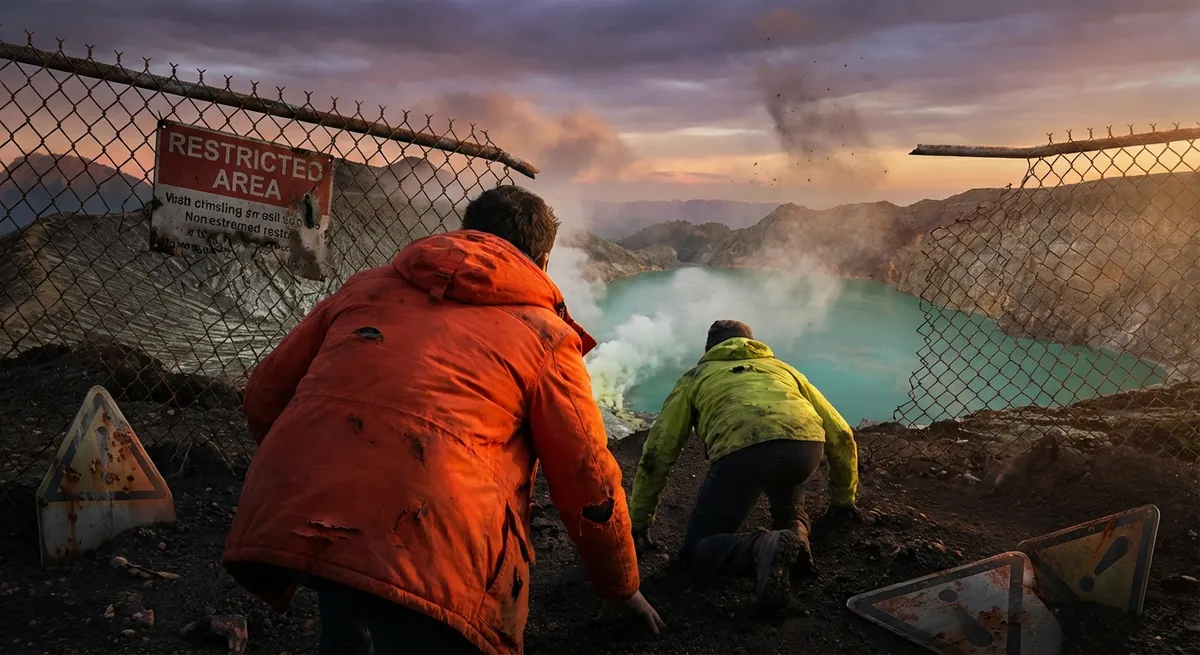
There are trips you plan—and trips that stalk you from the edges of the map until you finally snap and book the ticket. This is for the second kind. Forget “top 10 destinations” and “must-see landmarks.” These are the places you only hear about in late‑night hostel stories, that one weird Reddit thread, or from a friend who always seems to come back with stitches and a new tattoo.
These five travel discoveries aren’t about comfort or convenience. They’re about friction, risk, and that perfect moment when your pulse spikes and you realize: yep, this is exactly why you left home.
Volcanic Vigil: Sleeping on the Edge of a Living Crater
Most people admire volcanoes from a safe distance; you’re going to flirt with one. All over the world, volcano trekking has quietly evolved from “look from the viewpoint” to “hike up, camp near the crater, and watch the Earth breathe fire all night.” You’re not just visiting a mountain—you’re hovering over a pressurized wound in the planet’s crust.
Picture this: your tent pitched on ashy soil, sulfur in the air, and the low, animal growl of magma echoing from below. At active stratovolcanoes and lava lakes, guided overnight expeditions get you close enough to feel the heat on your face while staying on the right side of not-dying. Think pre‑dawn ascents where the sky is still black but the crater glows red, and you realize your “nightlight” is molten rock.
This isn’t an amusement park; it’s geological Russian roulette mitigated by local guides who read the mountain like a mood ring. You’ll learn how to recognize volcanic tremors, what those gas masks are actually doing for your lungs, and why wind direction suddenly matters more than your Instagram angle. In between the science lectures and safety briefings, there’s the surreal quiet of sitting on warm ground, sipping instant coffee while the core of the planet hisses just out of reach.
Extreme doesn’t always mean sprinting—it can be sitting perfectly still on a cooling lava flow, listening to rocks crack as they shrink, realizing you’ve never been this aware of being a temporary creature on an unstable world.
Glacier Mazes: Navigating a Dying World of Blue Ice and Hidden Voids
A glacier is not a big ice cube; it’s a slow-motion river armed with knives. To walk on one responsibly is to accept that you’re stepping into a vanishing labyrinth where everything beautiful wants to drop you into a hole. That’s the draw: it’s equal parts apocalypse and art gallery.
With crampons strapped to your boots and an ice axe in hand, you learn how to move on living ice—heel first, wide stance, no ego. Guided technical treks thread you through crevasses that swallow daylight, across snow bridges you definitely don’t want to think too much about, and into caves carved by meltwater that glow an unearthly neon blue. Every crack underfoot is a conversation between gravity, temperature, and time, and you’re stomping across the argument.
This is the kind of extreme travel that forces you to reconcile awe with grief. Your guide might casually point out that the arch you just photographed won’t exist next summer, or that the path you took was under 10 meters of solid ice a decade ago. The stakes are physical—slips, falls, hypothermia—but the real bruises land somewhere in your conscience.
Glacier expeditions elevate risk into ritual: roping into your team, testing every step, learning how to self‑arrest if you slide. The thrill doesn’t come from cheating death; it comes from respecting a moving giant that doesn’t care you exist, then carefully threading your way across its back anyway.
Storm Chasing as a Road Trip: Riding the Edge of the Sky’s Bad Mood
Normal travelers avoid bad weather; you’re here to hunt it. Extreme storm chasing has morphed from a niche scientist hobby into a cult road‑trip experience for people who think a vacation should include words like “supercell,” “rotation,” and “debris field.” Done with legit meteorologists and professional chase crews, it’s part science expedition, part Mad Max caravan under a boiling sky.
Instead of museums, your itinerary is pressure systems, wind shear, and drylines. You wake up to briefing maps, radar loops, and heated debates over which county has the better risk profile for spawning nature’s angriest spiral. Then you pile into trucks and vans, chasing towering storm structures that rise like alien fortresses on the horizon.
The adrenaline spikes when the sky goes from postcard blue to apocalyptic green, and your chase leader suddenly gets very, very focused. You might track rotating wall clouds from a country road, navigate sideways rain that feels like a pressure washer, or park just far enough from the action to watch lightning strobe across anvil clouds like a planet‑sized rave.
The wildest part? You’re not outrunning the storm; you’re dancing with its edges—constantly recalculating routes, escape paths, and safe viewing spots as the atmosphere mutates around you. It’s extreme travel where the destination literally doesn’t exist until the sky decides to build it, then tear it apart.
Subterranean Worlds: Crawling Into the Planet’s Blackout Zones
Every city has a nightlife; the Earth does too, but it happens underground. Technical caving—beyond the tourist boardwalks and Instagram‑friendly caverns—takes you into spaces that are aggressively uninterested in human comfort. You’re talking hours of belly‑crawling through cold mud, navigating vertical drops on rope, and squeezing through gaps that make you question every life choice that led you here.
This is extreme travel in negative space: no views, no horizon, just rock, silence, and the sound of your own breath echoing back at you. The reward? Caverns where your headlamp catches cathedral‑sized chambers dripping with mineral formations that look like they were sculpted by alien coral designers. underground rivers that vanish into black wells, fossils frozen into ceilings, and the bizarre, translucent creatures that thrive in absolute darkness.
The psychological load hits harder than the physical. Lose your light and you’re in pure, undiluted darkness—no city glow, no moon backscatter, just void. That kind of dark reboots your nervous system. You learn to trust your gear, your knots, and your team more than your instincts, because your instincts are mostly yelling “nope” the entire time.
Emerging after a long cave through‑trip is like arriving on a new planet—colors are too bright, air feels wrong, and you realize how thin the surface world really is. Once you’ve spent eight hours crawling inside a mountain, sitting in traffic feels laughably fictional.
Edge-of-Nowhere Expeditions: Traveling Where Rescue Is Just a Rumor
Most travel comes with an invisible safety net: hospitals, embassies, a decent cell signal. Edge‑of‑nowhere expeditions are what happens when you deliberately walk off that safety map. These aren’t quick hikes; they’re long, deliberate disappearances into regions where “backup plan” means “don’t make dumb decisions in the first place.”
Think multi‑day crossings of remote deserts where navigation is more important than cardio, or polar routes where the nearest road is a multi‑day ski away. Maybe it’s a boat drop on an uninhabited coastline with nothing but a satellite communicator, a water filter, and the creeping awareness that every problem is now entirely your problem.
The thrill here is slower, more insidious. It’s not a bungee jump; it’s waking up on day four, realizing the nearest coffee shop is measured in hundreds of kilometers, and feeling weirdly okay with that. You start counting time in camp chores, adjusting your day around wind direction, snow conditions, or tide tables instead of work emails.
This kind of extreme travel forces you to upgrade from “visitor” to “temporary resident of an indifferent ecosystem.” You learn to read the landscape: the shape of dunes, the structure of snow, the mood of the ocean. Your risk isn’t one dramatic event; it’s a thousand small choices about water, route, shelter, and energy.
When you finally step back into signal range and your phone detonates with notifications, you understand something most travelers never do: the world doesn’t actually revolve around you—and that’s the most freeing feeling on Earth.
Conclusion
Extreme travel isn’t about dangling closer to death for bragging rights; it’s about trading certainty for aliveness. Volcano rims, collapsing glaciers, storm‑torn highways, underground voids, and off‑grid horizons all have one thing in common: they confront you with the raw operating system of the planet, stripped of velvet ropes and visitor centers.
If you go chasing these edges, go with humility: hire the guides, respect the local rules, over‑prepare, and assume nature has no interest in your itinerary. The reward for that respect is a rare kind of memory—the kind that doesn’t fade into a highlight reel, because it permanently rewires how you understand risk, beauty, and your tiny, temporary role in a very volatile world.
Sources
- U.S. Geological Survey – Volcano Hazards Program – Detailed information on volcanic activity, hazards, and safety considerations for visiting active volcano regions
- National Park Service – Glacier Safety & Travel – Official guidelines on glacier hiking, crevasse risks, and backcountry precautions
- National Severe Storms Laboratory (NOAA) – Expert overview of severe thunderstorms, supercells, and storm safety essential for ethical storm chasing
- National Speleological Society – Best practices, safety protocols, and environmental ethics for technical and recreational caving
- U.S. Centers for Disease Control and Prevention – Remote & Wilderness Travel – Health and safety guidance tailored to adventure and remote-area expeditions
Key Takeaway
The most important thing to remember from this article is that this information can change how you think about Extreme Travel.