Some places feel like they were built to confuse satellites, annoy cartographers, and make your group chat ask, “Wait, you actually went there?” This is not about photogenic cafés or “hidden gems” that already have a Starbucks. These are the corners of the planet that behave badly: villages that refuse roads, landscapes that look CGI, and territories that technically exist but don’t fully agree on how.
This is your invitation to go where the map glitches a little.
The Village That Declared a Truce With Roads: Giethoorn, Netherlands
Giethoorn looks like a postcard drawn by someone who has never met a car. Instead of streets, you get canals. Instead of traffic, you get whisper-quiet electric boats, kayaks, and the occasional confused swan. It’s like Venice’s introverted Dutch cousin that never discovered cruise ships.
You arrive expecting some kitschy tourist trap, but walking into the village feels suspiciously like trespassing into a fairy tale. Wooden footbridges curve over dark, calm water. Thatch-roof houses look like they’ve been cosplaying “enchanted cottage” since the 18th century. The loudest thing is usually your own internal monologue asking, “People actually get Amazon deliveries here?”
This place is weird not because it’s remote, but because it’s stubbornly gentle in a world obsessed with efficient infrastructure. You can paddle past living rooms, float beneath low bridges that demand you duck, and then sit on a tiny terrace sipping coffee while boats drift past like slow-motion traffic. Night here is stranger still: soft window light on the water, almost no engine noise, and a low-level feeling that you’ve glitched into a simulation with the violence settings turned off.
For adventurous travelers, Giethoorn is not “hardcore”—it’s subversive. It’s what happens when a village quietly refuses to upgrade to the 21st century’s default settings.
The Salt Galaxy That Eats Horizons: Salar de Uyuni, Bolivia
Salar de Uyuni isn’t just big—it’s offensive. A prehistoric lake evaporated and left behind the world’s largest salt flat, a blinding white plane so vast that your sense of distance, scale, and direction just resign and go sit in a corner.
Step onto it and you lose normal visual anchors. The ground is a cracked hexagonal pattern of salt that stretches until it fuses with the sky. On clear days, it’s a blizzard of light; on rainy days, a paper-thin layer of water turns it into a reality-bending mirror where the horizon disappears and you walk between two identical universes.
The weirdness is in the details: abandoned train graveyards with rusting locomotives melting into the desert, hotels built entirely of salt blocks, islands of cacti rising out of the flat like hallucinations, and the knowledge that under your boots is one of the planet’s largest lithium reserves powering the same devices you’re using to post this.
Adventure here is half-physical, half-psychological. Your brain keeps asking, “Is that mountain 5 minutes away or 2 hours?” Depth perception breaks. Your guide uses tiny props—toy dinosaurs, plastic chairs—to take forced-perspective photos that look like you’re being eaten by a lizard the size of a bus. At night, when the sky detonates with stars and the ground still gleams, you stop being sure which direction “up” is.
Salar de Uyuni doesn’t feel like a destination; it feels like the loading screen before the real game starts.
The Border That Doesn’t Quite Agree With Itself: Baarle-Hertog / Baarle-Nassau
Most borders are boring: straight lines, fences, the occasional suspicious cow. Then there’s Baarle, a Belgian-Dutch town that looks like the Schengen Agreement had a nervous breakdown and spilled enclaves everywhere.
On the ground, you’re in two countries at once, and neither of them is behaving. The border is painted as white crosses and lines through streets, across sidewalks, and—in a few legendary cases—straight through buildings. One café has its entrance in the Netherlands and its back half in Belgium. Sit at one table and you’re in one legal system; slide your chair a few feet and you’re in another.
The cartographic chaos comes from centuries of land swaps, feudal deals, and stubborn local agreements, resulting in Belgian enclaves inside the Netherlands and Dutch counter-enclaves inside those. It’s a geopolitical Matryoshka doll with a sense of humor.
For an adventurous traveler, the thrill here is intellectual and social rather than “climb this, jump off that.” You can literally border-hop mid-lunch. Laws about shop closing times and taxes differ from one side to the other, so businesses have historically played jurisdictional Tetris to gain advantages. You start noticing which flag is above which door, tracking GPS confusion as your phone pings back and forth, and quietly marveling at the fact that this absurd micro-chaos works.
Baarle doesn’t offer adrenaline—but it does something weirder. It makes the concept of “country” feel flimsy and negotiable while you’re just trying to order a beer.
The Town That Officially Quit Daylight: Longyearbyen, Svalbard, Norway
Longyearbyen sits so far north that your internal clock gives up and becomes a suggestion. This Arctic settlement lives under two extremes: a summer where the sun refuses to set, and a winter where daylight is basically a rumor.
Visit during Polar Night and you step into a world where “day” is a slightly lighter shade of dark. Streetlights halo through blowing snow. The sky hovers between ink-blue and black for months. Locals walk around with headlamps like it’s permanently 4 a.m. and everyone collectively forgot to sleep.
The rules here escalate the oddness. It’s forbidden to be born or buried in Longyearbyen due to permafrost issues. You’re legally required to carry a rifle outside the settlement because polar bears treat the area like their backyard. Colorful wooden houses sit on stilts over frozen ground that’s quietly melting thanks to climate change, turning the town into a frontline outpost for global warming research.
Adventure takes the form of snowmobiles humming over frozen fjords, fox tracks vanishing into violet darkness, and the unshakeable awareness that if something goes wrong, you are massively, profoundly isolated. On clear winter nights, the aurora borealis erupts overhead, and for a few surreal minutes, the sky looks less like “sky” and more like a living organism deciding what mood it’s in.
Longyearbyen is weird not just geographically but existentially: a place humans decided to inhabit even after the planet politely hinted, “Maybe don’t.”
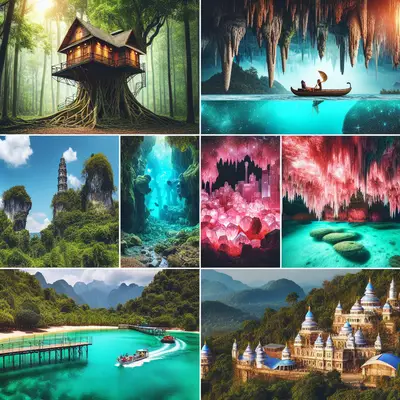
The Cave System That Eats Sound and Time: Waitomo Glowworm Caves, New Zealand
The Waitomo Glowworm Caves are proof that bioluminescent insects have better interior design instincts than most humans. Above ground: normal rolling farmland. Below: a limestone labyrinth secretly throwing a rave in slow motion.
You climb into a wetsuit, helmet lamp clipped on, and slip through a crack in the earth. Water licks at your boots, rocks sweat with underground humidity. Then the guide tells everyone to turn off their lights. Darkness slams down like a physical object.
Slowly, a sky of cold blue-green stars appears overhead. Not actually stars, of course—thousands of tiny glowworms clinging to the ceiling, dangling sticky threads to trap prey. They shine to lure, to hunt, to mate. They don’t care that you’re down here quietly losing your sense of proportion.
For adventure travelers, the magic is how physical and alien it feels. You can black-water raft through underground rivers on an inner tube, drift beneath galaxies of living light, and scramble over slick rock ledges by headlamp. Sound is swallowed. Time goes soft. Your universe shrinks to the trickle of water, the echo of your own breathing, and constellations made entirely of hungry bugs.
The weirdest part is what happens when you resurface: normal daylight feels aggressively fake, like an overexposed photo. For a few hours afterward, any ceiling with LED lights looks like a discount version of what you just saw.
Conclusion
The world isn’t short on weird—it’s just heavily filtered. Algorithms herd us toward the same sunrises, the same cocktails, the same “Top 10 Must-Sees.” But the planet still has places that mess with clocks, borders, gravity, and expectations.
Giethoorn trades roads for canals. Salar de Uyuni erases the horizon. Baarle turns borders into a board game. Longyearbyen negotiates with sunlight on a yearly contract. The Waitomo caves build galaxies out of insects.
If your passport’s feeling bored, aim it at somewhere that doesn’t behave properly. The best trips aren’t the ones that look good on your feed—they’re the ones that quietly rewire how you think the world is supposed to work.
Sources
- Netherlands Board of Tourism & Conventions – Giethoorn - Background on Giethoorn, its canals, and car-free character
- National Geographic – Bolivia’s Salar de Uyuni - Overview of the salt flats, geography, and unique landscape
- Official Website of Baarle - Detailed explanation of the Belgian/Dutch enclaves and border situation
- Visit Svalbard – Longyearbyen - Official tourism information on Longyearbyen, polar night, and local regulations
- Waitomo Glowworm Caves – Official Site - History and information about the cave system and glowworms
Key Takeaway
The most important thing to remember from this article is that this information can change how you think about Weird Places.