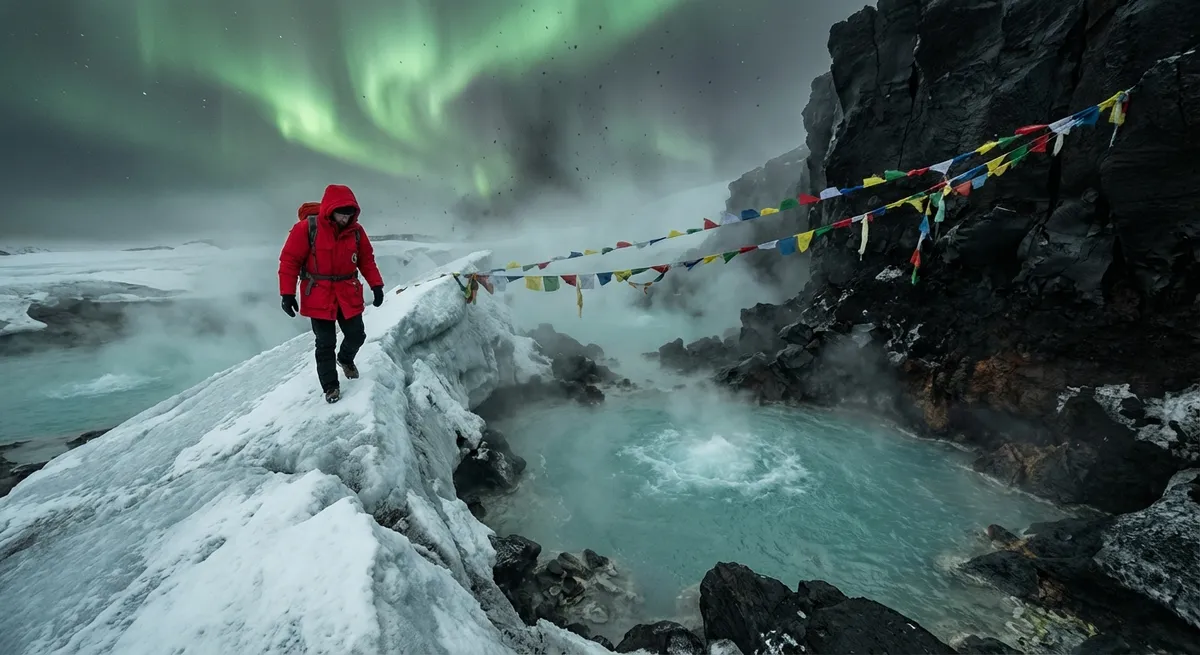
If regular vacations feel like a loading screen you can’t skip, you’re in the right corner of the internet. Extreme travel isn’t about bragging rights or chasing death; it’s about testing the edges of what your brain files under “possible.” This is your invitation to treat Earth like a glitchy open-world game: fewer resorts, more “how is this even real?” moments. Below are five wildly different, very real travel discoveries that demand curiosity, nerve, and a healthy disrespect for the default itinerary.
Riding the Edge of an Active Volcano (Hiking the Lip of Nyiragongo’s Successor)
The legendary lava lake of Mount Nyiragongo in the Democratic Republic of Congo went quiet after its 2021 eruption, but the region’s volcanic heart is still beating—and you can get dangerously close to its pulse.
The Virunga region sits on the East African Rift, where tectonic forces are literally tearing a continent apart. Here, you’re not passively “seeing nature”; you’re walking along one of Earth’s active fault lines while the planet edits itself in real time. Local guides and rangers in and around Virunga National Park and the broader rift region offer routes that skirt recent lava fields, fumaroles, and unstable, steaming ground that looks like the aftermath of a dragon tantrum.
Extreme here doesn’t mean ignoring risk; it means staring it down with data, permits, and expert guides. You’ll move through zones that show fresh scars from eruptions—collapsed houses frozen in black rock, forests abruptly terminated by jagged lava, villages that learned the hard way that the mountain decides the property line. Nightfall turns the place into a low-budget sci-fi set: sulfuric haze glowing in moonlight, distant tremors, and occasional orange flickers on the horizon from other restless vents along the rift.
The mind-bender isn’t just the danger—it’s the timescale. You’re walking on terrain younger than most social media platforms, touching rock that was incandescent magma while you were still doomscrolling last year. It’s a reminder that “solid ground” is a polite illusion, and that the planet is always under construction, whether we’re watching or not.
Sleeping in Polar Twilight on a Moving Ice Desert
Picture this: you’re zipped into a heavy-duty sleeping bag, your eyelashes stiff with frost, and the ground beneath you is very slowly, very silently drifting across the Arctic Ocean. Welcome to the world of ice camps and high-latitude expeditions, where “ocean view” means you’re literally camped on it.
In the high Arctic—places like Svalbard, northern Greenland, and the drifting ice near the North Pole—seasonal expeditions set up temporary camps on sea ice or in ultra-remote land stations. You arrive by ski, snowmobile, dog team, or plane if conditions and budgets allow. Once there, the map stops behaving like you expect. The ice shifts, fractures, and refreezes; your GPS coordinates creep while you’re standing still. You’re technically homeless: the address you slept at last night has drifted off.
Living out here is part survival course, part space mission rehearsal. You learn to manage whiteouts where the sky and snow merge into a single blank screen, to listen for the unsettling crack of ice under your tent, and to operate in temperatures where your breath turns to ice dust midair. Everything is calculated: where you pitch tents, where you store fuel, how you avoid surprise polar bear visits.
The reward? You witness a light show the equator will never understand. Polar twilight stretches hours into something between day and dream; auroras drape themselves over the sky like slow-motion green lightning. The extreme isn’t just the cold or the isolation—it’s the way your sense of up/down, night/day, land/sea becomes negotiable. It feels less like “going north” and more like temporarily exiting the normal world.
Surfing Tidal Waves That Run Backwards Up Rivers
Most surfers chase breaks that crash toward the shore. A tiny cult of maniacs hunts something stranger: tidal bores—walls of water that surge up rivers, reversing the current like someone hit rewind on the ocean.
Tidal bores form in a handful of spots worldwide where ridiculous tidal ranges squeeze ocean water into narrowing river mouths. When the conditions line up, a single, rideable wave rolls inland for kilometers. Think of it as a liquid freight train: noisy, muddy, relentless. Famous bores like the Pororoca in Brazil (on the Amazon tributaries), the Qiantang “Silver Dragon” in China, and sections of rivers feeding into Canada’s Bay of Fundy have drawn both scientists and stunt-chasing athletes.
Riding one is equal parts hydrodynamic puzzle and endurance test. You’re not just dropping in, carving, and paddling back out—you’re trying to stay on the same continuous wave for as long as your legs, lungs, and courage hold out. The water is often brown, cluttered with branches, eddies, and the occasional floating souvenir from upstream communities. Fall wrong, and you’re chewed through whirlpools and debris in a river that can’t decide which way it wants to flow.
Even if you never climb on a board, witnessing a bore is surreal. Locals gather like they’re waiting for a myth creature to surface, and then—on schedule—an audible roar builds downstream, birds panic, mudbanks disappear, and a wall of water rearranges the entire river in seconds. It’s a reminder that tides aren’t just gentle rises and falls; they’re planetary-scale physics occasionally expressed as a runnable wave.
Descending into Glacier Guts: Blue Caves and Ice Mazes That Won’t Survive You
Most people admire glaciers from a civilized distance: a distant white smear on a mountain. Extreme travelers dive headfirst into their anatomy, crawling into their melt-tunnels and caverns: temporary crystal organs that will collapse, flood, or vanish within seasons, sometimes days.
In hardcore glacier hubs like Iceland, Patagonia, the Alps, Alaska, and parts of Central Asia, skilled ice guides track evolving cave systems inside the ice. These aren’t picturesque tourist grottoes with railings and mood lighting; they’re dynamic, fragile passages carved by water, time, and gravity. Step inside and the world goes ultramarine—walls glowing with filtered blue light, crackling with the slow, sinister symphony of tiny fractures and distant avalanches.
Technically, you’re moving through a frozen river in cross-section. Your footholds are temporary, your ceiling is migrating, and the shapes you move through—arches, tubes, chambers—are decisions the glacier made while no one was watching. Safety here is a science and a gamble: guides read temperature, recent melt rates, weather forecasts, and acoustic cues in the ice, then decide whether a cave is safe for this hour.
This kind of travel short-circuits your sense of permanence. We treat mountains as eternal; then you watch an ice cathedral you explored in the morning partially collapse by evening. It’s a harsh, beautiful lesson in impermanence: you’re not visiting a place; you’re passing through a moment. Tomorrow, your photos will be proof a world existed that no longer does.
Living With Nomads on the Knife-Edge of Habitability
Extreme travel doesn’t always mean ropes, crampons, or helmets. Sometimes it means moving in with people who treat the harshest landscapes on Earth as home, not challenge—then agreeing to play by their rules instead of yours.
From reindeer-herding Sámi above the Arctic Circle to Mongolian herders on the steppe, from high-altitude communities in the Pamirs to desert nomads in the Sahara and Arabian Peninsula, there are cultures built on a quiet, generational mastery of “unlivable” environments. Signing on for an embedded stay—days or weeks living, working, and traveling with them—turns the landscape from a threat into a teacher.
You learn that warmth is less about gear than about knowledge: where to pitch camp to dodge katabatic winds, how to read the snow like a map, how to find water in dry season where a satellite image shows nothing. You ride animals instead of vehicles, follow weather instead of schedules, and eat what the land offers, not what your cravings dictate. Your phone becomes dead weight; the horizon takes over.
The extremity here is psychological. The modern travel brain is wired for control—booking, tracking, reviewing. Living nomadic means surrendering that illusion. Routes change mid-journey. Plans bend to storms, herds, or water sources, not to your internal calendar. Comfort shrinks to a small fire, dry socks, hot tea, and a story shared in a language you half-understand. You come back altered: less impressed by convenience, more impressed by resilience.
Conclusion
Extreme travel isn’t a checklist of dangerous stunts; it’s a deliberate decision to trespass beyond your comfort coordinates and into environments where your usual mental software crashes. Whether you’re tracing the fresh scars of a restive volcano, drifting on shifting polar ice, chasing a river that forgets its direction, tunneling into the veins of a glacier, or trading your itinerary for a nomad’s instinct, the common thread is this: the world is far weirder and wilder than the brochure version.
If your passport feels underused and your adrenaline feels bored, stop collecting destinations and start collecting realities that shouldn’t exist—except they do. You just have to be reckless enough (and prepared enough) to go meet them.
Sources
- USGS Volcano Hazards Program - Scientific information on volcanic activity, hazards, and monitoring worldwide
- National Snow and Ice Data Center (NSIDC) - Research and explanations on sea ice, glaciers, and polar environments
- NOAA Ocean Service: Tides and Water Levels - Detailed overview of tides, tidal bores, and coastal dynamics
- NASA Earth Observatory - Satellite imagery and articles on glaciers, rift zones, and other extreme Earth systems
- FAO: Pastoralism in the 21st Century - In-depth report on nomadic and pastoralist lifestyles in challenging environments
Key Takeaway
The most important thing to remember from this article is that this information can change how you think about Extreme Travel.