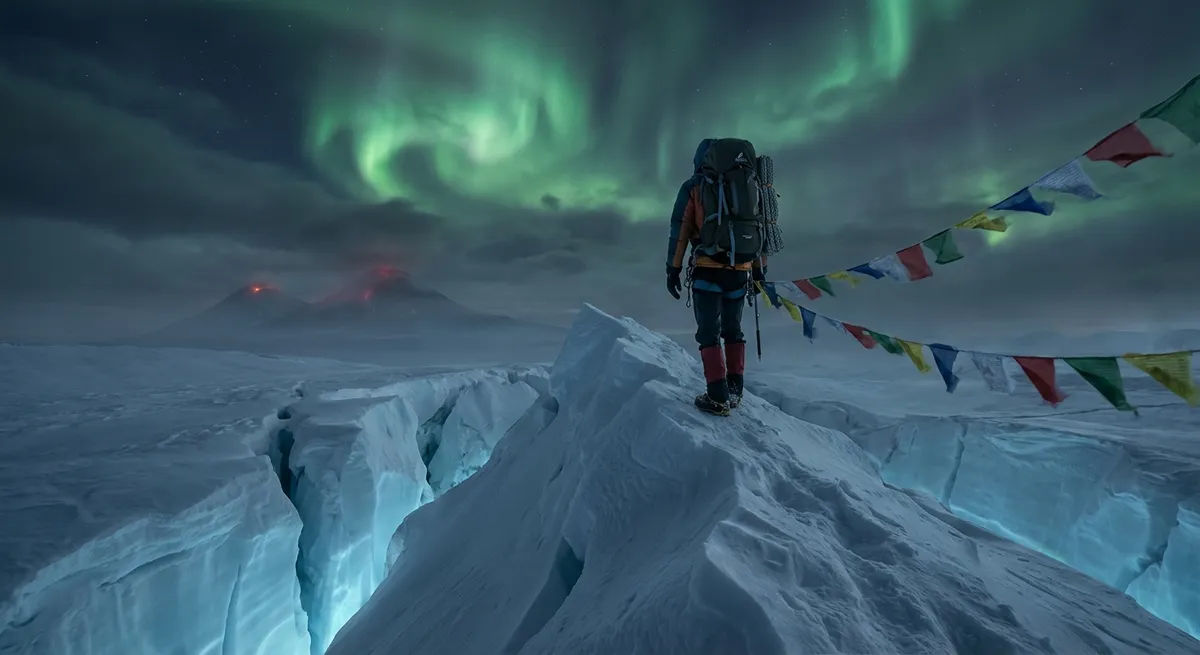
There are vacations, and then there are stories that get you banned from small talk forever. If you’re the kind of traveler who starts yawning at the phrase “all-inclusive,” this one’s for you. These aren’t just trips; they’re controlled detonations for your comfort zone—five wild discoveries for people who think “too far” is a challenge, not a warning label.
Ice, Lava, and Shipwreck Shadows: Diving in the Edge Zones
Most dives are about pretty coral and cute fish. These dives feel like trespassing in nature’s restricted areas.
Under Antarctic ice, divers descend through a hole carved in the frozen ceiling into a world that looks like another planet—turquoise light, crystal ice cathedrals, and Weddell seals ghosting past like silent torpedoes. In Iceland, Silfra fissure lets you drift between tectonic plates, fingertips almost brushing North America and Eurasia as glacial melt water so clear it feels like flying surrounds you. Legend has it visibility can hit 100 meters; your brain will keep insisting the bottom is closer than it is.
Then there are the shipwreck graveyards—Truk Lagoon in Micronesia, Scapa Flow in Scotland—where you swim through steel skeletons of war, past trucks still chained in cargo holds and plates still stacked in mess halls. It’s less “aquarium” and more “haunted museum with no exits.”
This kind of diving isn’t for casual snorkelers. We’re talking dry suits, technical training, and a serious respect for cold, depth, and overhead environments. But if you want to literally submerge yourself in extremes—ice, history, and the raw bones of the Earth—these watery edge zones deliver.
Walking on Fire: Volcano Front‑Row Seats (That Aren’t Theme Parks)
If you’ve ever stared into a campfire and thought, What if this was the size of a city block?, volcano country is calling.
On certain expeditions in places like Vanuatu, Hawaii, Iceland, and the Democratic Republic of Congo, you can trek to active craters where molten rock churns like an angry ocean. Imagine camping on the flanks of a volcano, your tent glowing red from the lava’s reflection, ash crunching under your boots, and the ground humming with underground pressure. At destinations like Mount Etna or Stromboli in Italy, you can hike guided routes and watch small eruptions paint the sky—nature’s illegal fireworks show.
Some travelers push it further with volcano boarding on the black slopes of Cerro Negro in Nicaragua, essentially tobogganing down fresh ash at highway speeds. Others go on scientific-style tours that thread carefully along cooled lava fields and fumaroles, reading the ground like a live manuscript of the planet’s temper.
This is not a selfie-with-background situation; it’s a stay-alert-or-regret-it environment. Wind direction, volcanic gas, and eruption alerts matter. Go with guides who treat the mountain as a living thing, not a stage prop, and you’ll get something a theme-park volcano can’t touch: the visceral knowledge that you are extremely, gloriously temporary.
Chasing Sky on the World’s Wildest Vertical Playgrounds
If your legs get restless in elevators, welcome to the vertical frontier.
In Norway’s fjords, via ferrata routes bolt ladders, steel cables, and suspension bridges directly onto cliffs that plunge into cobalt water. You clip in, lean back over 600-meter voids, and climb the kind of rock faces that used to be reserved for elite climbers and the occasional mountain goat. Similar routes run across the Dolomites in Italy and alpine regions across Europe, turning raw exposure into a semi-accessible thrill.
Desert towers in Utah and Jordan offer another flavor of vertical madness—freestanding sandstone spires that look like they were sculpted for fantasy films. Some require technical climbing; others, guided scrambling and rappelling. Either way, standing on top of a finger of rock surrounded by miles of emptiness feels like you’ve hacked gravity’s code.
For the truly altitude‑obsessed, there are glass platforms cantilevered over 1,000-meter drops in places like the French Alps or China’s Tianmen Mountain. Cheesy? Sure. But step onto a clear box over an abyss and tell your animal brain it’s safe. It won’t believe you, and that’s the thrill.
This is fear management, not fear denial. Harnesses, helmets, solid weather windows, and experienced guides turn “absolutely not” into “I can’t believe I did that.”
Rivers That Don’t Care About Your Weekend Plans
Most rivers are for picnics, kayaks, and lazy afternoons. Then there are rivers that sound like freight trains and flip rafts like toys.
From the Zambezi below Victoria Falls to the Futaleufú in Chile or the Gauley in West Virginia, big-water whitewater is its own brand of chaos. Rapids get rated up to Class V—boiling drops, hydraulic holes that can surf a raft, and standing waves taller than your guide. The routine is simple: paddle hard, listen even harder, and accept that sometimes you’re going swimming whether you planned to or not.
Multi-day expeditions raise the stakes and the beauty. You might portage around rapids with names like “Terminator” or “Oblivion,” then camp on sandy riverbanks under more stars than your city-raised eyes knew existed. Mornings start with strong coffee and helmet checks; afternoons end with sore shoulders and a weird craving to do it all again.
Respect the water, because it’s not negotiating. Go with reputable operators who take safety drills seriously and understand seasonal flows. The river doesn’t care if you trained for this. That’s what makes taming even a small piece of it feel obscene in the best possible way.
Human Limits Expeditions: Testing Where Your “No Way” Breaks
Sometimes the most extreme destination isn’t a place—it’s the version of yourself that comes home.
Human limits trips aren’t about stunt danger; they’re about stacking altitude, distance, cold, heat, or isolation until your excuses fall off. Think multi-day Arctic ski crossings where your breath freezes in your balaclava, desert ultras where your shadow is your only company for hours, or high-altitude treks that flirt with 5,000+ meters and make every step feel like a negotiation with thinner air.
You don’t have to be a super-athlete to tap into this—just willing to be uncomfortable for longer than usual. Maybe it’s a hut‑to‑hut crossing in winter in the Alps, a long-distance pilgrimage trail walked fast instead of slowly, or a bikepacking route that turns “scenic road” into “rolling survival test.” Your metrics become simple: water, calories, warmth, momentum.
These trips require planning like you actually like yourself: training months in advance, dialing in gear, learning how your body reacts to altitude or heat, and building recovery days into your route. The payoff isn’t a single photo; it’s a permanent shift in your baseline. Ordinary life feels suspiciously easy when you’ve proven you can function on frozen eyelashes, aching legs, and a brain that’s out of excuses.
Conclusion
Extreme travel isn’t about collecting danger like merit badges; it’s about stepping so far outside routine that you stop recognizing yourself—and then realizing you like the stranger you’ve become. Whether you’re staring into a lava lake, clipping into a cliff hundreds of meters above a fjord, or paddling into a rapid that roars louder than your fear, the common thread is simple: you showed up where most people say “no way.”
That’s the entire ethos of No Way Travel. The world is full of safe, padded corners. These aren’t them. Pick one, train hard, respect the risks, and go rewrite the limits you’ve been pretending are permanent.
Sources
- U.S. National Park Service – Scuba Diving Safety - Overview of training, equipment, and risk considerations for advanced and overhead-environment diving
- British Geological Survey – Volcanoes - Background on how volcanoes work, eruption types, and associated hazards
- American Alpine Club – Climbing Safety & Accidents - Real-world incident reports and safety lessons for vertical and mountain environments
- American Whitewater – Safety Code - Core safety principles and classifications for whitewater rivers and paddling
- Centers for Disease Control and Prevention – High Altitude Travel & Altitude Illness - Medical guidance on acclimatization, prevention, and risks for high-altitude expeditions
Key Takeaway
The most important thing to remember from this article is that this information can change how you think about Extreme Travel.