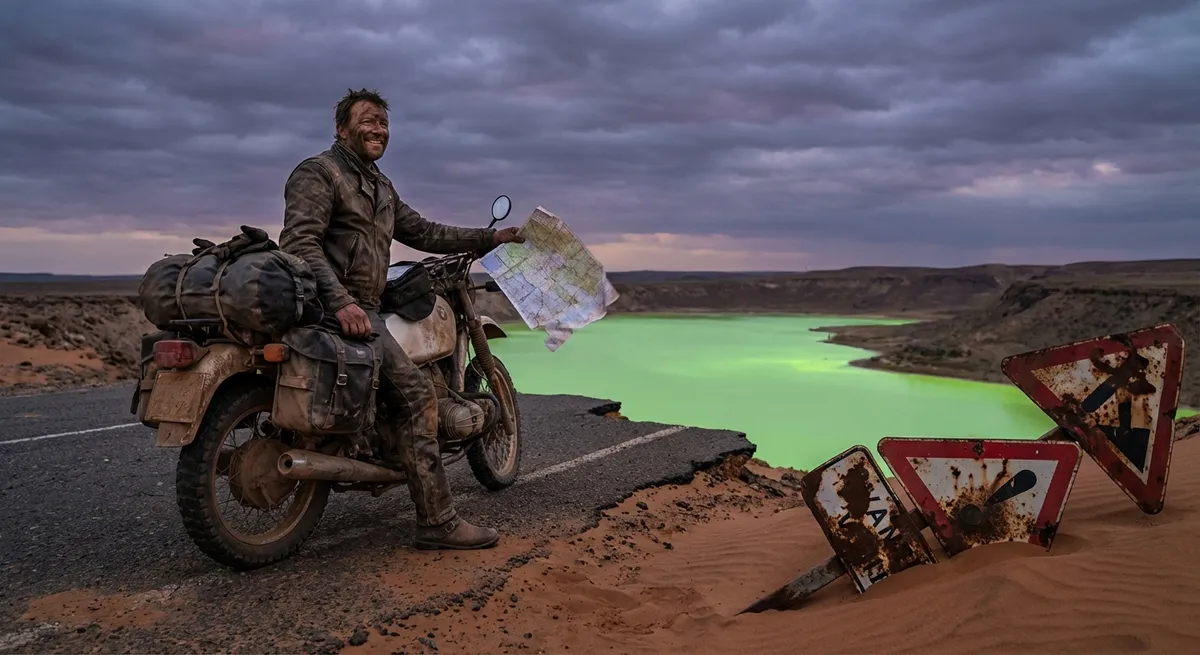
There’s a point on every trip where the guidebook thinks you went home yesterday. Extreme travel starts right after that moment. It’s the space where weather apps lie, road signs give up, and “Are we actually doing this?” becomes the most common sentence of the day. This isn’t about booking yet another bungee jump; it’s about chasing the places where your comfort zone has terrible cell reception—and discovering weird, electric pockets of the planet you didn’t realize existed.
Below are five discoveries that feel less like “vacations” and more like side quests your future therapist will want to hear about.
1. Storm-Chasing the Sky’s Meltdown in Tornado Alley
Most people drive away from a wall of rotating clouds. Storm chasers pay to sprint toward it.
In the American Great Plains—Oklahoma, Kansas, Texas, Nebraska—spring and early summer turn the sky into a live-action disaster movie. Specialized storm-chasing tours load you into vans with meteorologists, ex-firefighters, and people who care way too much about dew points. You’ll spend long days ripping along back roads, watching supercells bloom, merge, and explode into lightning-filled monsters.
This isn’t an amusement park: the distances are huge, the weather is moody, and some days you’ll chase nothing but ghost forecasts. But when it all lines up, you’ll find yourself parked at a safe distance, wind roaring, sirens wailing in some town down the road, staring at a spinning column of atmosphere that could pick up a truck like it’s loose paper. It’s less “tour” and more “collaboration with physics.” You learn to read the sky, watch professionals navigate danger with obsessive safety protocols, and feel the planet flex in real time.
Storm-chasing is only for travelers who understand that “risk managed” doesn’t mean “risk free.” But if you’ve ever watched a thunderhead and thought, I want to get closer, this is your version of a pilgrimage.
2. Into the Ice Vault: Sleeping Above a Collapsing Glacier
Most visitors treat glaciers like museum exhibits: approach the rope, take a selfie, back away slowly. Extreme travelers treat them like ticking clocks.
In places like Iceland, Patagonia, and Alaska, outfitters now run expeditions that place you just shy of the ice’s comfort zone. Picture hauling your gear over blue-veined ice, roped to your team, creaking sounds echoing under your crampons. You’ll set camp on solid rock just beyond the glacier’s reach, watching it calve and crack from a respectful distance while your guide updates you on the day’s new crevasses.
The intensity isn’t only physical. You’re camping beside a vanishing archive—layers of trapped air, ancient snow, and planetary memory melting out of existence. By day, you might navigate ice caves, practice self-arrest with an ice axe, or cross meltwater streams that appear and disappear in hours. By night, you listen to the glacier shift and moan like an old ship in heavy seas.
Extreme here doesn’t mean reckless. Guides drill avalanche awareness, crevasse rescue, and “what-if” scenarios until they’re muscle memory. It’s about standing on the front line of climate reality and realizing the word “permanent” doesn’t mean what it used to.
3. Trading Oxygen for Altitude: Life on the Thin-Air Trail
Most people dabble in altitude when they hike a scenic route and get a little winded. You’ll know you’ve leveled up when breathing feels like a deliberate hobby.
High-altitude trekking—think sections of the Pamir Highway in Tajikistan, the Annapurna region in Nepal, or remote plateaus in Bolivia—shifts the terms of your trip from “How far is it?” to “How breathable is it?” At 4,000–5,000 meters (13,000–16,000 feet), your heart pounds during basic tasks, water boils at lower temperatures, and sleep becomes a negotiation. You don’t “beat” altitude; you bargain with it, slowly.
The real discovery isn’t just views that look like desktop wallpapers gone feral. It’s the micro-culture of high places: villages where kids grow up above the clouds, shrines coated in prayer flags, tea houses that feel like life support stations for stray humans. You pay attention to details you used to ignore—your resting heart rate, your hydration, how your body responds to a single flight of stairs.
With serious altitude comes serious risk: acute mountain sickness, pulmonary or cerebral edema. Responsible outfitters teach you to listen for early warning signs, embrace slow ascents, and treat “going back down” as a power move, not a failure. The reward? You come home knowing you’ve stood in air too thin for regular life, and you earned every breath.
4. Caves that Breathe: Descending into the Planet’s Night Side
The underground is the world’s forgotten frontier. No cell signal, no sunsets, just rock, water, and your own headspace.
Extreme caving (with professionals, not a flashlight and a bad idea) drops you into vertical shafts, underground rivers, and chambers that could swallow cathedrals. In places like Slovenia’s karst regions, Mexico’s Yucatán, or Vietnam’s massive cave systems, expeditions involve rappelling into darkness, wading through chest-deep water, and squeezing through passages that make you understand exactly how big your ribcage is.
It sounds claustrophobic—and for some, it will be—but there’s an almost sacred stillness underground. The air feels older. Tiny mineral formations have been slowly sculpting themselves for millennia while humans invented and discarded entire civilizations up above. Your helmet light reveals ecosystems that never see the sun—pale fish, eerie insects, roots dangling from trees that have no idea what their underground life looks like.
Guides obsess over redundancy: backup headlamps, mapped routes, rope checks that border on ritual. The discovery here is twofold: the raw alienness of the subterranean world, and the surprising calm that comes when the surface and its noise vanish, and it’s just you, the rock, and the steady drip of time.
5. Riding the Edge of the Map: Expedition-Style Ocean Crossings
Cruises are floating hotels designed to keep you unaware you’re deep in the ocean. Expedition crossings do the opposite: they make sure you cannot forget.
Whether you’re taking an ice-strengthened vessel across the Drake Passage to Antarctica, hopping a research ship in the North Atlantic, or joining a sailing expedition in the Southern Ocean, the ocean becomes the main character, not the backdrop. Swell rolls can turn walking into an athletic event. Deck watches involve scanning for icebergs, whales, or storms building on a distant horizon line. Sleep becomes a rhythm synced to the ship’s constant motion.
You’re not just “on a boat”; you’re cooperating with a hostile, magnificent element. Seasickness humbles even seasoned travelers. Weather shifts rewrite your plans overnight. Yet in exchange for giving up control, you get moments no resort can purchase: bioluminescence pulsing in the wake at 2 a.m., albatross gliding for hours without flapping once, or the first sight of an ice shelf that looks like a continent trying to become a cloud.
Modern ships pack safety gear, advanced navigation, and trained crews—but the ocean doesn’t care about your itinerary. That’s the point. You learn to live with that indifference and find awe in it.
Conclusion
Extreme travel isn’t about collecting danger points or chasing viral stunts. It’s about stepping so far outside the padded envelope of “normal trip” that you start to feel the planet as it actually is: unstable, powerful, unpredictable, and weirdly welcoming to those who show up prepared and honest about the risks.
These five discoveries—chasing storms, bivouacking near dying glaciers, bargaining with altitude, crawling into the Earth’s dark lungs, and crossing seas that can flip your plans in an hour—aren’t bucket list items. They’re perspective resets. You come back carrying fewer souvenirs and more questions, less fear of discomfort and more intolerance for living on autopilot.
If your instinct while reading this was, “That sounds like a terrible idea, and I kind of want in,” your passport is already halfway stamped.
Sources
- NOAA National Severe Storms Laboratory – Storm Chasing - Overview of scientific storm chasing, safety considerations, and how professionals operate around severe weather
- U.S. National Park Service – Glaciers and Climate Change - Background on glacier dynamics, retreat, and why glacier environments are unstable and require caution
- Centers for Disease Control and Prevention – High-Altitude Travel & Altitude Illness - Medical guidance on altitude risks, acclimatization, and prevention of altitude-related illnesses
- National Speleological Society - Information on caving safety, conservation ethics, and organized speleological exploration
- British Antarctic Survey – Crossing the Southern Ocean - Details on Southern Ocean conditions, sea ice, and the challenges of expedition-style crossings
Key Takeaway
The most important thing to remember from this article is that this information can change how you think about Extreme Travel.