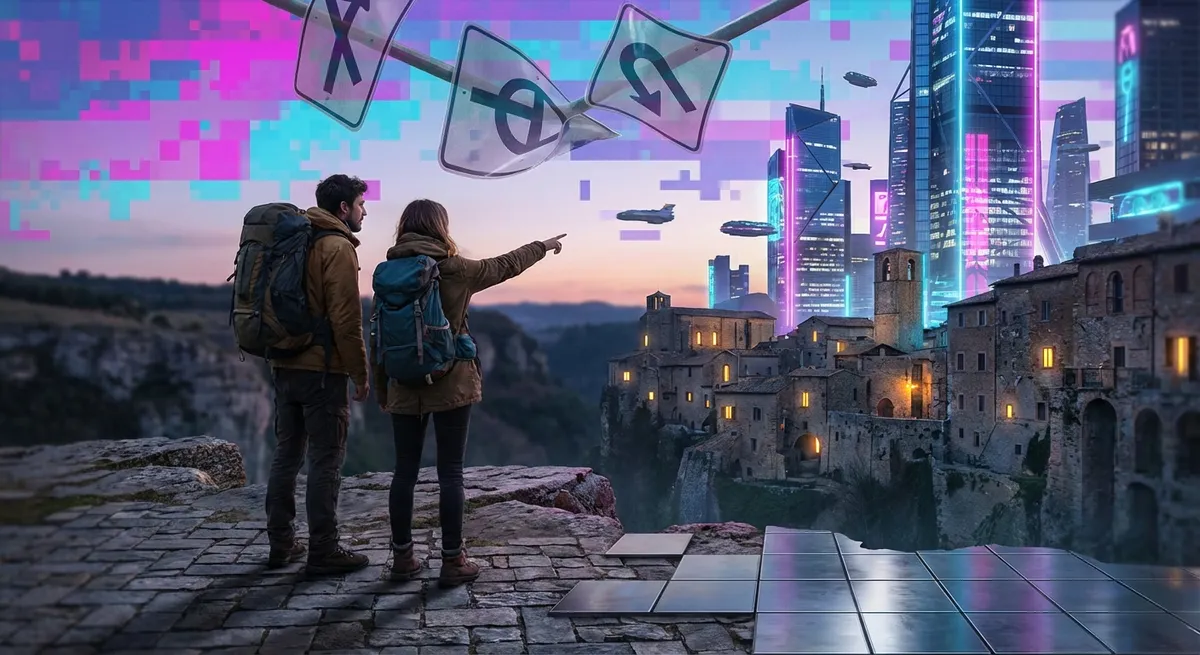
Every once in a while, you land somewhere that makes you wonder if the pilot misread the coordinates—or if you’ve slipped into a slightly wrong version of Earth. These are the places where the landscape argues with logic, the locals shrug off the bizarre like it’s normal, and your camera roll looks photoshopped even though you swear it isn’t.
This isn’t about “hidden gems” or “underrated spots.” This is about locations that feel like the universe accidentally used a glitch filter and never hit undo. If your idea of travel is chasing that “no way this is real” feeling, welcome to your next rabbit hole.
The Singing Desert Where Sand Dunes Roar Like Distant Engines (Badain Jaran, China)
Deep in Inner Mongolia, there’s a desert that growls at you. Not metaphorically—its dunes literally emit a low, resonant hum that sounds like a giant, slow-motion engine starting up. The Badain Jaran Desert is home to some of the tallest stationary dunes on the planet, and when dry sand avalanches down their slopes just right, the grains vibrate together and produce this surreal “singing” or “booming” sound. It doesn’t happen on command; you have to be patient, climb, and then slide or trigger small shifts to coax the desert into “performing.”
The weirdness doesn’t stop at the soundtrack. Hidden between these waves of sand are dozens of perfectly still lakes, some fresh, some salty, many tinted strange hues by minerals and algae. You’ll hike up endless caramel dunes, expecting only more emptiness, then suddenly stumble across a glassy blue lake guarded by cliffs and sand giants. Accommodation ranges from basic desert guesthouses to nomadic-style camps, where the night sky is so sharp it feels like it could cut you. It’s remote, bureaucratically tricky to access, and the roads are more suggestion than promise—but that’s exactly why it feels like you weren’t supposed to find it.
The Village Built Inside a Hole in the Earth (Setenil de las Bodegas, Spain)
In southern Spain, there’s a town that looks like someone tried to hide a civilization under a rock and then forgot about it. Setenil de las Bodegas isn’t perched on cliffs or nestled in valleys—it is wedged directly under giant slabs of overhanging rock. Many homes and bars are literally built into the cliffs, with whitewashed facades facing the street and raw rock forming the back wall and ceiling. Walk down Calle Cuevas del Sol and the sky disappears, replaced by a continuous stone overhang that looms above café terraces and LED beer signs.
Nothing here feels like the marketing-approved version of “quaint Europe.” One bar might be a cave where the ceiling sweats in summer. Another house might have a bedroom that’s half drywall, half exposed rock face. At night, the town glows white against black stone like a glitch in the landscape. It’s easy to base yourself in nearby Ronda or Seville and day-trip in, but staying overnight in a cliff-cave guesthouse, falling asleep under thousands of tons of rock, is a different kind of thrill. You don’t just visit Setenil—you tuck yourself inside it and hope the mountain keeps its mood.
The Forest of Perfectly Straight Trees That Refuse to Behave (The Crooked Forest, Poland)
Outside the Polish town of Gryfino, there’s a small pine forest that looks like something out of low-budget alien sci‑fi. Around 400 trees, all planted in the 1930s, emerge from the ground and immediately curl into a dramatic 90‑degree bend before straightening and shooting upward. Imagine a grove of wooden question marks, all bending in exactly the same direction, frozen mid‑shrug. No one can agree on what caused it. The theories: early foresters manipulating the trunks for boatbuilding, a freak snowstorm that warped saplings, or something much stranger nobody wants to put in writing.
The forest is tiny; you don’t go here for sweeping vistas. You come to walk among these bent trunks, tracing the curves with your hands, and feel your understanding of “how trees should work” quietly fall apart. The silence adds to the unease—there’s no big visitor center, no dramatic signage, just a simple woodland that won’t explain itself. It’s easy to combine with a trip to Szczecin or even Berlin, but the energy is the opposite of urban chaos: this is the kind of place where your brain keeps nudging you with one obsessive thought—“Why?”—and the landscape just smirks.
The Island Where Stone Giants Watch You From Every Direction (Rapa Nui / Easter Island, Chile)
You’ve seen photos of the moai—those stone heads staring out over a remote Pacific island—but being surrounded by them in person is another level of uncanny. On Rapa Nui, the moai aren’t some single, fenced‑off attraction. They’re scattered across the island like forgotten chess pieces from a supernatural game, half‑buried, toppling, standing in silent ranks, or lying abandoned in the quarry where they were carved. The more you see, the less sense they make. Why are some gazing inland instead of out to sea? Why did the builders stop mid‑production and just walk away?
The island is tiny and famously isolated, but its energy is heavy—like you’ve stumbled into the aftermath of a long, complicated argument between humans and the forces they tried to command. Hike up to Rano Raraku crater and you’ll find half‑finished moai frozen mid‑creation, as if the sculptors vanished for lunch and never came back. At Ahu Tongariki, a row of restored giants stare you down as waves crash behind them, and your sense of time warps: are you visiting them, or have they been waiting for you? Add in wild horses wandering the roads, winds that don’t quit, and a night sky so black it swallows your phone screen, and Rapa Nui starts to feel less like a destination and more like a riddle carved in stone.
The Underground Cathedral Made of Salt and Headlamps (Zipaquirá Salt Cathedral, Colombia)
North of Bogotá, miners carved a church out of a functioning salt mine—then kept digging until they’d built something that looks like a Catholic fever dream set inside a sci‑fi bunker. The Zipaquirá Salt Cathedral is a labyrinth of tunnels leading to chapels and crosses hewn directly into walls of mineral. Colored lights wash over veins of salt, casting strange glows on religious icons and making shadows that have nothing to do with the figures that cast them. This is worship as world‑building: a sacred space sculpted inside a resource extraction site, buried hundreds of meters below everyday life.
You’ll walk past dry, chalky corridors, then emerge into vast caverns that swallow your footsteps. The air tastes faintly of salt; your clothes pick up underground chill. Whether you’re religious or allergic to organized belief, the emotional whiplash is the same: awe, unease, curiosity, and the weird sense that you’re trespassing in someone else’s idea of the underworld. It’s part pilgrimage, part industrial archaeology, part surreal art installation. When you finally emerge into daylight blinking and disoriented, the surface world feels…too flat, like a movie set without enough layers.
Conclusion
If you travel to collect countries, these places will ruin your system. They’re not boxes to tick; they’re reality checks—reminders that Earth is still weirder than the algorithm’s best guess. Singing dunes, rock‑roofed villages, bent forests, stone giants, and underground cathedrals don’t fit neatly into itineraries or hashtags, and that’s the point.
Pick one that bothers you the most—the one that makes you say, “There’s no way that’s real”—and book it. The best trips don’t just change where you are; they scramble what you think is possible.
Key Takeaway
The most important thing to remember from this article is that this information can change how you think about Weird Places.