There’s regular travel. Then there’s the kind your friends read about in a group chat and type, “You’re not actually doing that… right?” This is for the second group—the people who feel most alive with a mild sense of “this might be a mistake” humming in the background. Extreme travel isn’t just about danger; it’s about tilting the planet on its axis and seeing what falls out: strange physics, hostile landscapes, and places that make your body file a formal complaint while your brain claps in pure awe.
Below are five travel discoveries that feel less like vacations and more like aggressive dares from the Earth itself. No itineraries. No “Top 10 must-see cafés.” Just raw, heavy-weather trips for people who think “comfort zone” sounds like an insult.
Riding the Planet’s Bruise: Storm-Chasing as a Moving Destination
Most trips have points A and B. Storm-chasing has a point “try not to die” stretched across a few thousand square miles of sky.
In the U.S. Great Plains—Oklahoma, Kansas, Texas, Nebraska—the horizon goes full cinema every spring. Supercell thunderstorms tower higher than commercial jets, rotating like slow, angry galaxies. Hail the size of your fist, lightning chains crawling across the clouds, sirens wailing in distant towns—you’re not sightseeing; you’re sitting in the VIP section of the atmosphere’s mood swings.
Legit storm-chasing outfits treat this like airborne physics class meets survival drill. You’re crammed in a van chasing radar signatures, learning about mesocyclones and wind shear, stopping in empty parking lots to film clouds that look like the sky is trying to land. Sometimes you meet the myth itself: a tornado scraping across the prairie, kicking up dirt, power flashes exploding blue as it shreds power lines.
It’s not about getting as close as possible—that’s amateur energy. It’s about threading the moving needle of terror and beauty with enough distance to drive away afterward. You’ll come home with photos that look fake, a new respect for meteorologists, and a permanent addiction to checking radar apps when a storm rolls in.
The Vertical Desert: Hanging Off the World’s Hardest Walls
Most people visit national parks to walk under the cliffs. Big-wall climbers come to sleep on them.
Places like El Capitan in Yosemite (USA), the towering faces of Baffin Island (Canada), or the desert monstrosities of Wadi Rum (Jordan) are essentially vertical expeditions. This is not a day hike with a cute summit selfie. You’re hauling your life up the rock inch by inch: water, food, gear, and a portaledge—a hanging tent bolted to the cliff so you can sleep like a bat with anxiety.
The days are methodical and brutal: fingers bleeding, feet crammed into shoes that feel like medieval devices, route-finding up stone that hasn’t cared about humans for millions of years. The nights are worse, which is to say, unforgettable. You zip into your sleeping bag, hover hundreds of meters above the valley floor, and feel the whole wall breathe with temperature shifts and wind. Your bathroom is a carefully choreographed operation with gravity as the main character.
This discovery isn’t just “climbing a big thing.” It’s realizing that vertical space is a travel destination in its own right. You’re not visiting Yosemite; you’re visiting a specific square of granite, living on it, arguing with it, and leaving only chalk smears and sunburn behind.
Borderline Volcanic: Camping at the Edge of the Earth’s Open Wounds
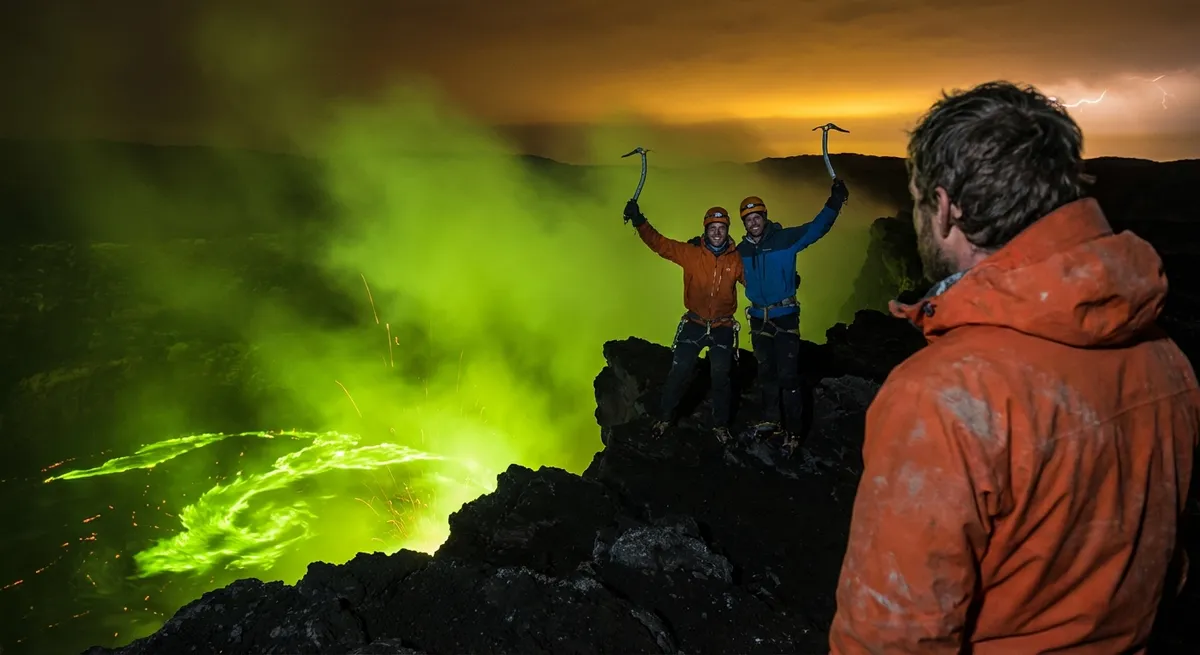
Volcano tourism sounds cute until you’re standing at the lip of a caldera, ears buzzing from the low-frequency growl of magma, and the ground feels like it has opinions.
From Iceland’s restless fissures to Vanuatu’s boiling crater lakes to Mexico’s towering Popocatépetl (best admired from a safe distance thanks to its mood swings), live volcano zones are like the Earth’s unfiltered emotional outbursts. You’re not just watching a landscape; you’re watching geology in real time, compressed into human timescale.
Some destinations let you go almost indecently close. Places like Stromboli in Italy or certain vents in Iceland give you access to trails where you can watch lava fountaining, gas vents hissing, and new rock being born under your boots. If you’re lucky (or unlucky, depending on perspective), you’ll hear the deep cannon-blast of an eruption—a sound that goes straight through your bones.
Camping within range of a restless volcano—where permitted and guided—is a masterclass in negotiable risk. Ash can fall like sinister snow. Your nose burns from sulfur. The stars above feel almost polite compared to the glow crawling up from below. It’s a discovery that the planet is not “solid ground;” it’s a slow, molten argument, barely cooled, and you are camping on top of the argument.
Ice Labyrinths: Descending into the Planet’s Melting Blue Veins
Glaciers look solid from the distance of a viewpoint. Up close, inside them, they’re more like haunted cathedrals made of compressed time and trapped air.
In places like Iceland, the Alps, Alaska, Patagonia, and Antarctica, glacial guides can drop you into crevasse systems and ice caves so blue your brain thinks someone turned on a filter. You screw crampons into your boots, rope up, and descend into vertical slots where walls glisten, meltwater trickles, and the silence feels strangely thick.
This is extreme not because it’s loud or explosive, but because the danger is quietly architectural. Bridges of snow can collapse. Tunnels can shift. The entire structure is an active, creeping river of ice sliding downhill in slow motion. Every echo of your axe bite into the wall is a reminder: this thing is moving, even as you try to read it like a frozen book.
The travel discovery here is psychological: you’re walking inside a climate headline. Layers of ancient snow pressed into ice, air bubbles from past centuries, melt patterns accelerated by modern warming—your photos will go viral, but the real imprint is the uneasy knowledge that this vast, dangerous beauty is literally vanishing while you’re inside it.
Nightfall at the Edge of Human: Deep Wilderness Where Rescue Is a Theory
There are places still left on Earth where “emergency services” is more of a concept than a promise. Not because nobody cares, but because there’s simply too much wild and not enough infrastructure.
Deep Amazon tributaries, hard-to-reach Arctic coastlines, interior deserts in Namibia or Mongolia, remote islands in the Pacific or Indian Oceans—these are regions where the map technically exists, but the margins are suspiciously vague. Getting in usually takes multiple modes of transport: bush plane, longboat, 4x4, then finally your own unwilling feet.
The extremity here is not a single stunt, but the compound weight of small risks stacked over days: water purification failing, a twisted ankle three days from help, weather closing in, navigation errors when the GPS decides it’s bored. Nights are thick with insects, predators, or simply an oppressive silence that reminds you how loud civilization really is.
Traveling this deep, often with local guides or Indigenous communities, is less about conquering anything and more about being aggressively humbled. You learn to count daylight hours like currency. You eat what the land allows. You realize that the world is still mostly not about humans, and the areas that are feel suddenly fragile and overdressed.
You don’t come back with cute “hidden gem” tips. You come back with a recalibrated sense of risk and a weird nostalgia for those hours when the nearest road was multiple bad decisions away.
Conclusion
Extreme travel is not a personality flex; it’s a different way of relating to the planet. You stop treating Earth like a theme park and start treating it like a volatile roommate who occasionally sets the kitchen on fire but also makes the best sunsets you’ve ever seen.
If you’re drawn to these kinds of trips, treat “adventure” and “preparation” as the same word. Go with experts. Learn the science behind the chaos. Understand that you’re not the main character out there—the storm, the wall, the ice, the volcano, the wilderness all were doing just fine without you.
And then, once you’ve done the homework and signed the waivers and annoyed your insurance company: step over the line. Out where your comfort zone can’t reach you, the world stops feeling like a backdrop and starts feeling intensely, overwhelmingly, vividly real.
Sources
- National Weather Service – Storm Spotter’s Guide – Overview of severe storms, tornado structure, and safety fundamentals relevant to storm-chasing tours
- Yosemite National Park – Climbing El Capitan – Official guidance on big-wall objectives, permits, and risks on one of the world’s most iconic cliffs
- U.S. Geological Survey (USGS) Volcano Hazards Program – Detailed information on volcanic activity, monitoring, and hazard types for active volcano regions
- National Snow and Ice Data Center – All About Glaciers – Scientific background on glacier dynamics, crevasses, melt, and safety considerations
- U.S. National Park Service – Wilderness Safety Tips – Practical guidance on risk, preparedness, and decision-making in remote wilderness areas
Key Takeaway
The most important thing to remember from this article is that this information can change how you think about Extreme Travel.