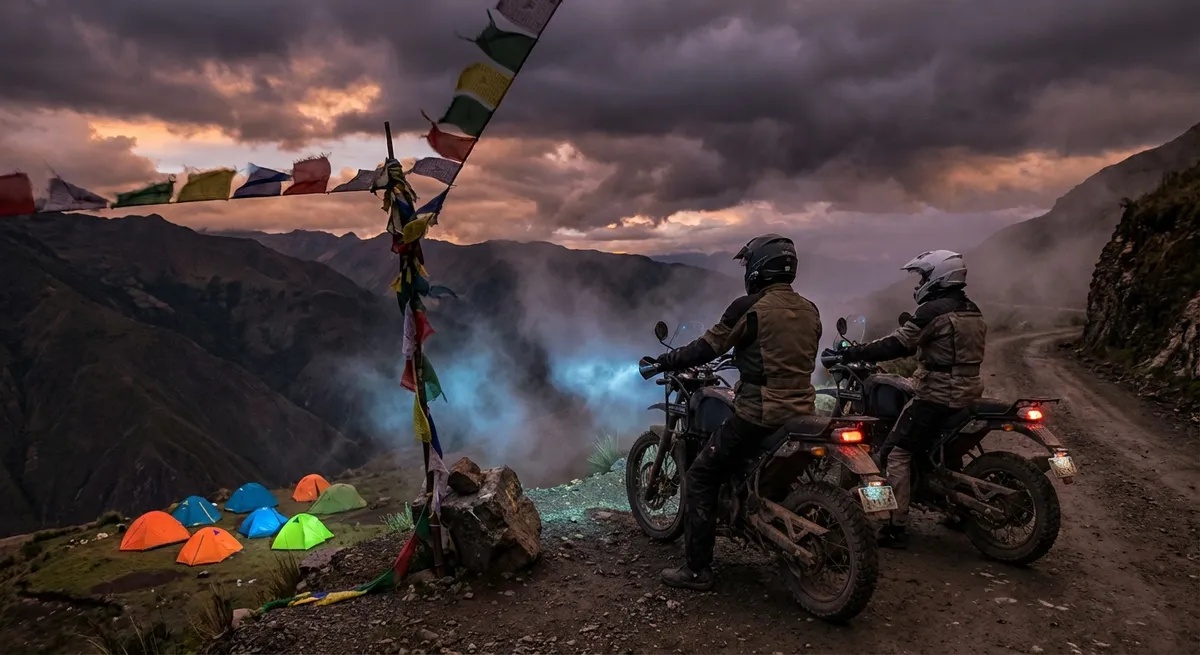
Most trips fit inside a postcard. These don’t. This is travel for people who look at the phrase “risk assessment” and hear “challenge accepted.” No Way Travel isn’t here to hold your hand; we’re here to dare you to use it—to grab onto the side of a boat, a glacier, or a rattling train and hang on for dear life.
Below are five extreme travel discoveries that aren’t just “off the beaten path”—they’re somewhere between “are you serious?” and “call my lawyer.” Research them, respect them, and remember: if it looks like a movie stunt, it probably is.
1. Sleeping on a Cliff Face in the Andes
Forget beachfront balconies. Try dangling 400 meters above a Peruvian valley, strapped into a transparent pod drilled into raw rock. Near the Sacred Valley of the Incas, “sky lodges” let you sleep in a hanging capsule bolted to a cliff—part mountaineering, part fever dream.
To get there, you either climb a via ferrata route straight up the rock (metal rungs, sheer walls, heart rate: maximum) or cross a series of hanging cables like a tightrope act with a helmet. At night, the valley drops into quiet black, and your window is pure sky—a vertical campsite with a mattress, a real toilet, and the very real awareness of gravity.
This is not a place for acrophobes or sleepwalkers. It is where you go when hotel “rooftop views” have stopped doing anything for your adrenaline. Conditions change fast in mountain environments—wind, rain, and human error do not care about your Instagram. Go guided, go prepared, and understand you are one system failure away from becoming a cautionary tale.
2. Riding the Steel Spine of the Arctic: Freight Trains and Frozen Nowhere
Commercial Arctic cruises? Cozy. Predictable. Boring. Now imagine clattering through sub-zero wilderness on a workhorse freight line, where your only entertainment is the shriek of steel and the silent, snow-blind horizon.
From northern Scandinavia to Canada’s frozen interior, the far north is laced with cargo-first railways moving ore, fuel, and supplies through landscapes that feel freshly carved by some angry weather god. On certain routes, hardy travelers can legally ride scheduled trains used mainly by workers and locals—no luxury cabins, no deck chairs, just basic cars barreling through ice and darkness.
The appeal? You’re watching the industrial lifeline of the Arctic in motion: meteorological brutality outside, metal and diesel inside. In winter, delays and cancellations are routine; in storms, they’re non-negotiable. This is the polar opposite of curated “winter wonderland” tourism—harsh, functional, and fascinating.
If you chase this kind of trip, study the line you’re using, respect local rules, and never assume you can “figure it out en route” in −20°C. In the Arctic, bad planning doesn’t just ruin your trip; it can end it.
3. Diving Into a Blue Hole That Wants to Swallow You Whole
Tropical lagoons look friendly from the surface. Blue holes don’t. These vertical underwater pits are ocean sinkholes: deep, dark, and unforgiving. Advanced divers chase them for the mix of geological wonder, psychological terror, and that irresistible pull of depth.
From Belize’s Great Blue Hole to the infamous “Dahab Blue Hole” in Egypt, these sites are riddled with arches, overhangs, and lethal temptation. Depth narcosis can hit like a drunk fog. Gas mixes must be managed with laboratory-level precision. One bad choice, one overconfident push, and you’re not coming back up.
Why go? Because it feels like dropping into the planet’s unplugged drain. You fin along the lip, then suddenly the seabed falls away into a midnight void. Sunlight fades, walls vanish into darkness, and the world shrinks to your bubbles and the glow of your dive computer.
Only attempt this with proper certifications, a serious dive operator, and an ego small enough to turn around early. Blue holes are not “let’s try scuba for the first time” destinations. They are where expert divers go to test the limits—of physics, of fear, and of their own restraint.
4. Chasing Volcanic Fury on the “Ring of Fire”
Volcano tourism is the definition of playing near the edge of the off switch. Across the Pacific Ring of Fire, active volcanoes tempt travelers with lava lakes, smoking craters, ash fields, and the intoxicating feeling that the ground is alive and slightly annoyed.
In places like Indonesia, Japan, and Central America, you can hike to steaming vents, traverse cooled lava flows, and stand close enough to hear a mountain breathing. But these landscapes are not props—volcano alert levels change, evacuation orders hit suddenly, and gases you can’t see can kill you faster than the lava you can see.
The real adventure is accepting that you are a visitor in a violently dynamic system. You learn to read hazard maps, to track alert statuses from geological agencies, to understand what “increased seismicity” actually means. You discover that the bravest decision is often to back off when the experts say so.
The payoff: sunrise over a smoking crater, the earth glowing faintly from within, ash crunching under your boots. It feels like standing at the edge of the world’s operating system, watching it boot up in real time.
5. Crossing Deserts Where the Horizon Is a Lie
Deserts mess with your senses. Heat mirage, endless repetition, the disorienting silence—these places are designed to break both machines and human overconfidence. Whether you’re picking your route across the Sahara, the Atacama, or Australia’s red interior, desert expeditions are less “road trip” and more “tactical survival.”
A true extreme desert journey means long distances without services, unreliable tracks, and weather that swings from searing days to unexpectedly cold nights. Breakdowns are not an inconvenience; they’re a scenario you plan for with contingencies, backups, and emergency beacons. Even the dunes move, subtly rewriting the map.
Why do it? Because no other landscape strips life down so efficiently. It’s just you, your crew (if you’re smart), your water, and your planning skills versus a place that doesn’t care if you exist. Navigation becomes an art. Shade becomes currency. A distant dust devil becomes something you track like a predator.
Done right, it’s transcendently beautiful: moonrise over salt flats, night skies so dense with stars they look fake, and a silence so total it feels like a hard reset for your brain. Done wrong, you become a cautionary line in a rescue report.
Conclusion
Extreme travel isn’t about flexing on social media; it’s about stepping so far outside the safe zone that you remember you are small, mortal, and very much alive. Cliff-face sleeping pods, Arctic freight lines, blue-hole descents, rumbling volcanoes, and hostile deserts all share one truth: they don’t bend to your plans.
If you chase these experiences, do it with knowledge, humility, and respect—for the environment, for local communities, and for the fragile body you’re hauling around this planet. Pack your curiosity, your risk awareness, and your willingness to walk away when conditions turn.
The world’s wild edges are still out there. They’re not waiting for you—but they won’t stop you from showing up, if you dare.
Sources
- Centers for Disease Control and Prevention – Traveler’s Health – Official medical and safety guidance for travelers, including advice for high-altitude, desert, and remote-area trips
- U.S. Geological Survey (USGS) Volcano Hazards Program – Up-to-date information on volcanic activity, hazard maps, and risk levels, useful for planning volcano-adjacent travel
- National Oceanic and Atmospheric Administration (NOAA) – Ocean Exploration – Educational resources on underwater environments, including deep-sea and sinkhole-type formations relevant to extreme diving
- International Mountaineering and Climbing Federation (UIAA) – Safety Resources – Standards and best practices for climbing and via ferrata activities like cliff-face access routes
- National Park Service – Desert Hiking Tips – Practical guidance on surviving and planning trips in hot, arid environments and remote desert terrain
Key Takeaway
The most important thing to remember from this article is that this information can change how you think about Extreme Travel.