Most people “travel” to relax. You’re not most people. If your idea of a good time involves mild risk, questionable decisions, and stories that HR should never hear, welcome to the right corner of the internet.
This is No Way Travel territory: the places you discover on the tenth forum page, the spots that don’t come with lanyards, liability waivers, or laminated maps. These are five extreme travel discoveries for people who don’t want a vacation — they want a confrontation with the world.
1. The Glacier That’s Actively Dying Under Your Feet
Mass tourism goes to pretty blue lakes. You? You go above them, onto the cracked spine of a glacier that may not exist in a few decades.
Head for glacier trekking hubs in places like Iceland, the Alps, New Zealand, or Patagonia — not just to stare at ice from a safe overlook, but to actually strap crampons into millennia-old frozen chaos. This isn’t a cable car selfie; it’s walking along crevasses that plunge down like Earth’s open wounds, listening to the ice groan and shift beneath you.
With a trained guide and proper gear, you’re front‑row for the planet’s slow‑motion emergency: meltwater rivers roaring under your boots, shards of blue ice glowing like neon collapsed cathedrals, and unstable seracs waiting to shatter with a thunderclap. You’re literally stepping on a disappearing world; it feels less like sightseeing and more like looting a collapsing museum.
There’s risk: unpredictable weather, hidden crevasses, and the constant reminder that nature doesn’t care about your GoPro. But the payoff is brutal clarity. You’re not reading about climate change. You’re harnessed into it.
2. The Overnight Train Where Sleep Is Optional and Chaos Is Mandatory
Comfortable travel flies over countries. Extreme travel tears straight through the middle of them at 40 mph in a rattling metal tube that smells like instant noodles and diesel.
Long‑haul overnight trains — especially across parts of Asia, Eastern Europe, and South America — are rolling chaos capsules. You’re not just “going from A to B”; you’re temporary roommates with snorers, card sharks, grandmothers wielding food, and that one guy who definitely brought livestock on board somehow.
You learn to sleep through border checks at 3 a.m., negotiate bunk space with strangers using three words and a lot of charades, and eat whatever someone presses into your hand because you can’t read the label. Doors don’t always close right. Windows sometimes don’t open. The train stops in the middle of nowhere for no stated reason and nobody seems concerned.
It’s not luxurious. That’s the point. You see a country sideways — not curated highlights, but backyards, factory edges, forgotten towns, and midnight platforms lit by a single flickering bulb. When the sun comes up and you’re still moving, hair wrecked, teeth unbrushed, sipping questionable coffee from a paper cup? That’s the exact moment you realize you’re in it, not just looking at it.
3. Camping Inside a Volcano’s Shadow (On Purpose)
Normal travelers photograph volcanoes from a distant viewpoint and call it a day. Extreme travelers willingly sleep within range of something that occasionally spits fire.
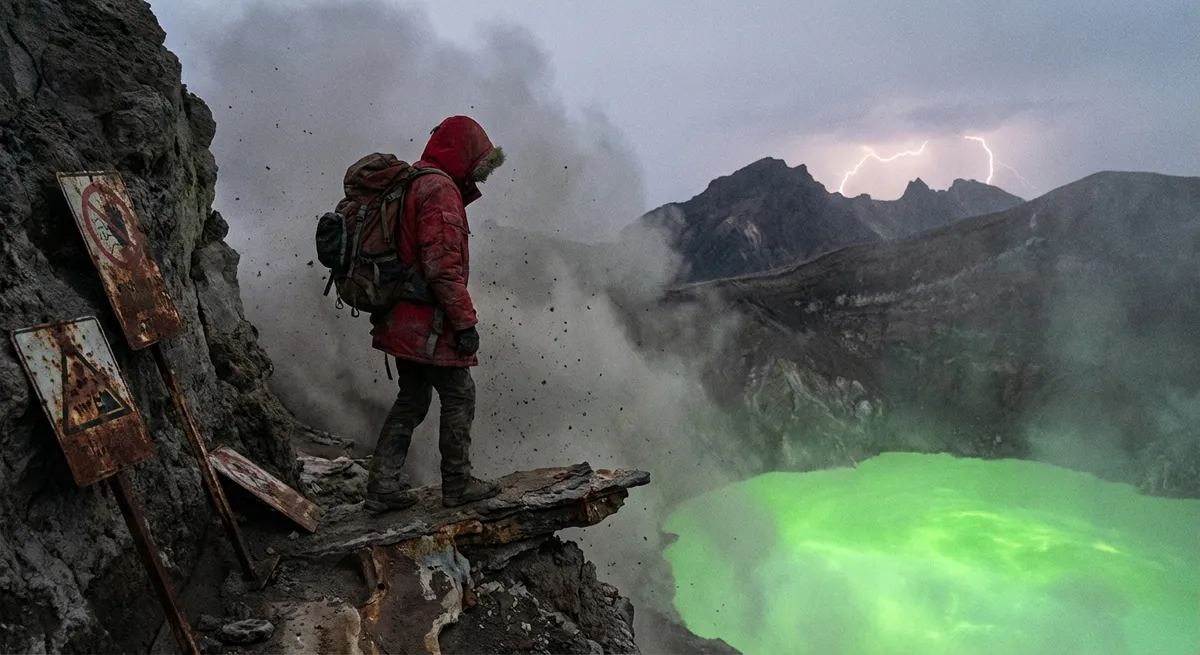
In volcanic regions like Indonesia, Central America, Iceland, and East Africa, there are places where you can camp or stay overnight near active or dormant volcanoes — close enough to watch red‑hot lava flows from a safe vantage (with local guidance), hear deep subterranean rumbles, or wake up to ash‑tinted sunrises over sulphuric craters.
Nothing about it feels stable. The ground is warm in weird places. Steam vents hiss like the Earth is muttering threats. Your gear smells faintly of brimstone. You lie awake wondering how often seismologists check their instruments and whether that last tremor was “normal.”
It’s not mindless thrill‑seeking; it’s choosing to exist, briefly, on the edge of a geologic mood swing. You’re camping inside the world’s operating system, watching it process data in magma and gas. And when lightning storms arc over a smoking crater at night, you stop thinking in Instagram captions and start thinking in “I will never be able to explain this properly to anyone at home.”
4. The Desert Where Your Sense of Direction Actually Breaks
Plenty of people “get lost” in cities and then find a café with Wi‑Fi. You can do better. Try desert traverse experiences where, for once, there’s nothing to navigate by except the sun, stars, and the slowly unraveling thread of your own confidence.
In places like the Sahara, the Atacama, the Arabian desert, or the Australian outback, guided multi‑day desert crossings strip travel down to its raw version: water, shade, movement, and not screwing up. Dunes repeat like broken code. Distances are lies; that ridge that looks 15 minutes away is an hour. You feel your body heat up from all sides. Your pack becomes an adversary.
You might travel by 4x4 for stretches, then hike or sand‑board or climb ridges. Nights are the payoff: sky so bright with stars it feels fake, temperatures dropping hard, firelight carving everyone’s faces into desert mythology. You understand why ancient cultures built religions out here — the landscape is so indifferent it feels divine.
The risk isn’t stunt‑level danger but accumulation: dehydration, disorientation, underestimating how fast conditions shift. That’s why you go with people who actually know what they’re doing. Your job is to confront the mental static that shows up when there are no buildings, no noise, and nowhere to hide from yourself.
5. Nearly Nowhere: Chasing the Farthest Edge of Human Infrastructure
Extreme travel doesn’t always mean vertical cliffs and avalanches. Sometimes it means chasing the edges of the grid itself — places where internet dies, roads turn speculative, and the idea of “next flight out” becomes theoretical.
Think remote archipelagos, Arctic or sub‑Arctic communities, high‑altitude plateaus, and isolated islands served by erratic ferries or tiny prop planes. You’re not going for resorts; you’re going for the last gas pump, the single store with unpredictable stock, the unofficial town mechanic who is also the bartender, mayor, and probably DJ.
Here, minor inconveniences become adventures: a storm cancels the only transport for three days; the map swears a road exists, but the locals just laugh; your “hotel” is someone’s spare room with six locks on the front door because the wind is absurd. There’s no “doing it for the ’gram” when there’s no signal and no one cares what you’re wearing.
What you get instead: the raw texture of a place that doesn’t bend around tourists. You learn to work with what’s there rather than demand what you’re used to. You adapt to short opening hours, single‑menu restaurants, and the idea that if something breaks, you fix it with whatever you can find — or you live without it.
In a world obsessed with being connected, choosing a place that can’t hear you is its own kind of extreme.
Conclusion
Extreme travel isn’t just about adrenaline; it’s about agreeing to lose control of the script.
You walk on ice that’s older than your language. You share midnight noodles with strangers on a train that may or may not be on time. You sleep under a volcano that occasionally coughs fire, cross deserts that erase your sense of scale, and push into places where the grid fades out and your improvisation skills switch on.
These aren’t vacations — they’re confrontations with the parts of the planet (and yourself) that don’t soften for visitors.
If your comfort zone is already boring you, consider that your sign. Pack light. Assume less. Go somewhere that does not care you arrived.
Sources
- National Park Service – Glacier Travel and Safety – Overview of glacier hazards and why proper guides/equipment matter
- Icelandic Meteorological Office – Volcanic Activity – Real‑world information on monitoring and risks around active volcanoes
- UNESCO World Heritage Centre – Volcanoes and Volcanic Landscapes – Background on notable volcanic regions and their significance
- NASA Earth Observatory – Deserts – Explains how deserts form and why conditions can be so extreme
- US Department of State – Traveler’s Checklist – Practical guidance on preparation and risk management for remote and challenging trips
Key Takeaway
The most important thing to remember from this article is that this information can change how you think about Extreme Travel.