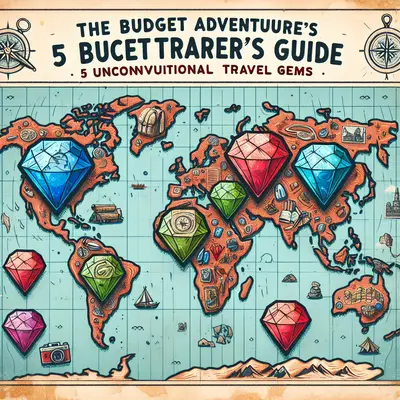
The world isn’t reserved for people whose credit cards never get declined. If your savings account looks like a horror film jump scare, this isn’t the end of your travel story—it’s the plot twist. Budget adventure isn’t about deprivation; it’s about audacity, timing, and knowing which corners of the planet give you the most chaos per dollar.
This is your field manual to five wild, wallet‑defying travel discoveries: places and tactics that feel way more “I must be rich” than “I ate instant noodles for three weeks to afford this.” Ready to make your bank app nervous?
Discovery #1: The Night-Train Time Warp (Sleep + Travel for the Price of One)
If you’re still paying for a bed and transportation separately, you’re basically tipping the universe. Overnight trains are the original budget cheat code: your bed is your vehicle, your commute is a moving movie, and sunrise is your curtain call.
Across Europe, Asia, and parts of Africa, night trains turn long distances into budget-friendly teleportation. Book a second-class sleeper or couchette instead of a private cabin, and you trade polished “luxury” for gritty magic: strangers sharing snacks, whispered stories, and that bizarre 3 a.m. moment when the train halts in the middle of nowhere and everyone silently questions their life choices.
Why it’s a game-changer for budget adventurers:
- You’re buying both transport and accommodation in one ticket.
- You arrive in the morning ready to explore instead of burning a full day sitting in transit.
- Night trains often connect to smaller towns your standard flight search never showed you.
Pro tip: In regions like Southeast Asia or Eastern Europe, book directly from rail company websites or at the station for the cheapest fares; third-party sellers often slap on convenience fees disguised as “magic.”
Discovery #2: The Skill-For-Shelter Swap (When Your Talent Becomes a Boarding Pass)
You don’t always need money to stay somewhere—you just need to be useful. The budget traveler’s secret economy is a global web of farms, hostels, sailboats, community projects, and creative spaces where beds are earned, not bought.
Think:
- Helping on an organic farm in exchange for a bunk and dinner.
- Teaching a language or leading yoga sessions at a guesthouse.
- Assisting on a small sailboat repositioning between islands.
- Photographing or shooting video for a local eco-lodge.
This isn’t dull “volunteering for a T-shirt” energy. Done ethically, it’s a deep dive into local life and an excuse to stay in places you’d never afford otherwise. It also turns “I can’t afford more than 3 nights here” into “I accidentally lived here for 6 weeks and now know the name of every street dog.”
Rules of the game:
- Get the deal in writing: hours, days off, meals, and type of work.
- Avoid anything that smells like replacing paid local jobs or unqualified “voluntourism” (like teaching without credentials where it’s not warranted).
- Quit immediately if the vibe shifts from “exchange” to “exploitation.”
Your passport might get you into a country, but your skills can keep you there long enough to actually live in it.
Discovery #3: Fringe-Festival Cities (Where Culture Explodes and Prices Implode)
Hunting for cheap thrills? Aim for cities right before or right after a major festival, not during. The days surrounding big cultural events are like aftershocks—cheaper than peak dates, but still buzzing with energy, leftover installations, and people who didn’t get the memo to go home.
In Europe, that might mean hitting a city the week after a famous arts or music festival. In Asia or Latin America, time your visit around local religious celebrations, food festivals, or seasonal holidays. You get:
- Street art, stages, and decorations still up but crowds thinned out.
- Discounted accommodation as prices dive back to normal (or below).
- Locals who are finally no longer in full survival mode and ready to talk, share stories, and maybe invite you to the “real” version of the festival next year.
- Research festival dates, then search flights + stays for 3–10 days before and after the core event.
- Look for secondary neighborhoods just off the main tourist drag—prices can drop by 30–50% with a 15-minute walk or one bus ride.
- Ask locals about “after-parties” or spin-off events; smaller, cheaper, weirder gatherings often pop up as the main festival dies down.
The trick:
You’re not just saving money; you’re catching a city in its emotional hangover—raw, unfiltered, and way more real.
Discovery #4: The Off-Season Borderlands (Where Two Countries Split the Bill)
Border regions—where two countries bump shoulders—are where budget travelers can get mischievous. Stay on the cheaper side, explore both.
These zones are filled with:
- Dual-identity towns where you can cross a river or a bridge and suddenly be in another language, currency, and cuisine.
- Price imbalances: one country’s “expensive” city is a short bus away from the neighboring country’s budget base camp.
- Wild, hybrid cultures that don’t show up in glossy brochures: mixed markets, blended food, and people who hop borders the way you cross a street.
- Find pairs of neighboring countries where one is significantly cheaper than the other (based on accommodation and food costs), then base yourself in the cheaper one.
- Use public buses, local taxis, or shared rides to cross over for day trips or short stays in the pricier country.
- Exploit different exchange rates, SIM card prices, and grocery costs—buy food and essentials where they’re cheaper, play tourist where you’d normally be priced out.
How to make it work:
You end up stitching together two different countries into one budget-friendly, cross-border experience—like hacking geography itself.
Discovery #5: The Ultra-Cheap City Safari (Turn Transit Systems into Adventure Rides)
If you treat urban transport like a necessary evil, you’re missing the cheapest adventure park on Earth. Buses, metros, ferries, and oddball local rides (hello, songthaews, jeepneys, tuk-tuks, and tro-tros) are where a city drops its guard and shows you its real face—for pocket change.
Instead of booking a pricey city tour:
- Pick a long bus or tram line that cuts across neighborhoods and ride it end-to-end.
- Get off wherever looks interesting: a chaotic market, a quiet side street, a random park full of people doing inexplicable exercise routines at sunrise.
- Swap from bus to ferry to metro, not to get somewhere “efficiently,” but to let the city carry you around like driftwood with a day pass.
- Transit passes often cost less than a single tourist-day ticket to a big attraction.
- You’ll see residential zones, industrial edges, local food courts, and hidden river banks that never show up in “Top 10 Things To Do” lists.
- Spontaneous stops = cheap food stalls, local cafés, weird street art, and occasional “how did I end up at this neighborhood festival?” moments.
Why this is especially magical for budget travelers:
Instead of “where should I go today,” ask: “Which line looks the longest and strangest?” Then swipe, sit, and surrender.
Conclusion
Your bank balance doesn’t get to decide how wild your stories are—only how creative you have to be in writing them. Budget adventure isn’t about standing outside a fancy hotel wishing; it’s about realizing the night train, the skill swap, the fringe-festival backstreets, the borderland bus, and the city tram are all doorways wide open to you right now.
The world isn’t asking if you can afford it. It’s asking if you’re willing to travel cleverly enough to crash the party anyway.
Sources
- Eurail Night Trains Guide - Overview of night train options and classes across Europe
- Amtrak Official Site – Overnight Travel Tips - Practical advice and examples of using overnight trains for combined transport and accommodation in the U.S.
- U.S. Department of State – Country Information - Reliable resource for checking safety and entry info when exploring border regions and offbeat routes
- Lonely Planet – Volunteering & Work Abroad - Discussion of ethical work/volunteer exchanges and considerations for travelers
- World Bank – International Comparison Program - Data on purchasing power and cost differences between countries, useful for planning cheaper bases near more expensive neighbors
Key Takeaway
The most important thing to remember from this article is that this information can change how you think about Budget Adventures.