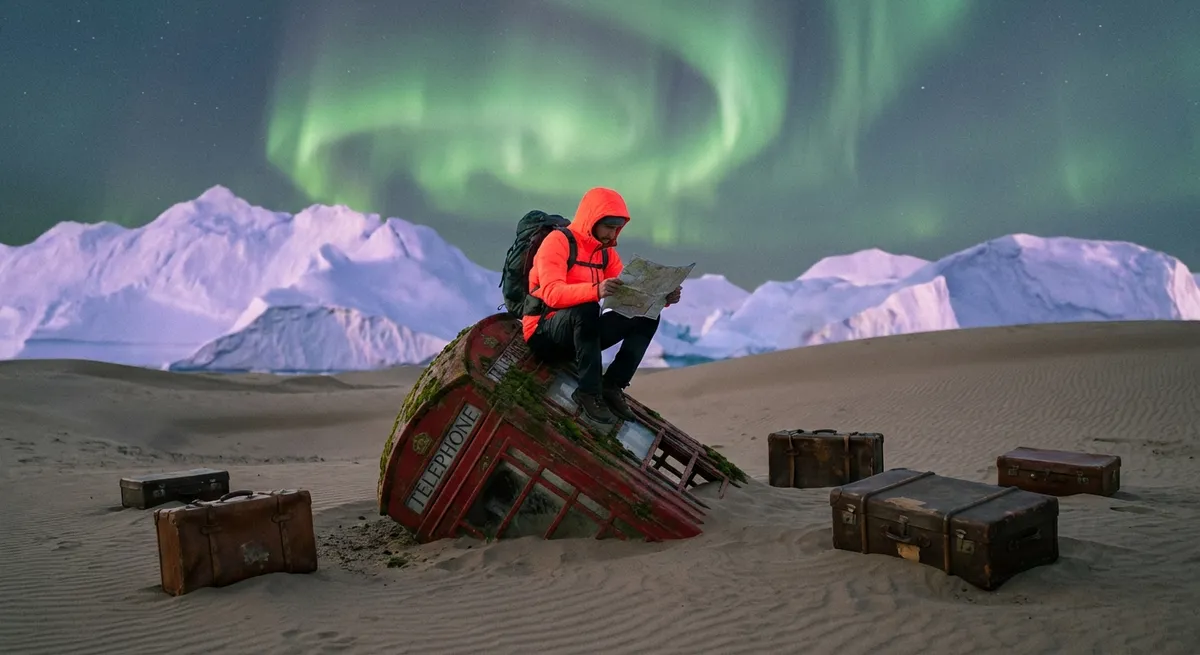
Some places don’t just sit on the map, they argue with it. They look wrong, feel improbable, and make your rational brain ask, “Who approved this?” That’s where No Way Travel thrives—on the seams between normal and “you sure this is allowed?”
These five weird destinations aren’t about cute quirks or Instagrammable murals. They’re places that feel like the universe mis-clicked, yet somehow left them running. Pack curiosity, pack skepticism, and maybe pack a backup exit plan.
1. The Town That Shouldn’t Exist on a River of Fire: Dallol, Ethiopia
If Mars opened a pop-up shop on Earth, it would be Dallol.
Dallol is a hydrothermal field in Ethiopia’s Danakil Depression, well below sea level and casually competing for “hottest inhabited place on Earth.” The landscape is an acid-colored fever dream: pools of neon green and yellow, salt chimneys, sulfurous steam, and crusts that look solid but sometimes aren’t. It’s not “pretty” in the conventional sense; it’s aggressively otherworldly.
There’s no strolling around solo here—this is guided-expedition territory. The air can reek of sulfur, the ground can be unstable, and temperatures laugh at your idea of “hydrated.” Yet, walking among mineral formations that look like they belong on another planet resets your sense of what Earth is capable of. It’s a live geology lab, still bubbling, still building, still trying to melt your shoes.
Ethically, you’re also traveling through the homeland of the Afar people. This isn’t some abandoned corner of the planet; it’s a harshly lived-in one. If you go, you go respectfully: with local guides, legitimate operators, and a clear understanding that you’re a guest on an edge where humans have learned to survive what most would call uninhabitable.
2. The Cathedral of Bones That Whispers About Time: Sedlec Ossuary, Czech Republic
Forget marble angels. How about a chandelier made of human bones?
In a small suburb of Kutná Hora, the Sedlec Ossuary looks like another old, slightly gloomy chapel—until you step inside and realize the décor is 40,000–70,000 human skeletons arranged into art. Skulls stack into pyramids, femurs line arches, and a full bone chandelier hangs from the ceiling like death’s own centerpiece.
It’s macabre, yes, but also strangely meditative. The bones mostly belong to victims of plagues and wars centuries ago. Rather than hide the remains, the ossuary turns them into a physical reminder that time steamrolls everyone. You don’t just look at mortality here; you walk through it, under it, and past it to the gift shop.
This isn’t a theme park in morbidity. It’s an active Catholic chapel and cultural heritage site. The weird part isn’t just the bones; it’s how normalized they are. School groups shuffle past tibias; locals might stop in for a quiet moment. The message is simple and heavy: you’re temporary—what are you doing with your time?
3. The Island That Forgets It’s an Island: Jindo Sea “Moses Miracle,” South Korea
Sometimes a sea just…steps aside.
Off the southwest coast of South Korea, between Jindo and the smaller island of Modo, a narrow land bridge briefly appears when the tide dramatically retreats. For a short window, the sea seems to split, revealing a path about 2.8 km long. It’s not a stable beachfront stroll; it’s a wet, rocky, temporary opening—part pilgrimage, part festival, part “I can’t believe this is happening.”
Locals call it the “Jindo Sea-Parting Miracle.” Maritime charts call it tide and topography doing their thing. Either way, walking the exposed path with thousands of others, as marching bands and traditional dancers light up the shoreline, feels like collaborating with nature’s backstage crew. You’re literally walking where, hours later, fish will be swimming.
The trick here is timing. The phenomenon only happens a few times a year, linked to the lunar cycle, and for less than an hour each time. Miss the window, and you’re just staring at a very normal-looking sea wondering if all the photos were staged. Catch it, and you’re standing in the middle of the ocean, land underfoot, water towering on both sides, wondering what other “miracles” are just physics plus patience.
4. The Rainbow Mountain That Looks Poorly Photoshopped: Vinicunca, Peru
Standing in front of Peru’s Rainbow Mountain, your first instinct is that someone overdid the saturation slider.
Vinicunca, also called Montaña de Siete Colores, stacks bands of reds, yellows, greens, and purples like geological lasagna. Those colors aren’t paint; they’re layers of sediment and mineral deposits squeezed and tilted by tectonic drama, then slowly revealed by erosion and retreating snow. The result is a mountain that looks like the terrain texture failed to load properly.
Reaching it isn’t a casual saunter. You’re above 5,000 meters (16,000+ feet), so altitude is not a theoretical concern—it’s a force that turns overconfident hikers into gasping statues. The hike itself isn’t technically hard, but the lack of oxygen is. You earn every meter of that view, and your lungs will file complaints.
The weirdness here isn’t just visual; it’s social. In a few years, Vinicunca has gone from remote to heavily touristed. Locals who used to mainly work with livestock now rent horses, sell snacks, and run stalls. You’re not “discovering” anything—you’re witnessing how quickly a place can shift once the internet decides it’s worth a detour. Go with humility, go slowly, and go with an operator who treats both the mountain and its communities as something more than a photo backdrop.
5. The Desert Playground of Vanishing Art: Seven Magic Mountains, Nevada, USA
In the empty Mojave desert, south of Las Vegas, seven towering stacks of neon-painted boulders stand in defiant color against the beige. They look like glitching Tetris pieces dropped from a rave in the sky.
This is Seven Magic Mountains, a land art installation by Swiss artist Ugo Rondinone. Each “mountain” reaches over 30 feet high, made from locally sourced boulders, all aggressively painted in electric hues. It’s weird because it doesn’t belong. The desert is a master of subtlety; this is an unapologetic highlighter stain.
At first, it was meant to be temporary, a short-lived experiment in contrast. Then people kept coming. And posting. And driving out just for 10 minutes of staring at fluorescent rock columns doing absolutely nothing. The project has been extended multiple times—an unintentional case study in how humans will travel far to stand in front of something that breaks the rules of its surroundings.
The odd tension: you’re in an environment defined by silence and slow erosion, visiting a human-made statement that might vanish again. It’s an invitation to think about how long anything you build really lasts—out here, the desert’s patience is the only permanent thing.
Conclusion
These places don’t fit neatly into “top 10 landmarks” lists or polite travel brochures. They’re geological glitches, historical confrontations, tidal stunts, and artistic interruptions—each one a reminder that the world is stranger than our itineraries usually allow.
If you chase anything, don’t make it just pretty views. Chase the landscapes that argue with your expectations, the sites that leave you slightly unsettled, the journeys that demand you show up fully awake. The map is full of weirdness hiding in plain sight; all you have to do is decide that normal is no longer your north star.
Sources
- UNESCO World Heritage Centre – Historic Centre of Prague (near Sedlec Ossuary region) - Background on the broader historical context of Czech heritage sites, including religious and funerary architecture
- Smithsonian Magazine – Dallol: The Hottest Place on Earth? - Explores the surreal environment and conditions in Dallol, Ethiopia
- Korea Tourism Organization – Jindo Sea Parting Festival - Official information on the sea-parting event, dates, and cultural context
- Peru Travel (Official Tourism Site) – Rainbow Mountain - Details on Vinicunca, its formation, altitude, and travel considerations
- Seven Magic Mountains – Official Project Site - Information on the land art installation, artist, concept, and visitor logistics
Key Takeaway
The most important thing to remember from this article is that this information can change how you think about Weird Places.