Most travelers ask, “Where should I go?”
You’re here asking, “What on this planet is even happening over there?”
This is not a comfort itinerary. This is a field manual for travelers who get bored the second a place becomes “iconic.” Below are five very real, very bizarre travel discoveries that feel less like destinations and more like reality glitches you can walk around in. None of them are headline-famous, but all of them will rewrite how you think about “seeing the world.”
1. The Desert That Refuses to Be a Desert (Lençóis Maranhenses, Brazil)
On the north coast of Brazil, there’s a stretch of white sand dunes so vast it looks like the Sahara got drop-shipped onto a humid coastline. By all logic, it should be a bone-dry desert. It isn’t.
Every rainy season, thousands of turquoise lagoons appear between the dunes of Lençóis Maranhenses National Park, filling with rainwater that has nowhere to drain. The result: a sci‑fi landscape of luminous pools and undulating white sand, like someone scattered Caribbean lagoons across the Moon.
You don’t “visit” this place; you traverse it. Local guides lead multi-day treks across the dunes where your sense of direction unplugs completely. You swim in random, unnamed lagoons that exist for a few months, then vanish. The sand is hot, the water is cool, and the horizon refuses to give you a fixed point to trust.
The weirdest part: it’s technically not a desert. There’s too much rainfall to qualify, despite the dune-sea aesthetics. It breaks the rules but in a quiet, Brazilian-coastal way. No neon signs, no resort sprawl—just an ecosystem that shrugs at your definitions and invites you to get lost on foot.
If you go, time it between roughly June and September when the lagoons are full. Skip the quick 4x4 tour and spend at least one night in the dunes. Stars, silence, and the unsettling feeling that the planet accidentally loaded the wrong texture pack here.
2. The Island That Spins Like a Time Machine (Svalbard, Norway)
Svalbard isn’t just “far north.” It’s where maps start to look uncertain and civilization shows up as a footnote. Technically Norwegian, culturally Arctic, spiritually its own planet.
Here, the sun plays psychological tricks. In summer, it never sets—just cruises around the sky in a lazy loop. At 2 a.m., it’s bright enough to read outside. In winter, the opposite: full polar night, with the sun refusing to show its face for months. Your body clock gives up trying. Time feels less like a line and more like a circle that someone dropped.
Longyearbyen, the main settlement, adds its own layer of odd:
- You’re legally required to carry polar bear protection outside town boundaries (yes, that means rifles… yes, it’s normal here).
- Many people are “temporary residents,” drifting in on work contracts and leaving before the place fully claims them.
- The ground is underlain by permafrost, so buildings are raised on pillars. Even the cemetery is effectively closed; bodies don’t decompose properly in the deep cold.
As if that wasn’t strange enough, Svalbard hosts the Svalbard Global Seed Vault, a literal backup drive for Earth’s agriculture buried inside a mountain. You can’t just walk in, but knowing it’s there—a climate-controlled archive of seeds from around the world, stored against future catastrophe—turns a simple hike into an accidental sci‑fi storyline.
Come here if you want to feel what it’s like when the concept of “normal day” loses all structural integrity. Sleep schedules are optional. Reality feels reversible. The world south of 70°N starts to seem suspiciously ordinary.
3. The Forest That Sounds Like It’s Breathing (Yakushima, Japan)
Yakushima is a subtropical island off the southern tip of Kyushu, Japan, but it doesn’t feel like part of any modern nation. It feels like someone preserved an ancient, moss-drunk forest inside a weather system that forgot how to turn off.
This island gets soaked. Some parts see rain on over 300 days a year. The result: a dense, dripping green cathedral of twisted cedar trees, ferns, and moss that muffles sound until you start to hear your own heartbeat. Mist pools in the valleys, slides over branches, and disappears just as you try to photograph it.
The star attraction is the yakusugi—absurdly old Japanese cedars. Some are over 1,000 years old; Jōmon Sugi, the most famous, is estimated to be thousands of years old, older than much of recorded human history. Trails wind past roots so huge you can step into them. Your sense of scale goes on strike.
The weirdness here isn’t loud. It sneaks up on your nervous system. Hours into a hike, the combination of constant moisture, shadowed trails, and ancient trees starts to warp your perception of time. “Today” feels irrelevant. You are hiking inside someone else’s timeline—the forest’s—and you’re just a brief glitch passing through.
This is not neon Tokyo or temple Kyoto. This is Japan’s mythic subconscious, still running in the background. If you like your travel with a side of existential re-calibration, Yakushima delivers.
4. The Beach That Behaves Like a Mood Ring (Jökulsárlón & Diamond Beach, Iceland)
On Iceland’s southeast coast, there’s a lagoon where icebergs break off a glacier, float slowly toward the sea, and then wash up on a black sand beach like alien gemstones. Locals call it Diamond Beach; it’s connected to the glacial lake Jökulsárlón.
The recipe is simple:
- Massive glacier (Vatnajökull) calves icebergs into a lagoon.
- Ice chunks get sculpted by waves and currents.
- The Atlantic hurls them onto volcanic black sand.
The result is a beach that reboots itself every hour. Clear ice hunks glow blue in cloudlight, others refract the sun like crystal, some turn milky white. Each visit is a new art installation, designed by no one and curated by physics.
Stand there long enough and you’ll notice something odd: the soundscape. The crackle of melting ice, the hiss of black sand shifting, the slap of waves against frozen blocks—this isn’t a normal beach soundtrack. It’s like listening to a glacier dissolve in slow motion.
What makes it truly weird is the timeline awareness. You are watching thousand-year-old ice break apart at your feet. Some pieces are small enough to pick up; others tower over you, studded with volcanic ash from eruptions older than your entire family tree. It’s beautiful and unsettling, like holding a ticking clock.
Visit in shoulder seasons if you can—late spring or early autumn—when there’s still plenty of ice but fewer sightseers. Walk farther along the beach in either direction; the crowds thin and the place turns from “famous photo spot” to “end-of-the-world physics lab.”
5. The Cave That Reverses Your Sense of Planet Scale (Son Doong, Vietnam)
So you think you understand what a cave is: dark, cramped, echoey, maybe some stalactites if you’re lucky. Son Doong in central Vietnam laughs at that definition and then eats it.
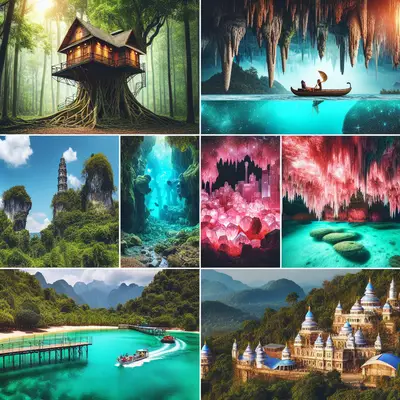
Son Doong Cave is, by volume, the largest known cave on Earth. It’s so vast that it has its own weather system inside. Clouds form under the roof. Forests grow in collapsed sections where sunlight punches through the limestone. Rivers run along the floor. You walk in expecting “underground” and end up standing in a valley with jungle, mist, and cliffs—all inside the cave.
The spatial dissonance is intense. Your head tries to label things—“tunnel,” “room,” “chamber”—and gives up. At some points, the cave ceiling is over 200 meters high. That’s skyscraper territory. Camp at the base and your tent looks like a toy someone dropped into a cathedral.
Because of conservation efforts and safety, access is limited and expensive, and you need to go with authorized expedition operators. This isn’t a casual detour; it’s a commitment. Multi-day trek, rivers to cross, technical guidance required. But that’s part of what keeps the place strange: it hasn’t been tamed into a theme park.
Inside Son Doong, you stop feeling like a traveler and more like a misplaced character from a planet-exploration film. Your sense of what Earth “normally” looks like gets reprogrammed. After this, small talk about “nice views” will feel hilariously underqualified.
Conclusion
The world is full of places that look good on postcards. These aren’t those.
Lençóis Maranhenses erases the border between desert and lagoon. Svalbard bends time until day and night lose meaning. Yakushima quietly dissolves your sense of “now.” Diamond Beach lets you hold thousand-year-old ice while it dies in your hands. Son Doong flips the inside of the planet outward until you forget which way is “up.”
You don’t chase spots like these to check them off a list. You go because they make the familiar world feel suspicious again—in the best possible way. If your compass is set toward the uncanny, these are not just destinations; they’re invitations to re-learn what a planet can be.
Sources
- Brazil’s Lençóis Maranhenses National Park – UNESCO World Heritage Centre - Background on the unique dune-lagoon ecosystem and its World Heritage status consideration
- Governor of Svalbard – Norwegian Government - Official information on Svalbard’s geography, climate, and regulations (including polar bear safety)
- Yakushima World Heritage Site – Japan National Tourism Organization - Overview of Yakushima’s ancient cedar forests, rainfall, and conservation status
- Vatnajökull National Park – Government of Iceland - Details on Jökulsárlón glacial lagoon, Diamond Beach, and glacial dynamics
- Son Doong Cave – National Geographic - In-depth exploration of Son Doong’s size, internal ecosystems, and expedition logistics
Key Takeaway
The most important thing to remember from this article is that this information can change how you think about Weird Places.