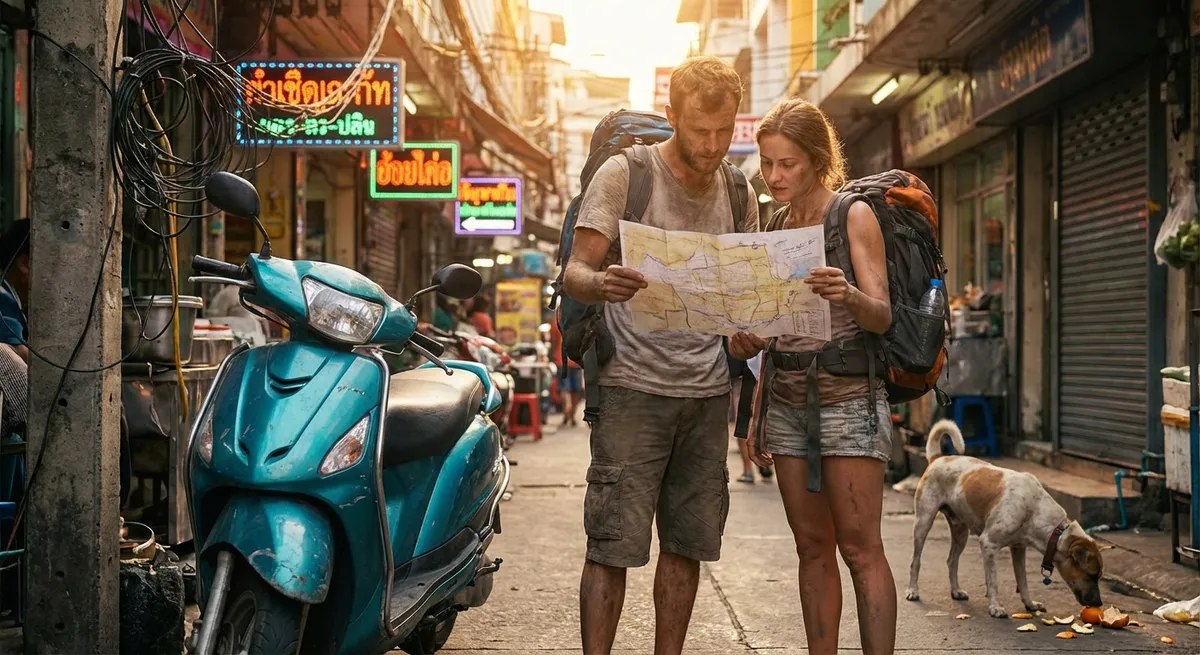
Travel gets interesting the moment your plans fall apart and your budget laughs in your face. This isn’t about ticking off “top 10 attractions” you found on page one of Google. This is about riding the cheapest bus to the end of the line, following the weird smell of street food into an alley, and finding something you can’t believe isn’t in any guidebook. If your wallet is light but your curiosity is loud, these low-cost, high-weirdness discoveries are your new playground.
Why Being Broke Is a Superpower (If You’re Brave Enough)
Big money buys comfort. Small money buys stories.
When you don’t have the cash to autopilot your trip with Uber rides, rooftop cocktails, and boat tours “with prosecco included,” you’re forced into the stuff that actually makes a place real: insomnia-level street markets, too-loud night buses, $2 haircuts from a barber who wants to talk politics. Budget pressure pushes you toward public transport, local food, and genuine human chaos—which is exactly where adventures live.
The trick is flipping your mindset: instead of asking “What can I afford?” ask “What can I hack?” Staying somewhere with a kitchen means grocery-store anthropology. Using local buses means a front-row seat to everyday life. And skipping the hyper-curated “experiences” opens up the much messier, much better experiences nobody is selling.
None of this is about suffering; it’s about trading polish for presence. The less you spend, the more you have to notice. And noticing is where travel actually begins.
Discovery #1: The 24-Hour Cities That Start After Your Bedtime
Some cities have a secret second life that budget travelers accidentally unlock because night buses are cheaper than hostels.
Think of places where the real action kicks off when respectable people are brushing their teeth: late-night food markets in Southeast Asia, 24-hour bakeries in Eastern Europe, sunrise fish auctions in port cities. When your budget pushes you into weird hours—overnight trains, dawn check-ins, red-eye flights—you get access to a parallel universe: stalls setting up, temples sweeping their steps, delivery drivers loading half the city into three-wheelers.
You don’t need bottle service or a club wristband; you need comfortable shoes and a sense of mischief. Loiter respectfully around transport hubs, markets, docks, and 24-hour eateries. Ask taxi drivers and street vendors where they eat when they get off work. These are the places where you’ll find the cheapest, best food—and the most unapologetically local energy.
Night is when cities let their guard down. It’s also when the price of food, transport, and accommodation often drops. Stay awake for it, and your budget stretches like jet lag.
Discovery #2: Abandoned Spaces That Cost Nothing and Feel Illegal (But Aren’t)
Most people pay for tickets to curated “attractions.” Budget travelers go hunting for the stuff that’s been left behind.
All over the world, there are disused rail lines turned into walking paths, abandoned factories repurposed as street-art galleries, and ghost infrastructure—ruined piers, silent grain silos, forgotten hillside forts—sitting wide open and free. They’re not secret, exactly; they’re just not packaged. You’re walking inside yesterday’s big idea, and there’s something weirdly thrilling about that.
Start by searching terms like “urban exploration,” “rail trail,” or “industrial heritage walk” plus the city or region you’re visiting. Many countries now officially protect and signpost old industrial sites and rail lines as cultural or hiking routes. When they’re legit, they’re usually safer and legal—no trespassing, no drama, just atmospheric ruins and strange views.
Wandering through yesterday’s infrastructure on today’s budget is like time travel for the price of a bus ticket. Bring a flashlight, a snack, and a healthy respect for “do not enter” signs.
Discovery #3: Hyper-Local Food Rituals Hidden in Plain Sight
You don’t need a food tour when the whole city is one, and your ticket is small coins and a reckless palate.
Every region has some food ritual that’s low-cost but high-theater: workers’ breakfast joints that open before dawn, night-only soup carts that vanish by sunrise, weekly markets where farmers show up with exactly three products and absolute conviction. These aren’t “must-eat spots”; they’re “this is how people actually fuel their lives” spots.
Your mission: chase the lines, not the reviews. If you see a crowd of locals forming around something—steam, smoke, shouting, plastic stools—go stand in it. Point, smile, ask “what’s good?” and commit. Some of the most unforgettable meals are the least Instagrammable: mismatched bowls, wobbly tables, fluorescent lights that make everything look vaguely haunted—and food so fresh and cheap it feels like cheating.
To find them, skip the glossy restaurant roundups and look for coverage of street food, markets, and traditional dishes in local blogs or regional newspapers. Then go analog: ask your hostel owner, bartender, or barber, “Where do you eat when you’re broke and hungry?” That’s your gold.
Discovery #4: Free Borders—Where Cultures Collide Without an Entry Fee
Some of the strangest, richest budget adventures happen not in cities or sights, but in the seams between countries and regions.
Border zones, tri-point markers, and frontier towns are often a mix of languages, currencies, and loyalties smashed into one messy, fascinating stew. They tend to be cheaper than capital cities and far more improvised. One street might serve three different national cuisines; one bus station might shout directions in two or three languages.
Many parts of the world have visa-free movement agreements or open borders where you can literally walk from one culture to another, no drama. That means you can ride a local bus to the edge, wander across on foot, and have coffee, snacks, or even a whole day trip in a completely different legal reality—without paying for a long-haul flight.
What you get for almost nothing: colliding traditions, overlapping markets, and people who are casually multilingual because they have to be. It’s geography in motion, and it feels far more “abroad” than most polished tourist districts.
Discovery #5: Micro-Festivals and Weird Little Celebrations the Internet Forgot
The biggest festivals are expensive and crowded. The small ones are scrappy, cheap, and utterly unhinged in the best way.
Almost every town, parish, neighborhood, or village has some hyper-local celebration you’ve never heard of: a harvest ritual, a saint’s day, a seasonal parade, an all-night concert in a courtyard, a local sports rivalry that borders on religious. These events usually aren’t designed for outsiders—which is why they can be so magical if you show up humble and curious.
Your research hack: instead of looking up “best festivals in [country],” search in the local language for “program,” “calendar,” “fiesta,” “festival,” “cultural center,” or “events.” Check community boards, city hall pages, and local arts organizations. Budget-wise, these things are an absolute bargain: free to attend or very cheap, with street food and drinks priced for locals, not tourists.
You might find yourself sharing homemade liquor with grandmas, watching improvised fireworks that 100% wouldn’t pass safety checks elsewhere, or joining a dance you don’t know the steps to. It feels like trespassing into someone’s family reunion—except you’re welcome, as long as you’re respectful.
How to Build Your Own Low-Budget, High-Strangeness Itinerary
Forget perfectly timed hour-by-hour plans. Budget adventure is more like a scavenger hunt you rig in your own favor.
Pick a cheap base: somewhere with public transport, a market, and at least one late-night food option. From there, chase patterns instead of landmarks:
- Ride public transit to the end of the line.
- Walk wherever you see people but not tour buses.
- Follow the sound of music, chanting, or sports commentary.
- Drift toward markets, waterfronts, parks, university neighborhoods, and train tracks.
Layer in three questions for almost everyone you meet:
“Where do you go when you want to eat something good but cheap?”
“Is there anything interesting happening this week that tourists usually miss?”
“If I got off at the wrong stop, where would you tell me to wander?”
You’ll come home with stories that start with “So I got on the wrong bus…” instead of “Like everyone else, I went to…” And those, in the end, are the stories worth telling.
Conclusion
Budget adventure isn’t a downgrade from “real” travel—it’s the unsanitized version. With less money, you’re forced into the friction points: odd hours, outer neighborhoods, leftover spaces, messy festivals, hybrid borderlands. That’s where the world stops acting like a performance and starts being itself.
If you’re willing to get lost cheaply—on foot, on buses, in side streets and side quests—you’ll find the discoveries that don’t fit in a brochure. The map says you’re here. Your instincts say, “Take the next wrong turn.”
Listen to your instincts.
Sources
- World Bank – International Tourism Expenditures - Provides global context on how much travelers typically spend, useful for understanding how budget travel compares to average tourism costs
- UNWTO – Tourism and Culture Synergies - Explores how travelers interact with local culture, markets, and festivals, supporting the idea that informal, local experiences are core to meaningful travel
- U.S. National Park Service – Rails-to-Trails & Historic Railroads - Example of how abandoned and historic rail lines become low-cost walking and cycling routes, echoing the “abandoned spaces” style of exploration
- European Commission – Schengen Area - Explains how open internal borders work in Europe, illustrating how travelers can cross frontiers cheaply and experience borderland cultures
- BBC Travel – The Secret Life of Night Markets - Offers insight into late-night street food culture and markets, resonating with nocturnal, budget-friendly city exploration
Key Takeaway
The most important thing to remember from this article is that this information can change how you think about Budget Adventures.