If you’ve glanced at a newsfeed this week, you’ve probably seen Bali again—but not for surf breaks or smoothie bowls. Adult content creator Bonnie Blue is suddenly facing a potential 15‑year sentence after allegedly filming explicit videos on the island in violation of Indonesia’s strict anti‑pornography laws. It’s a brutal reminder: paradise still has rules, and “do it for the content” can end very badly when you don’t respect the country you’re walking into.
But here’s the twist: the same Bali that’s chewing up reckless creators is also quietly rewarding travelers who move differently—those who don’t need to turn every temple into a thirst‑trap and every rice terrace into a backdrop. If you’re willing to go low‑key, unplugged, and ultra‑respectful, entire hidden worlds open up—on Bali and far beyond.
This isn’t a list of “best beaches” or “top photo spots.” This is where you go when you’re done performing your trip and ready to actually live it.
A Volcano Temple You Hike to in the Dark (Bali, Indonesia)
While headlines circle around Bonnie Blue’s Bali legal mess, the island’s quieter spine—its volcanic highlands—barely gets a whisper. Everyone knows Mount Batur, but slip away from the standard sunrise convoy and aim for the lesser‑known Pura Luhur Batukaru region, wrapped around Bali’s second‑highest peak, Mount Batukaru. It’s one of the island’s most sacred zones, and it hums at an entirely different frequency than the influencer‑saturated south.
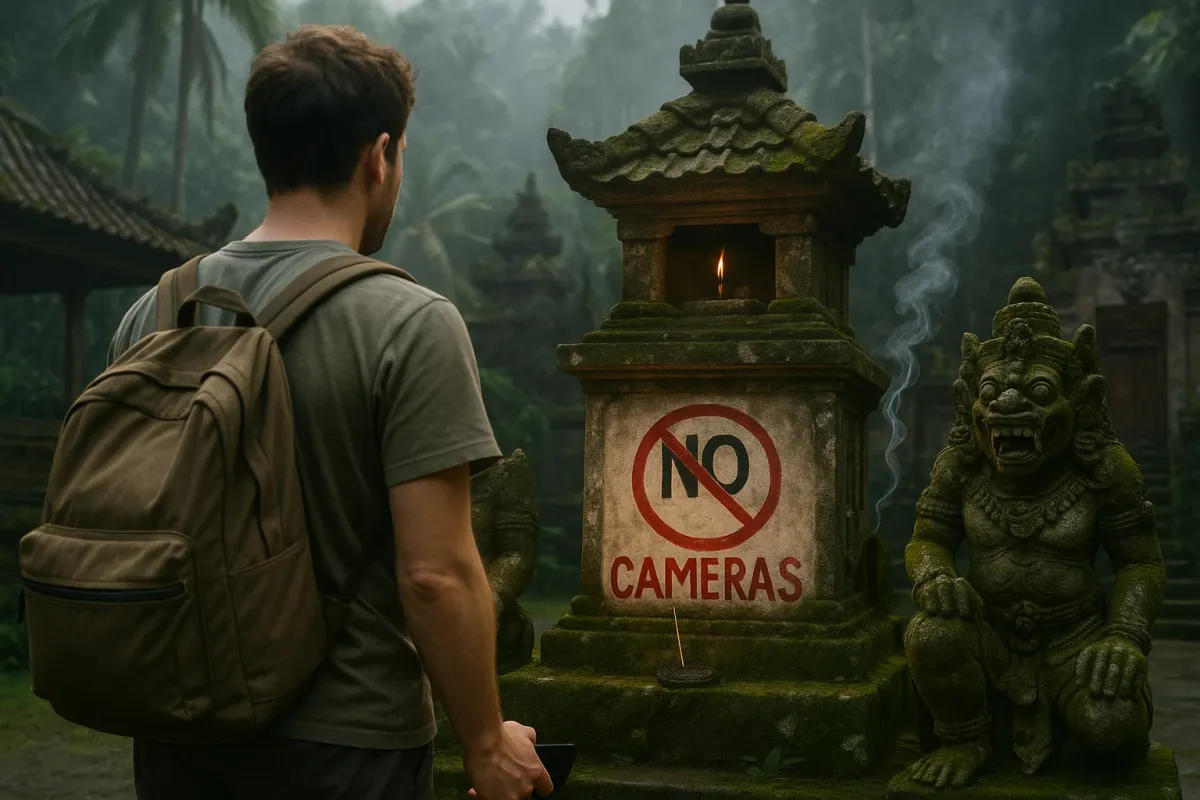
You leave before midnight from a homestay in the foothills, hiking by torchlight through spice‑thick jungle, guided by a local who probably has better night vision than your camera ever will. There are no neon hiking poles, no drone swarms—just a mud trail, cicadas, and the occasional temple dog who decides you’re now in his personal expedition crew. A side path leads to a mossy cluster of shrines that never make it onto TikTok because they’re not supposed to; this is living Hindu worship, not a set.
By the time the sky thins from black to cobalt, you’re standing above clouds that look like they’ve been copy‑pasted from an old screensaver. Instead of ring lights and scripted “OMG sunrise” reactions, it’s just your heart thudding in your ears and the faint clang of a temple bell drifting up from somewhere deep below. You don’t film this place. You don’t stage it. You just stand there, dripping sweat, breathing cloud, and realize Bali isn’t a playground—it’s a living religion you’re lucky to witness.
A Silent Surf Village Where the Wi‑Fi Gives Up (Sumbawa, Indonesia)
Bali’s content scandal is partly a symptom of its own success: too many people chasing the same fantasy on the same small island. If your instinct is to run from the crowd, point your compass east and keep going—past Lombok, past the party islands—and slip onto Sumbawa, where the waves still break for riders, not cameras.
Tucked away along its southern coast are fishing villages like Hu’u and Lakey Peak, where reef breaks peel off in front of warungs that still serve coffee in chipped glasses. You wake up to the sound of roosters and motorbikes, not beach clubs. The local kids surf barefoot on sun‑bleached boards that look like they’ve survived three lifetimes, and they’ll happily out‑paddle you on any given day. Nobody cares what brand of boardshorts you’re wearing; everyone cares that you share the lineup and the reef with respect.
There are guesthouses run by families who will ask you about your parents before they ask you for your passport. Electricity might flicker, and the Wi‑Fi will absolutely rage‑quit on you when the wind picks up—forcing you offline and into the present. Sunset is a communal appointment: surfers, fishermen, and stray dogs all lining the shore to watch the sky burn down into violet and ash. The only thing going viral here is your sunburn.
A Deserted Sculpture Park the Algorithm Forgot (Guimarães, Portugal)
While the internet is busy circulating lists of the “world’s most unbelievable public sculptures,” Portugal is quietly hiding an outdoor gallery that feels like it fell out of somebody’s surreal daydream—and then got left off every major list by mistake. On the fringes of Guimarães, far from the main tourist spell of Porto and Lisbon, you can stumble into a woodland scattered with contemporary sculptures that nobody’s really shouting about online.
There’s no grand gateway, no ticket booth—just a network of trails where modern art has been dropped like breadcrumbs for the curious. One path takes you past a giant fractured head emerging from the ground; another leads to angular metal forms that slice the fog when it rolls in off the hills. On slow weekdays, it’s entirely possible you’ll have the place to yourself, wandering among installations that look like they’ve been staged for a fashion shoot that never happened.
What makes it a hidden gem isn’t just the work—it’s the silence. There are no selfie queues, no over‑produced reels, no “here’s how to pose with this statue” threads. Just you, the sculptures, and the rustle of leaves. You can sit on a mossy bench and sketch, write, or do nothing at all, knowing that somewhere out there a post about “50 Sculptures Around The World” is trending—and this forest isn’t in it.
A Ghost Train Line Turned Jungle Trail (Chiang Mai Province, Thailand)
While social media obsesses over “unexpected things people found,” northern Thailand has its own treasure: an entire abandoned railway project that never made it past the blueprint phase, leaving behind half‑finished bridges, overgrown embankments, and tunnels slowly being eaten by the jungle. The locals in certain pockets of Chiang Mai province still talk about the “ghost line” that was meant to connect remote communities—and then just… stopped.
You can hike portions of the old route with a local guide who knows which bits are romantic decay and which bits are structurally unsound nope. One minute you’re following a faint track bed along a ridge, the next you’re crawling through a short, hand‑carved tunnel dripping with stalactites, your headlamp beam swallowing columns of dust. Vines coil through rusted rebar; old concrete pylons jut out of the undergrowth like the bones of a giant animal.
Every so often, you stumble across evidence of how close this line came to existing: survey markers, a forgotten signpost, a length of track half‑buried in red earth. It’s a parallel world where modern Thailand chose a different timeline—then abandoned it mid‑sentence. No entrance fees, no interpretive plaques, just a quiet, eerie sense that human ambition never quite wins against jungle patience.
A Night Market That Doesn’t Care You’re There (Ambon, Maluku Islands, Indonesia)
While Bali’s tourism scene is under the microscope, the Maluku Islands—once the legendary Spice Islands—are barely in the global conversation. Fly into Ambon, walk away from the waterfront bars, and ask for the local night market, not the one edited for postcards. You’ll know you’re close when the air gets dense with clove smoke and sizzling fish.
There are no English menus and zero curated “foodie” corners. Vendors shout over crackling oil, skewering octopus, frying breadfruit, grilling fish so fresh it might still be negotiating with Poseidon. Plastic stools are optional; sometimes you just sit on the curb with your plate balanced on your knees, sweating in the humid dark next to office workers, students, and dockhands who are here to eat, not perform dinner.
You become wonderfully invisible—just another hungry human trying to juggle sambal heat and the molten interior of something fried five seconds ago. A vendor might pull you into a conversation using three words and a lot of laughter, then hand you a dish you can’t name but will dream about later. This is the opposite of curated Bali brunch culture: nothing styled, nothing sanitized, everything real. When you leave, you smell like smoke and cloves and fish and joy—and none of it fits neatly into a square frame.
Conclusion
This week’s Bali scandal is a loud, messy reminder that the world is not your personal film set. Every hidden gem on this planet comes with its own rules, rhythms, and red lines—and the real adventure is learning to move inside them without turning everything into content.
If you’re willing to hike in the dark without posting, surf waves nobody’s named yet, get lost in sculpture forests the algorithm ignored, follow ghost railways into the green, and eat at markets that barely register you—you unlock a different level of travel. Less performance, more presence. Less “look at me,” more “listen to this place.”
The world doesn’t owe you a perfect shot. But it has endless secret chapters for travelers who know when to put the camera down and let the story happen.
Key Takeaway
The most important thing to remember from this article is that this information can change how you think about Hidden Gems.