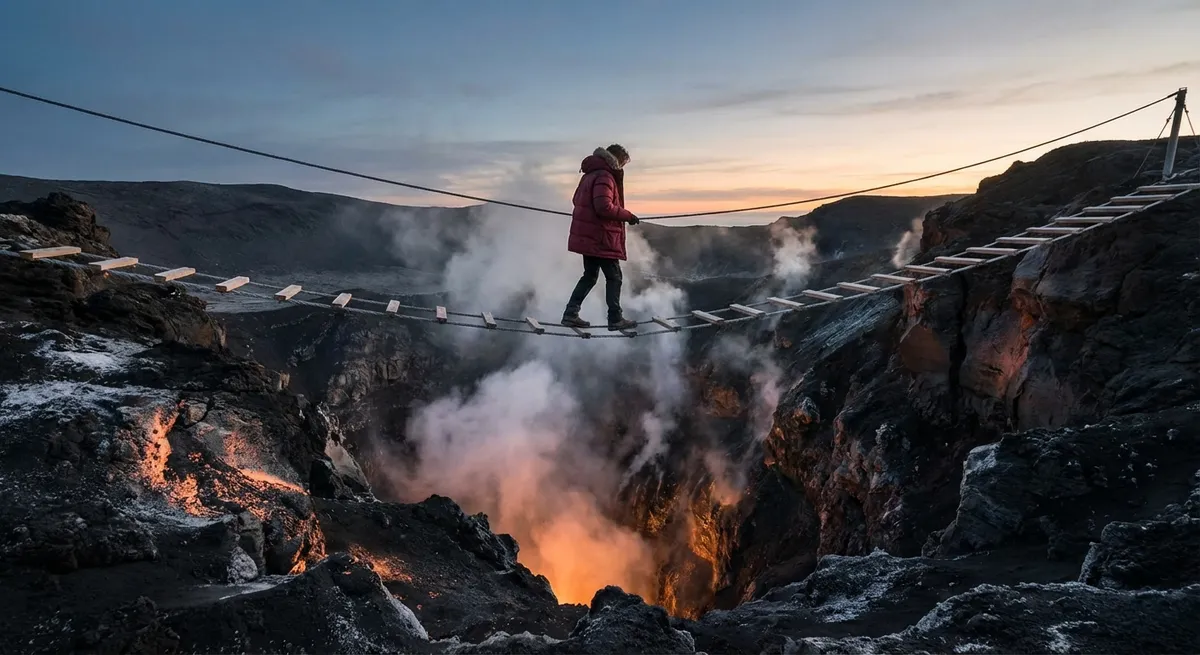
Some trips give you postcards. Others rewire your survival instincts. Extreme travel lives in that deliciously uncomfortable space where your lizard brain screams “Nope” while the rest of you books the ticket anyway. This isn’t about staged danger or sanitized “adventure packages.” This is about chasing the edges—places where the planet still feels wild, rules are flexible, and comfort is a negotiable concept.
These five travel discoveries aren’t for spectators. They’re for the people who pack a headlamp, a backup headlamp, and still walk toward the only unmarked trail.
1. Volcano Front-Row Seats: Sleeping on the Fire Line
There’s a special kind of silence you only hear standing on the lip of an active volcano: a heavy, low roar under your feet and the constant hiss of a planet exhaling. If your idea of “extreme” is more lava than lounge chair, welcome to the fire line.
In places like Guatemala’s Pacaya or Indonesia’s Mt. Bromo, you can hike into landscapes that look like sci‑fi movie sets—ash plains, steaming vents, and crater rims that glow at night like some underworld nightclub. The air tastes like metal and smoke, and your boots crunch on rock that was liquid rage not long ago. With licensed guides and strict rules, you can trek close enough to feel the heat slap your face when the wind changes.
If you want to go even harder, certain regions offer multi‑day trekking around active volcanic chains. You’ll sleep in basic shelters or tents, wake up sore and ash-dusted, and watch the sunrise from slopes that could erupt within your lifetime. This isn’t mindless risk; it’s calculated awe. You learn to read cloud shapes, check seismic updates, and respect closed zones like your life depends on it—because it does.
Volcano travel is the purest reminder that Earth is not finished, not stable, and not remotely under our control. Going there isn’t about tempting fate; it’s about accepting that you never ran the show to begin with.
2. Storm-Chasing Road Trips: Racing the Sky’s Mood Swings
Most travelers flee bad weather. Extreme travelers study the radar, fill the gas tank, and drive straight at it.
In the central United States and parts of Australia and Europe, storm-chasing has evolved from a fringe obsession into a niche form of adventure travel. You pile into a van with meteorologists, guides, and a bunch of people who think “supercell” is a love language. Instead of seeking sunshine, you scan the horizon for rotating clouds and listen to radio chatter about wind shear and dew points.
The adrenaline hits not because you’re in danger every second, but because you’re riding the edge of a moving, chaotic system. One moment blue sky, the next a wall of charcoal cloud spooling itself into a column. Sometimes you watch lightning stitch the sky horizontally for miles; sometimes you hear hail hammer the car roof while your guide calmly says, “We’re going to reposition.”
Days can be long, anticlimactic, and spent chasing forecasts that fizzle. But when it all lines up—when a storm spins itself into a living tower of rotating cloud—you feel like you’re standing in a cathedral built from atmosphere and electricity. The trick is knowing when to watch, when to retreat, and when to accept that nature doesn’t perform on your schedule.
This is not your average road trip; it’s a days-long game of “don’t get crushed by hail” mixed with science class and existential dread. And yet, many who try it once come back, unable to return to normal weather ever again.
3. Ice-Locked Frontiers: Learning to Function Where Everything Freezes
Cold is a filter. It strips away distraction, weakness, and any illusion that you’re in charge. Extreme travelers don’t just visit wintry landscapes; they commit to them—sleeping, hiking, and sometimes skiing across places where exposed skin is a tactical error.
In polar or high-arctic regions, “going outside” means gearing up like you’re leaving a space station. You learn that ice has a thousand textures and sounds, that snow can hide crevasses big enough to erase you, and that a crackling aurora overhead can make you forget your fingers stopped cooperating ten minutes ago. Basic tasks—boiling water, pitching a tent, buckling a strap—become mini survival puzzles at -30°C.
Multi‑day expeditions over ice caps or winter mountain ranges are exercises in meticulous risk management. You’re counting calories, checking frostbite, sharing body heat, and trusting your team to notice when you’re moving slower than you should. Somewhere between the frozen eyelashes and numb toes, you cross a threshold: you stop fighting the cold and start flowing with it.
The reward is access to a world that feels almost alien—blue ice caves glowing from within, endless white horizons broken by jagged peaks, and nights so clear you can hear your own breath echo inside your hood. It’s not comfortable. It’s not meant to be. But once you realize you can function out there, the rest of life feels strangely… temperate.
4. Vertical Obsession: Living Life on the Wall
For most people, cliffs are boundaries—places to stop, look over, and back away. For vertical addicts, they’re invitations.
Big-wall and multi‑pitch climbing turn rock faces into multi-day playgrounds. Instead of finishing your route and heading down for a beer, you sleep on the wall itself, in a portaledge hammered into a blank vertical slab. Your bed sways in the wind a few hundred meters off the deck, your bathroom is a system of bags you really, really double-check, and dropping your headlamp becomes a full-blown tragedy.
The game here isn’t speed; it’s commitment. You and your partner (or team) move methodically upward, hauling gear, problem-solving each pitch, and managing fatigue while gravity does its passive-aggressive thing below. Weather isn’t a background detail; it’s a potential evacuation notice. A sudden storm can turn rock into a waterfall and your portaledge into a panic chamber.
But the payoff is surreal: waking up inside a vertical world before the sun hits the valley floor, cooking breakfast with your legs dangling over empty air, and topping out onto a summit after days of living on the edge—literally. You learn to be comfortable with exposure, to trust tiny anchors and your partner’s judgment, and to accept that control is a shared hallucination between you and your gear.
Extreme? Absolutely. Reckless? Not if done right. The climbers who last tend to be almost boringly careful, practicing systems until they’re second nature—because on the wall, you don’t rise to the occasion; you fall to the level of your preparation.
5. Decompression Zones: Descending into Alien Underworlds
If space is the final frontier, the deep ocean is the one laughing quietly in the dark, waiting. Extreme travelers with a taste for water turn that laugh into a call.
Technical and deep diving swap out the colorful coral clichés for something stranger: shipwreck graveyards, underwater caves, and cold, murky depths where sunlight gives up early. You descend with redundant air supplies, multiple computers, and a checklist that would make pilots jealous. Here, the danger isn’t obvious drama; it’s quiet math—gas mixtures, ascent rates, decompression stops.
In cave systems and overhead environments, there is no “straight up” escape. Lines guide you through flooded tunnels the width of your shoulders, past silt that will blind you if you kick too hard. In wrecks, twisted metal frames become both playground and trap. Your world shrinks to the beam of your torch, the hiss of your regulator, and the comforting line of your buddy’s fins in front of you.
It sounds claustrophobic, and for some people it absolutely is. But for others, it’s hypnotic. Weightless, muted, and suspended in a world almost no one sees, you realize that Earth has more hidden rooms than any of us were taught. Surfacing after a long dive feels like switching planets—gravity hits, sound returns, and your brain tries to reconcile the memory of silent steel corridors with the sun on your face.
Mastering that environment isn’t about bravado; it’s about system thinking, humility, and rehearsed calm. You don’t muscle through a problem at 40 meters; you breathe through it. Extreme travel doesn’t always mean going harder. Sometimes it means going slower, deeper, and quieter than you ever thought you could.
Conclusion
Extreme travel isn’t one specific destination—it’s a decision to keep stepping toward the places where your instincts stutter. Volcano rims, storm alleys, ice deserts, vertical worlds, and underwater labyrinths all have the same gravitational pull: they remind you that you’re small, mortal, and lucky to be here at all.
If you go, go prepared. Train like you’re fragile, plan like everything can fail, and then show up ready to be astonished. The point isn’t to cheat death; it’s to brush up against the raw edges of being alive and walk away changed.
The world still has thresholds waiting. The only question is how close you’re willing to stand.
Sources
- US Geological Survey – Volcano Hazards Program – Authoritative information on active volcanoes, monitoring, and safety considerations
- National Severe Storms Laboratory (NOAA) – Storm Spotters Guide – Background on severe storms and storm behavior that underpins safe storm-chasing practices
- British Mountaineering Council – Winter & Alpine Skills – Guidance on cold-weather mountaineering, avalanche awareness, and risk management
- American Alpine Club – Climbing Safety & Accidents – Real-world case studies and safety analysis for vertical and big-wall climbing
- Divers Alert Network (DAN) – Decompression & Dive Safety Resources – Evidence-based information on decompression, dive medicine, and technical diving risks
Key Takeaway
The most important thing to remember from this article is that this information can change how you think about Extreme Travel.