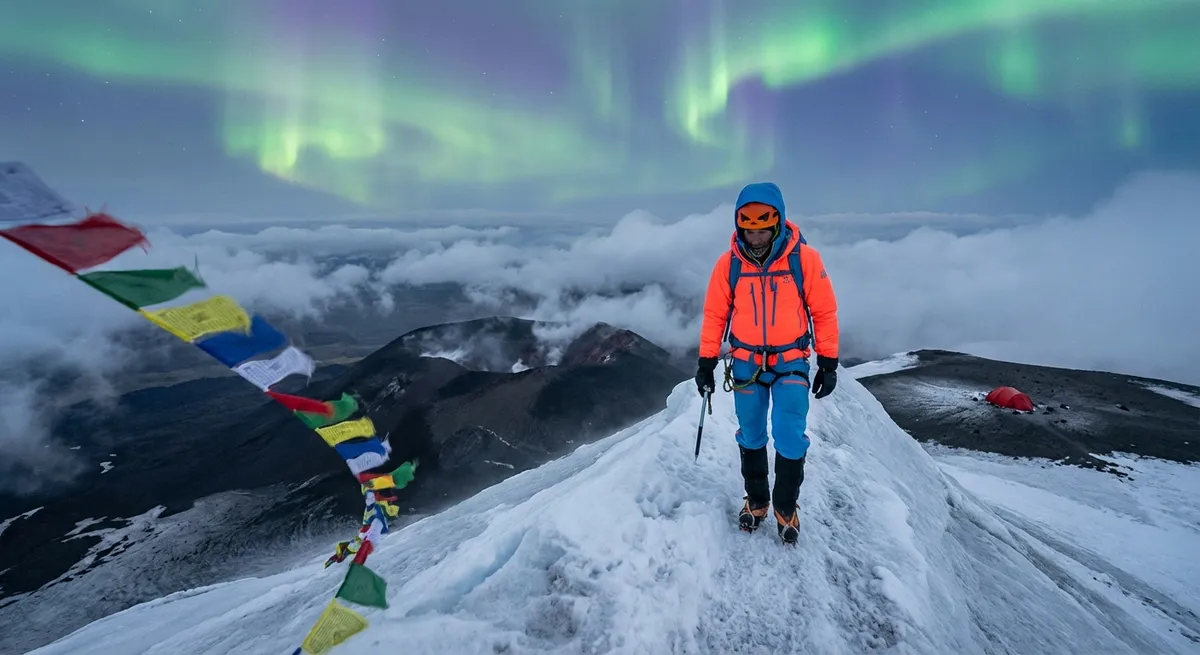
If your idea of “adventure” isn’t a zipline and a welcome drink, you’re in the right corner of the internet. Extreme travel isn’t about danger for danger’s sake—it’s about going so far off-script that your comfort zone has to apply for a visa. These five travel discoveries aren’t packaged, polished, or influencer-ready. They’re raw, demanding, and unforgettable—exactly the way No Way Travel likes it.
1. Sleeping on Moving Ice: Life Aboard an Arctic Expedition Vessel
Cruises are for buffets. Expeditions are for people who want to wake up to a ship shoving its way through sea ice while polar bears patrol the horizon.
Modern polar expedition ships let you live inside a planet-level science documentary. You’re not just watching the Arctic; you’re floating through it. One day you’re pushing through drift ice under a sky that never gets dark; the next you’re stepping onto a frozen coastline that feels like it shouldn’t legally exist. The air is so cold and clean it almost hurts, and your breath crystallizes fast enough to make you feel slightly mortal.
The extremes aren’t only physical. Your sense of space and time gets weird. Days are measured in ice thickness, whale sightings, and whether the Zodiac can land on the shore without flipping. You attend safety briefings not about pool depths but about what to do if a curious polar bear wanders too close. If conditions shift, plans don’t “change”—they evaporate. The weather and the ice decide where you go; you just hang on and adapt.
This kind of travel demands a high tolerance for unpredictability, tight quarters, and full-body cold, but the payoff is brutal beauty and rare wildlife encounters. You leave with a different understanding of “remote,” and an almost unsettling awareness of how fragile and powerful this frozen world really is.
2. Riding the Edge of Altitude: Thin-Air Trekking in the High Himalaya
Plenty of people “do Everest” from the comfort of a Netflix queue. A few hike to base camp. But if you want extreme without needing to be a pro climber, high-altitude trekking in lesser-known valleys of the Himalaya hits the sweet spot between survivable and unreasonably intense.
Out here, the air gets insultingly thin long before your ego is ready. Every step above 4,000 meters feels like you’re walking through half-set concrete while someone slowly tightens a belt around your lungs. Weather changes with zero interest in your itinerary: sun, snow, fog, repeat. Paths can be nothing more than a suggestion scratched into scree. Your world shrinks to boots, breath, and the next switchback.
The extremity isn’t just vertical; it’s cultural. Some routes pull you through villages where yaks outnumber vehicles, electricity is a rumor, and prayer flags out-color any city skyline. You might sleep in teahouses clinging to cliffs, share garlic soup with people who’ve lived at these altitudes for generations, and wake to the sound of distant avalanches instead of traffic.
Acclimatization becomes your main religion. You learn to read your own body like an altitude meter—headache, nausea, insomnia, loss of appetite. You turn around if you need to, because up here, ego is dead weight. But if you respect the mountain, this form of extreme travel rewards you with the feeling of walking inside a living cathedral of rock and ice.
3. Diving into Black Water: Night Encounters in Open Ocean
If you want to know how comfortable you really are with the unknown, jump into deep, open ocean at night—on purpose.
Blackwater diving is among the most surreal legal experiences a human can have. You drift in the upper layers of open ocean after dark, tethered to a boat as powerful lights lure up creatures from the deep. Below you: hundreds or thousands of meters of nothing. Around you: an alien parade of transparent, bioluminescent, and unclassifiable life forms that look like concept art for sci-fi movies.
There’s no reef, no bottom, no comforting landscape—just the awareness that you’re a small, air-breathing accident suspended over a bottomless void. Depth perception dissolves. Your sense of “up” and “down” becomes theoretical. The only proof you’re not floating in space is the salt on your lips and the occasional curious fish face materializing and vanishing like a glitch.
It’s not about adrenaline hits from sharks (though those might show up). The real extremity is psychological. You are choosing to enter a habitat your species was never meant to explore, at a time of day when most people are scrolling in bed. If you can stay calm here—rhythmic breathing, situational awareness, slow movements—there isn’t much in everyday life that can rattle you later.
4. Heat That Thinks You’re a Joke: Desert Crossing with No Shade in Sight
A lot of travel chases beaches. Extreme travel chases places where the sun is an apex predator and shade is basically contraband.
Crossing a serious desert—on foot, by bike, or even in a rugged overland vehicle—is an exercise in accepting that your body is basically a sack of water trying not to evaporate. Distances twist your brain: you walk for hours and that distant ridge barely moves. Heat radiates off the ground, off your gear, off your own skin. Every decision—when to move, when to rest, how much to drink—is a calculation against dehydration and heat stress.
Navigation stops being romantic and becomes survival math. You learn to read dunes, wind patterns, and the cruel optimism of mirages. Nights swing the pendulum in the opposite direction: temperatures crash, stars explode across the sky, and you realize you’ve never seen true darkness before. Sound disappears; your own heartbeat feels like noise pollution.
The desert strips you down to fundamentals: water, direction, shelter. It makes minimalism non-negotiable and turns comfort into a negotiable luxury. Survive a true desert crossing and “I forgot my phone charger” stops qualifying as a problem.
5. Living with the Edge: Volcano Slopes and Eruptive Landscapes
Most people see volcanoes as background scenery or disaster-movie props. Extreme travelers see them as neighborhoods, playgrounds, and laboratories of raw geology.
Staying in communities built on volcanic slopes means sleeping where the planet occasionally reminds everyone who’s in charge. Steam vents hiss in the distance, sulfur hangs in the air, and the ground can feel oddly warm beneath your boots. Trails might lead you past still-cooling lava fields, forests resurrecting out of ash, or craters that look like someone took a cosmic ice cream scoop to the earth.
You might hike before dawn to the crater rim to catch the first light hitting a smoking caldera, or descend into lava tubes formed by old eruptions. At active volcanoes with safe, controlled access, you can sometimes see lava glowing like molten metal at a distance that feels morally questionable but logistically supervised. Sirens, evacuation plans, and hazard maps become part of the local vocabulary.
The extremity here is living with constant, low-level risk. People farm, pray, and raise kids in the shadow of something that can reset the whole region on a geologic whim. It’s humbling to witness that kind of coexistence. You leave with a different understanding of “permanent” and a front-row memory of what “living planet” actually looks like.
Conclusion
Extreme travel isn’t defined by how much you can scare yourself, but by how much you’re willing to surrender: control, comfort, certainty. It’s choosing moving ice over pool decks, thin air over city smog, black water over lit-up shorelines, burning horizons over curated sunsets, and unstable ground over polished plazas.
If you walk into these experiences with respect—for the environment, the people who actually live there, and your own limits—you walk out changed. Not “I found myself” changed, but “I saw how small I am and somehow that feels like freedom” changed.
When you’re ready to step past the edge of normal, the world has plenty of places that don’t care if you’re comfortable. That’s where No Way Travel lives.
Sources
- U.S. Geological Survey (USGS) – Volcano Hazards Program - Technical information on volcanic activity, hazards, and monitoring that informs safe travel near active volcanoes
- National Oceanic and Atmospheric Administration (NOAA) – Arctic Theme Page - Background on Arctic conditions, sea ice, and climate relevant to polar expedition travel
- Centers for Disease Control and Prevention – High-Altitude Travel & Altitude Illness - Evidence-based guidance on acclimatization, symptoms, and prevention of altitude sickness for Himalayan and other high-altitude treks
- Divers Alert Network (DAN) – Night and Limited Visibility Diving - Safety considerations and best practices for night and blackwater diving in open ocean
- U.S. National Park Service – Hiking in the Desert - Practical advice on hydration, heat, and survival strategies for desert environments
Key Takeaway
The most important thing to remember from this article is that this information can change how you think about Extreme Travel.