Most people collect passport stamps; you collect stories that make your friends say, “There’s no way that actually happened.” Good. You’re in the right place.
This isn’t a list of “hidden gems” and it’s not about cheap flights or photogenic lattes. This is about the moments when your comfort zone taps out, your adrenaline takes over, and your brain quietly whispers, “We probably shouldn’t be here.”
These five discoveries aren’t bucket-list items. They’re pressure tests—for your instincts, your gear, and your idea of what travel is even for.
1. The Glacial Midnight Silence You Can Hear Ringing
Step away from city noise long enough and silence stops being peaceful—it becomes unnerving.
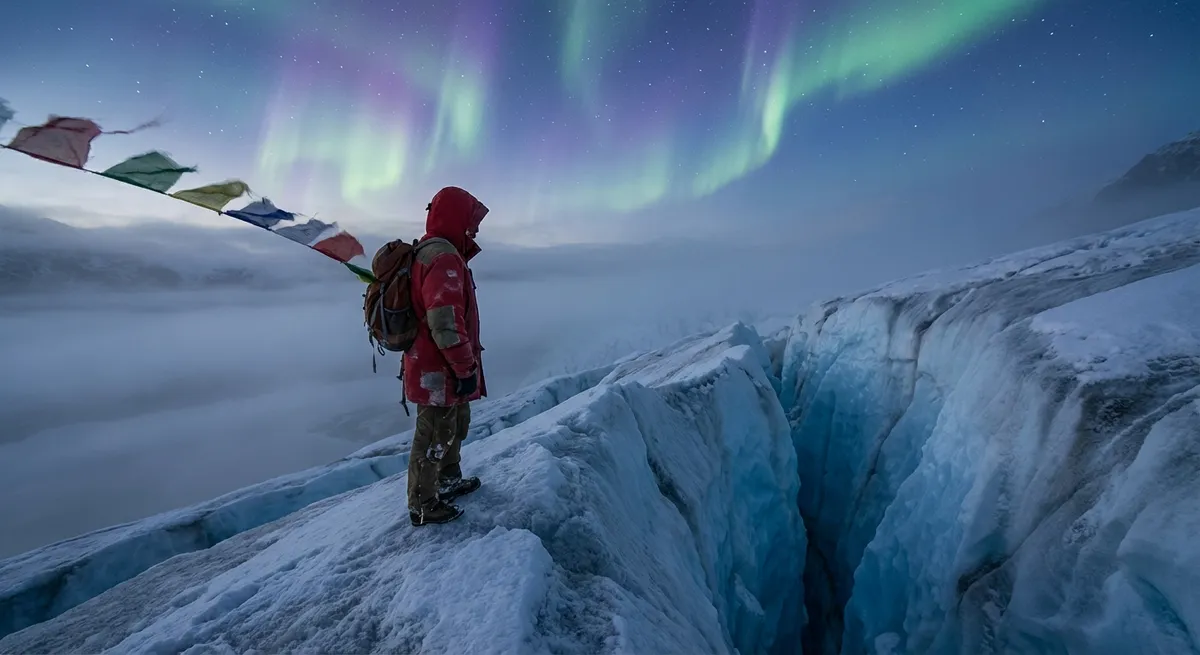
Picture this: You’re standing on ancient ice in a polar region—Svalbard, Greenland, or Antarctica—your boots biting into snow that fell before your country even existed. It’s midnight, but the sun is still hanging low like it forgot to set. There is no wind. No cars. No generators. Just the faint groan of a glacier shifting its weight like a sleeping titan.
Extreme polar expeditions aren’t just about cold; they’re about exposure. To weather, to isolation, to the realization that if your gear fails, there’s no “running back to town.” Guided glacial treks and icefield crossings are possible even for non-professionals—if you go with operators who treat the environment like a live experiment in survival, not a backdrop for your Instagram.
You learn to walk differently—shorter steps, cautious footing. You learn to listen for things you never noticed before, like the crackling of ice crystals under sudden sunlight or the way your own breath sounds too loud inside your balaclava. This kind of silence can flip your nervous system from “vacation mode” to “primordial alert” in seconds. And that’s exactly why it’s addictive.
2. Riding the Edge of Volcanic Fury (Without Becoming Lava Toast)
Volcano travel is where geology decides to cosplay as a war zone—and lets you get uncomfortably close.
Think of places like Vanuatu’s Mount Yasur, Iceland’s volcanic highlands, or the slopes of Stromboli in Italy. You’re hiking over cooled lava that looks like it was poured last week, smelling sulfur, feeling the low, stomach-deep rumble of a planet that is very much not stable.
On some volcano trips (with licensed guides and local authority clearance), you can approach active craters close enough to feel the heatwaves pounding your face. You’ll see molten rock eject into the sky like cosmic fireworks and ash clouds drift into the atmosphere. It’s not a theme park. It’s Earth literally remaking itself in real time—and you’re on the front row.
The discovery here isn’t just, “Wow, lava is hot.” It’s the realization that the ground you treat as solid is more like a crust on top of a molten ocean. You’re suddenly aware that entire civilizations have been wiped out by exactly what you’re marveling at. That tension—between awe and threat—is what supercharges the experience.
Volcano expeditions demand respect: gas masks sometimes, helmets often, and unwavering obedience to your guide always. When the crater breathes, you listen.
3. Borderlands Where Maps Get Politely Vague
There are places where Google Maps shrugs and gives you a dotted line and a warning. The world is full of borderlands—frozen conflicts, demilitarized zones, buffer zones, and disputed territories—that exist in a strange limbo between “open” and “definitely don’t wander off alone.”
Think of legally accessible areas near the Korean Demilitarized Zone (DMZ), the curious micro-states and enclaves in Europe, or border towns where history is layered so densely that every street could start an argument. These aren’t war-tourism playgrounds; they’re living fault lines where geopolitics, identity, and daily life have to share the same cramped apartment.
Traveling in these regions with ethical, local-led tours can drop you into surreal scenes: a quiet farm field lined with warning signs, a village split by a border written in a language residents don’t speak, or a checkpoint where your passport suddenly feels very small.
The thrill isn’t about danger; it’s about proximity to tension. You start to feel how fragile “normal” actually is. Conversations with locals—if you’re patient and respectful—can be more electrifying than any bungee jump. You’re not just seeing a place; you’re standing in the unresolved question mark of global politics.
4. Caves That Eat Your Sense of Direction for Breakfast
Above ground, you’re an adult. Underground, you become a beginner again.
Caving—proper, technical spelunking, not just strolling through a lit-up tourist cavern—messes with your brain in ways roller coasters never could. Once you’ve squeezed through a tight limestone crack on your belly, felt the rock press against your ribs, and turned off all your lights at your guide’s command, you understand what dark really means.
Deep cave systems (in places like Mexico, Slovenia, or the U.S. Appalachians with permitted outfits) can involve rappelling down vertical shafts, wading through underground rivers, and navigating halls filled with stalactites that took thousands of years to grow and one careless helmet bump to destroy. Claustrophobia and awe play tug-of-war in your chest the entire time.
The unique discovery here is how quickly your senses re-calibrate. Your hearing sharpens. Your spatial awareness becomes almost animal. You learn to trust ropes, rock, and teammates more than your own ego. Every meter you descend feels like peeling away a layer of civilization and dropping closer to the planet’s operating system.
Caving teaches a brutal little lesson: you’re not “conquering” nature. You’re politely negotiating a brief guest pass.
5. Ocean Storm Chasing: When the Sea Decides You’re Small
Most travelers go to the coast for calm seas and sunset cocktails. Then there are those who look at a brutal weather forecast and think, “Let’s go see that.”
Extreme ocean experiences—on research vessels, expedition cruises, or with specialized sailing crews—can take you into heavy weather conditions that most people spend their lives avoiding. Think towering swells in the Southern Ocean, the infamous churn of the Drake Passage, or the aftermath of a major storm for scientific observation trips.
You’re strapped in, watching waves rise higher than your hotel back home. The ship climbs, shudders, and slams down into troughs like it’s punching the ocean. Spray lashes the windows. Your coffee abandons its cup. Suddenly, all your land-based confidence deflates. The sea doesn’t care who you are, how many followers you have, or what your return ticket says.
The discovery here is a raw recalibration of scale. You realize how absurdly small your species is on a planet mostly covered in water. In between squalls, when the clouds tear open and the sky looks like a wound of light, you might even feel an unwelcome emotion: humility.
Ocean storm trips aren’t for thrill-chasing alone. Many are tied to scientific research, conservation, or polar logistics. You’re not just along for the ride; you’re a witness to data collection in some of the harshest conditions Earth can casually throw at you.
Conclusion
Extreme travel isn’t about proving you’re fearless. It’s about admitting you’re not—and going anyway, with preparation, respect, and a healthy awareness that you’re not in charge out there.
You step onto ice that could outlive your entire family line. You peer into a volcano rewriting landscapes. You walk the edges of invisible political tensions. You crawl under the skin of the planet. You ride a storm and accept that if the sea wants to bully you, it will.
If regular travel is about seeing the world, extreme travel is about letting the world see what you’re really made of.
Pack your curiosity. Pack your caution. Then go find the places where your comfort zone stops—and your real stories start.
Sources
- U.S. National Park Service – Glacier Travel & Safety – Overview of glacier hazards, gear, and best practices for safe guided travel on ice
- United States Geological Survey (USGS) – Volcano Hazards Program – Detailed information on volcanic activity, associated risks, and how scientists monitor eruptions
- United Nations – Treaty on the Non-Proliferation of Nuclear Weapons & DMZ Context – Background on demilitarized and security-sensitive regions connected to geopolitical border areas such as the Korean DMZ
- National Speleological Society – Educational resources on responsible caving, conservation, and safety in cave environments
- NOAA Ocean Today – Storms & Hurricanes – Scientific perspective on severe ocean storms, their formation, and associated marine hazards
Key Takeaway
The most important thing to remember from this article is that this information can change how you think about Extreme Travel.