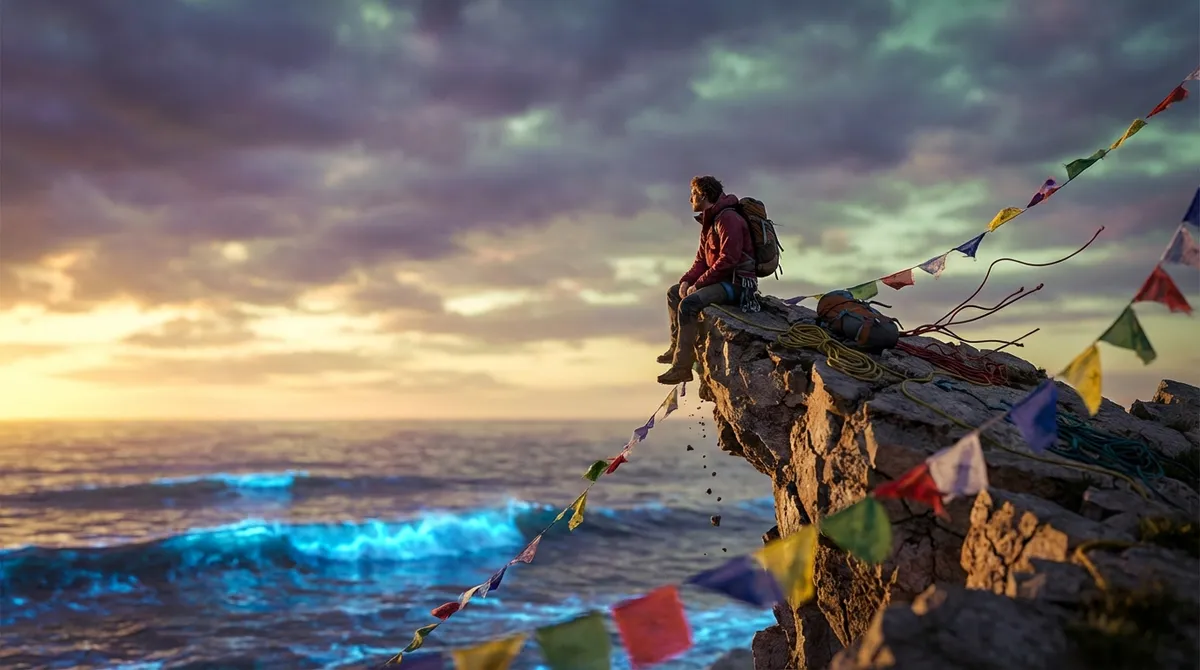
There’s normal travel: sun loungers, city breaks, predictable sunsets. And then there’s the other kind—where your heart rate replaces your smartwatch, the map looks like a bad idea in progress, and your travel insurance policy starts sweating. This is that second thing.
These are not polite adventures. These are five wild thresholds: places where the environment, the altitude, the darkness, or the sheer absurdity push you out past the safety rail—and that’s exactly why you go.
1. Ice-Locked Nights on Lake Baikal’s Frozen Highway (Russia)
Most people visit lakes to swim. At Lake Baikal in winter, you drive on it, sleep on it, and listen to it crack beneath you.
Siberia’s Lake Baikal holds more water than any other freshwater lake on Earth, and in the deep freeze of winter, it transforms into a translucent, kilometer-thick sheet of blue ice, seamed with white fractures that stretch to the horizon. Locals turn it into a seasonal highway; extreme travelers turn it into an obsession. You can skate, bike, or even fat-ski across it as winds rip through the valley and the ice sings—yes, literally sings—with eerie, laser-like tones as it expands and contracts.
It’s not just cold; it’s surgical. Temperatures can dive below -30°C, and one loose glove or poorly sealed boot can wreck a trip. Safety becomes ritual: layering correctly, reading the networks of cracks, checking ice thickness near pressure ridges, and following local guides who treat the lake like a living creature with moods and pressure points. The reward? Nights in heated cabins or tents on the shore, with stars so sharp they feel like they’ll puncture the sky, and days of pure, alien ice-planet immersion that makes regular winter trips look like a warm-up act.
2. Volcano Shadowlines and Ash-Laced Air on Mount Merapi (Indonesia)
There’s hiking a mountain—and then there’s climbing one that erupts on a disturbingly regular schedule.
Mount Merapi, near Yogyakarta in Java, is one of the most active volcanoes on Earth. Trails wind through villages built on its slopes, past pastures and hardened lava flows that feel like a museum of previous disasters. Pre-dawn summit pushes are the classic move: starting at night, scaling steep, ash-covered paths, and timing your final scramble with the first glow of sunrise.
What makes Merapi a different animal is its psychological edge. Every step reminds you that this volcano is not retired; it’s on break. Locals talk about past eruptions with a calm that feels almost supernatural, pointing out evacuation routes and old pyroclastic flow paths like they’re just landmarks. Up high, the air stings your lungs with sulfur, fumaroles hiss like broken radiators, and views stretch across Central Java—until you glance down at the jagged crater lip and realize how temporary the current calm might be.
You’re not just bagging a summit here. You’re walking into an active geological event paused mid-sentence—and trusting it won’t finish that sentence while you’re standing on top of it.
3. Diving Into Null: Freediving the Blue Hole Worlds
Oceans are already unnerving: depth, pressure, darkness. Blue holes take that anxiety and concentrate it into a perfect vertical portal.
From Egypt’s Dahab Blue Hole to Dean’s Blue Hole in the Bahamas and the Great Blue Hole off Belize, these underwater pits look like someone dragged a cosmic cookie cutter through the seafloor. Circular, impossibly deep, and ringed with reef, they lure freedivers, tech divers, and people with a complicated relationship to gravity. For extreme travelers, the thrill isn’t just depth—it’s the mental reckoning with a giant shaft of nothingness beneath your fins.
Freedivers describe the descent as a kind of falling meditation: equalization checks, pressure building around sinuses and lungs, the world narrowing to your descent line. Walls vanish into cobalt; bubbles drift up like reversed rain. Tech divers, equipped with mixed gases and redundancy systems, drop far beyond recreational limits, navigating tunnels, overhangs, and light beams slicing through blue void. Every protocol is sharp-edged: gas planning, depth limits, decompression schedules. There is no casual “let’s see what happens” here.
On the surface, it’s just ocean and sun. Underneath, it’s one of the purest thresholds humans can voluntarily cross: between control and surrender, light and depth, logic and that tiny voice that asks, “Why are you pointing your body at this hole and going down?”
4. Riding the Edge of the World’s Dryest Air in the Atacama Extremes (Chile)
The Atacama Desert doesn’t care if you think you’ve seen deserts before. It’s so dry, parts of it have gone centuries without measurable rain. NASA literally uses it as a Mars stand-in.
Extreme travelers treat the Atacama like a sandbox for high-altitude experimentation. You’re not just road-tripping; you’re crossing salt flats that look like shattered glass, biking above 4,000 meters where your lungs bargain for every breath, and hiking into valleys where the Milky Way feels close enough to knock your head on. Night skies here are among the clearest on Earth, which is why it’s home to massive telescopes that stare deep into the universe while you stare deep into your instant noodles at a very wind-battered campsite.
The challenges are sneaky. It’s not the “oh no, I’m dying in the dunes” drama you see in movies; it’s low-grade altitude headaches, moisture-sucking air that turns your lips to sandpaper, and a sun that fries you while the wind freezes your hands. You have to think like an astronaut: constant hydration, ruthless sun protection, slow pacing, and attention to your body’s micro-signals. One ambitious day at altitude without respect for acclimatization can collapse your entire plan.
But the payoffs feel like alternate planets: rainbow mineral hills, steaming geyser basins at dawn, and salt lakes so still they mirror the sky until you can’t tell which side is up.
5. Glacial Void Walking and Crevasse Hunting in Iceland’s Icefields
Ice is not inherently gentle. On Iceland’s glaciers, it becomes a moving, cracking, melting labyrinth that rewrites itself every season.
Instead of just snapping photos from the viewpoint, extreme travelers rope up and head into the ice. Guided glacier traverses and ice-climbing routes take you across crevasse fields, blue moulins (vertical shafts carved by meltwater), and ice caves that look like someone rendered a wave in solid glass. Crampons bite into slick surfaces, axes thunk into ice walls, and the soundscape is all quiet drips, distant cracks, and the occasional rumble as the glacier adjusts its massive weight.
The risk is not cartoonish; it’s technical. Misjudge a snow bridge, and you could plunge into a crevasse. That’s why serious glacier trips are all about systems: rope techniques, arrest practice, route finding, and temperature management to avoid both hypothermia and sweat-soaked chill. You move clipped into a line, trusting both the guide’s choices and your teammate’s reaction times more than your own bravado.
Standing at the lip of a blue moulin—water spiraling into an abyss you can’t fully see—and feeling your rope tug tight is a visceral reminder: this is not a theme park. The glacier is indifferent, beautiful, and in motion, whether you’re on it or not.
Conclusion
Extreme travel isn’t about pain worship or collecting bragging rights like boy-scout badges. It’s about voluntarily stepping into environments where you are unmistakably small, fragile, and very, very mortal—and choosing to stay there long enough to feel your brain reboot.
From ice highways and volatile volcanoes to underwater voids, Martian deserts, and shifting ice fortresses, these are trips that demand full presence. You can’t doomscroll on a glacier or tweak your email underwater in a blue hole. You’re too busy being fully, viscerally alive.
If your idea of a “good trip” involves a little fear, a lot of respect, and a story your friends will genuinely doubt, these thresholds are waiting. Just remember: the line between “wild adventure” and “terrible idea” is thin—and crossing it safely is the real art.
Sources
- UNESCO World Heritage Centre – Lake Baikal - Background on Lake Baikal’s scale, ecology, and global significance
- Smithsonian Magazine – Inside Indonesia’s Mount Merapi, One of the World’s Most Active Volcanoes - Context on Merapi’s activity and local life around the volcano
- National Geographic – Blue Holes: The Final Frontier - Exploration of blue holes and why they fascinate divers and scientists
- ESO – Atacama Desert and the Very Large Telescope - Explanation of why the Atacama’s conditions are ideal for astronomy (and how extreme they are)
- Icelandic Met Office – Glaciers in Iceland - Authoritative information on Iceland’s glaciers, their dynamics, and safety considerations
Key Takeaway
The most important thing to remember from this article is that this information can change how you think about Extreme Travel.