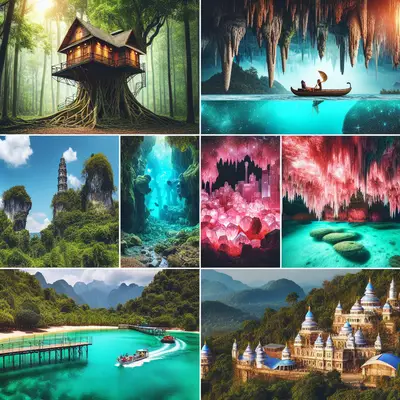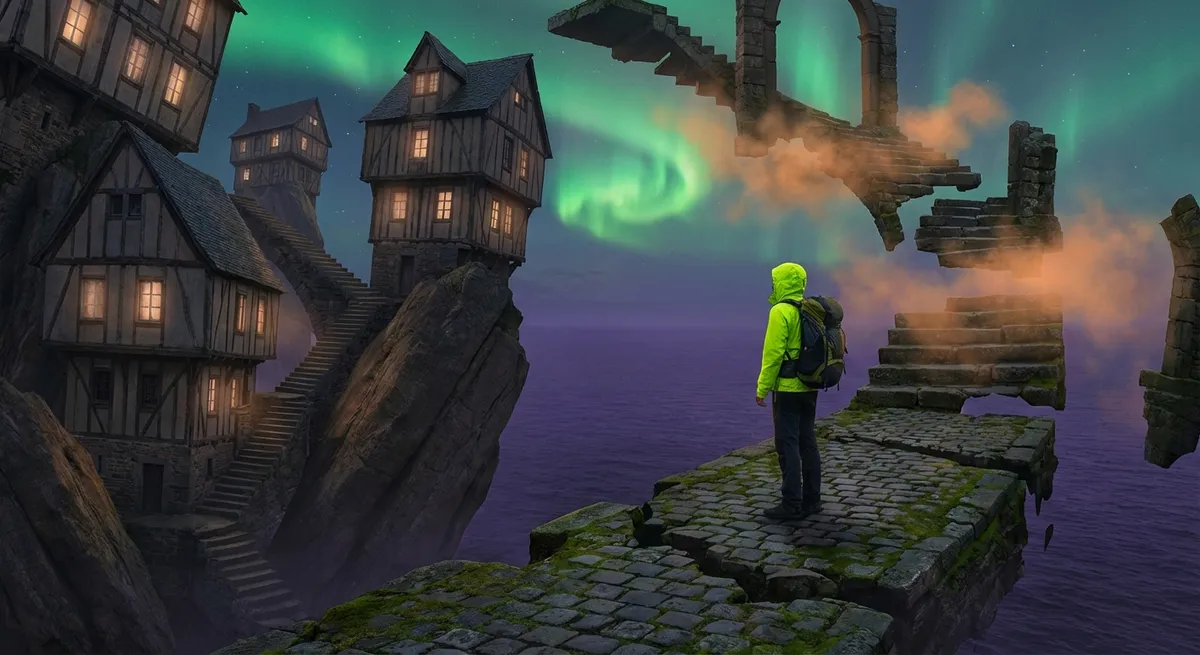
There are places on this planet that feel like someone misread the blueprints. Landscapes that glitch, towns that cosplay as other planets, human-made oddities that absolutely no zoning board should have approved. This isn’t “quirky café in a cute alley” weird. This is “did we just slip into a parallel universe?” weird.
Welcome to the wrong side of reason: five travel discoveries that will nuke your idea of a normal trip—and make your social feeds look like you faked every single photo.
The Sinking Stone Forest That Eats Your Sense of Scale (Tsingy de Bemaraha, Madagascar)
Madagascar’s Tsingy de Bemaraha doesn’t look real. From above, it’s a razor-blade ocean—thousands of limestone needles stabbing into the sky. From below, it’s a vertical maze where your footing, depth perception, and fear of heights go to fight it out.
This “stone forest” was carved over millions of years by water dissolving limestone and dropping it into oblivion. What’s left is a labyrinth of knife-edged spires, canyon cracks you have to side-shuffle through, and suspension bridges that make your thighs question your life choices. Lemurs leap overhead like they’re in a nature documentary; you’re the extra trying not to fall into a chasm.
Travel here feels like exploring an alien planet with gravity mostly intact but common sense removed. Routes involve via ferrata gear, steel cables, and ladder systems bolted to stone fangs. You don’t just visit; you climb, squeeze, crawl, balance, and occasionally swear. The reward: views so bizarre your followers will assume you used AI.
The Living Rainbow Mountain That Won’t Sit Still (Landmannalaugar, Iceland)
Peru has its famous rainbow mountain—but Iceland quietly hosts a version that looks like a painter rage-quit onto an entire mountain range. Landmannalaugar in the Icelandic Highlands is a swirling mass of color: caramel, rust, sulfur yellow, pastel green, and ash-black, created by rhyolite rock and geothermal chaos.
Steam hisses from the ground. Mud pools gurgle like an upset stomach. The hills are streaked as if someone melted crayons down their slopes. Snow patches linger randomly where they have no business existing. Hike here and every ridge feels like you walked through a filter change: gray desolation one minute, candy-colored ridges the next.
Campers soak in a natural hot spring at the valley base—surrounded by sulfur, lava fields, and mountains that look Photoshopped. Weather flips from sun to sleet in a couple of hours, turning the whole landscape into an unstable painting. It’s not just weird-looking; it behaves weirdly too, like the ground is quietly reminding you that Iceland is basically a live volcano pretending to be a country.
The Town That Rehearses the Apocalypse Nightly (Aokigahara & Mount Fuji’s Shadow, Japan)
On the slopes of Mount Fuji, Japan keeps one of its strangest combinations: a perfectly iconic volcano looming over one of the planet’s eeriest forests—Aokigahara, the “Sea of Trees.” Forget horror-movie clichés; the real weirdness here is how a place can be so silent it feels like sound has been deleted.
The forest sits on ancient lava flows, so tree roots twist over black rock like veins on a creature’s back. The ground in places is hollow, swallowing sound. Compasses can misbehave due to the magnetic properties of the rock, and trails can fade into wild undergrowth faster than your confidence. It’s easy to see why ghost stories bloom here.
Head back into Fuji’s wider shadow—lake towns like Kawaguchiko—and the vibe flips sharply. Vending machines blink under postcard-perfect views of the volcano; locals commute like nothing is weird about living under a mountain that has erupted repeatedly through history. Hike parts of the pilgrimage routes up Fuji, then drop down into cafes obsessively themed around the mountain. It feels like humanity building a cheerful shrine around a sleeping dragon and pretending it’s just “good for tourism.”
The Island Where the Ground Keeps Breathing (Socotra, Yemen)
Socotra looks like evolution got bored and started improv. Off the coast of Yemen, this island is often labeled “the most alien-looking place on Earth,” which undersells how wrong everything appears—in the best possible way.
The dragon’s blood trees grow like umbrellas designed by Dr. Seuss, their canopies perfectly mushroomed, their red sap historically used as medicine and dye. Bottle trees are swollen, pink, and awkward, like they’re halfway through an embarrassing puberty. Beaches are ghostly white and mostly empty. Caves bore into cliffs, and vultures spiral on thermals as if they’ve been here since the dinosaurs—and probably have cousins who were.
Around a third of Socotra’s plant life exists nowhere else on Earth. Step onto the island and your internal atlas short-circuits: are you in a desert, a high plateau, a jungle, or some forgotten Jurassic test lab? Political instability and logistical difficulty mean relatively few outsiders make it here, which keeps Socotra’s surreal atmosphere intact. It’s not just remote; it feels like the island refused to participate in the last few million years of mainland reality.
The Doorway Where the Desert Melts Into Salt (Salar de Uyuni, Bolivia)
At first glance, Bolivia’s Salar de Uyuni is just a gigantic salt flat. Then the rain comes, and the world breaks. A thin film of water turns 10,000+ square kilometers of cracked white crust into a perfect mirror—the sky duplicated under your feet, horizon line erased.
In dry season, the salar is a bright, blinding geometric fever dream. Hexagonal salt polygons click together as far as you can see. Old train cars rust and die at the “train graveyard” in Uyuni town, giving the approach a post-apocalyptic overture. Islands like Incahuasi erupt from the flatness, covered in massive cacti that look like they evolved specifically to confuse visitors.
In wet season, vehicles appear to float on clouds. Walk just a few meters from your 4x4 and your brain loses its depth cues—what’s reflection, what’s real, where is the sky actually located? Travelers come here to take forced-perspective photos with toy dinosaurs and coffee mugs, but the real memory burn comes from that moment when you realize you’re standing between two identical infinities. Sunrise and sunset feel like the world rendering twice, once above, once below.
Conclusion
These aren’t “nice stops on a sensible itinerary.” They’re ruptures—places where Earth shrugs off its usual user interface and shows you the experimental builds. Tsingy shreds your vertical comfort zone. Landmannalaugar paints geology like a vandal. Fuji’s shadow balances serenity and dread. Socotra nurtures a parallel evolution. Uyuni deletes the horizon just to see what you’ll do.
If your next trip feels too reasonable, that’s your cue. Book the landscape that doesn’t behave. Go where your camera can’t decide what it’s looking at. Travel shouldn’t just change your mind; it should occasionally make you question what planet you woke up on.
Sources
- UNESCO: Tsingy de Bemaraha Strict Nature Reserve - Official overview of the geology, ecology, and significance of Madagascar’s stone forest
- Icelandic Tourist Board – Landmannalaugar Area - Practical and environmental information about the rhyolite mountains and hiking region
- Japan National Tourism Organization – Mount Fuji & Surrounding Areas - Background on Mt. Fuji, nearby towns, and cultural context
- UNESCO: Socotra Archipelago - Detailed description of Socotra’s unique biodiversity and endemic species
- NASA Earth Observatory – Salar de Uyuni - Scientific perspective on the formation and characteristics of Bolivia’s massive salt flat
Key Takeaway
The most important thing to remember from this article is that this information can change how you think about Weird Places.