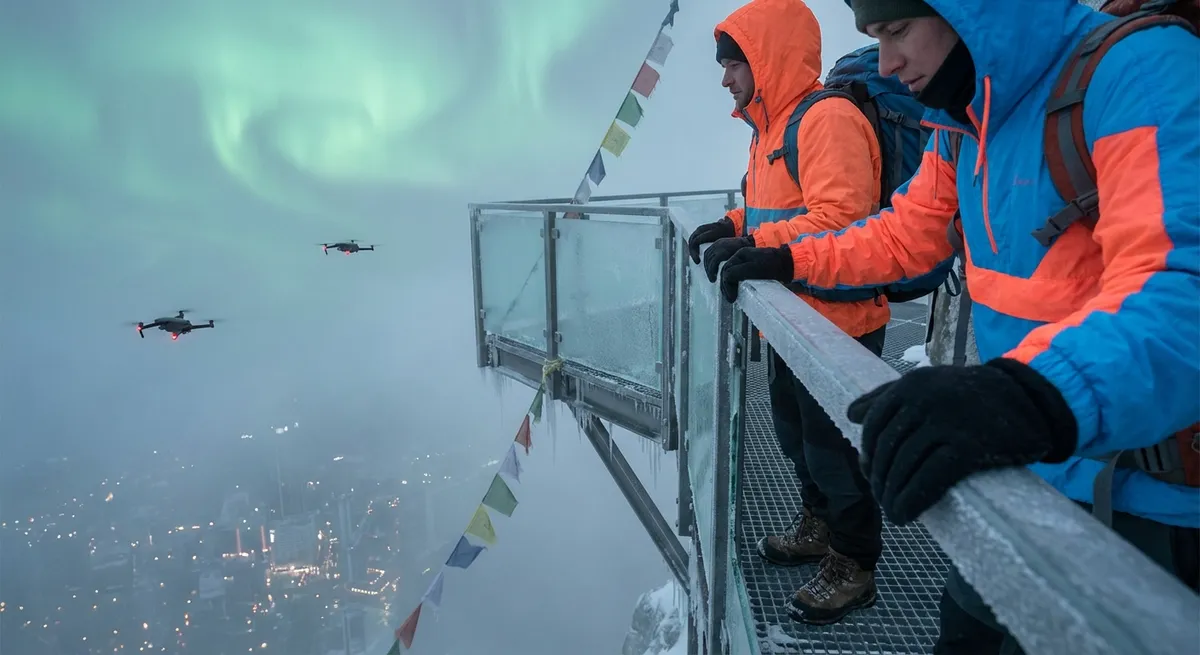
The world doesn’t actually need more “bucket list” ideas; it needs more ways to mess with your compass. This isn’t about tallest bungee jumps or most Instagrammed cliffs. This is about trips that tilt your reality—places where gravity feels negotiable, day and night get weird, and the landscape basically dares you to step into it. If you’re the sort of traveler who reads the warning sign and thinks, “That’s adorable,” these extreme experiences will feel less like vacations and more like consensual chaos.
Riding the Edge of Active Earth: Volcanic Frontlines You Can Actually Visit
Volcano trips are the purest “the planet is alive” experience you can buy without joining a research expedition. Instead of looking at mountains from a safe overlook, you’re climbing into the furnace’s lobby.
In Iceland, you can literally drop into the magma chamber of a dormant volcano like Þríhnúkagígur. A cable lift lowers you 120+ meters into a cavern painted in metallic reds, greens, and purples—evidence of past eruptions that didn’t quite finish the job. It feels like wandering inside a dragon’s ribcage while scientists calmly explain, “Yes, this was once full of liquid rock.”
In Vanuatu, the trek up Mount Yasur on Tanna Island is the opposite flavor of comfort. Thunder from inside the crater, ash in your teeth, orange glow pulsing like a heartbeat—every sense screams “nope” while your brain whispers “keep going.” Eruptions send lava bombs into the air, and you stand at a distance that seems reasonable until you realize you can feel the shockwaves in your sternum.
Extreme volcano travel isn’t just about flirting with danger; it rewires your idea of terrain. Instead of static landscapes, you’re meeting a planet that breathes, grinds, and occasionally spits fire with bad manners. The key is going with serious local guides who treat the mountain like a moody relative, not a tourist attraction.
Chasing Eternal Twilight: Living Inside the Polar Time Warp
Forget jet lag. Nothing scrambles your inner clock like existing where the sun either refuses to rise or refuses to set. Polar regions aren’t just cold; they’re psychologically extreme.
Head north in summer to Svalbard, Norway, and your brain gets hacked by the midnight sun. It’s 2:30 a.m., you’re hiking in full daylight, and your body keeps waiting for darkness that never arrives. Sleep feels optional. Conversations get weird. Time dissolves into one long glowing afternoon. Even mundane activities—eating soup, tying your boots—feel slightly unhinged, because your instincts keep shouting, “This is the wrong hour for this.”
Flip the calendar and chase polar night instead. Towns above the Arctic Circle spend weeks or months without a sunrise. The world compresses into gradients of blue and violet; streetlights and cabin windows feel like portals instead of utilities. In places like Tromsø, Norway, or Rovaniemi, Finland, locals lean into the darkness with saunas, coffee strong enough to legally be a drug, and northern light shows that make the sky look hacked by a cosmic DJ.
The extremity here isn’t cliffs or storms—it’s your own brain chemistry. Circadian rhythms glitch. Moods yo-yo. Your sense of “day” and “night” becomes a loose suggestion. You come home realizing how fragile your version of normal actually was.
Into the Whiteout: Crevasse Countries and Moving Ice
Most people think of glaciers as pretty backdrops. Extreme travelers treat them like living obstacle courses made of ancient ammunition. Icefields move, crack, groan, and casually hide holes deep enough to swallow buildings.
Guided glacier trekking in places like Patagonia’s Southern Ice Field or Alaska’s Harding Icefield feels less like hiking and more like slow-motion negotiation with a frozen alien world. You strap spikes to your boots, learn the language of snow textures, and listen for the hollow echoes that mean “don’t you dare step here.” A blue crevasse isn’t just beautiful; it’s a letter from the past, whispering about centuries of snow compacted into glass.
Then there’s ice climbing—toe picks and ice axes burying into vertical walls of frozen waterfalls or glacier faces. Every move is deliberate. Every placement is a tiny bet that the ice will hold. The silence is so complete that your own breathing sounds like an intrusion. When you look down, the world below feels absurdly far away, like you’ve briefly stepped out of the planet’s usual contract with gravity.
The real extremity isn’t the cold; it’s how quickly conditions can shift. Sun softens surfaces, snow bridges collapse, creeks reappear where solid ice stood yesterday. You come away with a new respect for landscapes that are technically “still,” but constantly rewriting themselves under your feet.
Underworld Expeditions: Caving Where the Planet Forgets You Exist
If mountains are the world flexing upward, caves are the places it quietly folds inward and keeps secrets. Extreme caving is less about lights-and-handrails tourist caverns and more about sinking into blackness where GPS, cell service, and most of your comfort evaporate at the entrance.
In places like Mexico’s Sistema Huautla or Slovenia’s deep karst systems, you descend via ropes into narrow shafts that feel like rock swallowing you vertebra by vertebra. Passages tighten, ceilings drop, and suddenly you’re crawling through stone, listening to your own chest scuff the ground. Your imagination gets loud very quickly.
Vertical drops open into chambers the size of cathedrals, lit only by your headlamp’s thin beam. Underground rivers appear out of nowhere, slide past your ankles, and vanish into deeper holes. In some cave systems, you navigate by inflatable boats through lakes that have never seen sunlight—your lamp catching tiny blind creatures that evolved here while the surface world was busy inventing cities.
Caves are a different category of extreme: psychologically heavy, aggressively quiet, and indifferent to your presence. Climbing a mountain makes you feel big. Dropping into the underworld reminds you how microscopic you are—and that sensation is its own addictive thrill.
Where Land Ends Hard: Meeting Earth’s Sharpest Edges
Headlands, ridgelines, and desert rims are where the planet stops playing gentle. These are the places that feel like the crust itself was ripped open and then left unsupervised.
Think of walking the knife-edge sections of Nepal’s lesser-known ridges, where the path is sometimes a foot wide with void on both sides, and clouds tear past below you instead of above. Or scrambling along the spines of Spain’s Picos de Europa, where limestone has been chewed into towers and blades by weather so relentless it might as well be personal.
Then there are coasts like South Africa’s Wild Coast or the Faroe Islands, where cliffs rocket straight out of the ocean in nearly vertical walls, and the wind acts like it’s trying to file you off the edge. The soundtrack is waves detonating against rock far below, invisible but very obviously there. Trails are more “strong suggestions” than engineered routes; occasionally you’re just reading the landscape and making micro-calculations with every step.
What ties these “end of the world” spots together isn’t a single activity—it’s that you’re constantly one misstep away from a truly final consequence. The terrain demands humility. You learn to read rock, wind, and your own fatigue levels like gospel. And when you finally sit down somewhere safe, watching weather slam into geography at full volume, ordinary views back home feel like screensavers.
Conclusion
Extreme travel isn’t about collecting scars or flexing on social media with the most dangerous selfie. It’s about finding places where Earth stops behaving politely and starts showing you its source code—lava, ice, darkness, depth, exposure. Those moments where your instincts light up, your senses sharpen, and the world feels raw and unedited? That’s where No Way Travel lives.
If you’re going to chase these wrong-side-up experiences, do it with respect: for local guides, for safety protocols, and for landscapes that do not care how many followers you have. Go prepared, go humble, and let the planet rearrange you a little. That’s the whole point.
Sources
- Icelandic Tourist Board – Volcanic and Geothermal Areas - Overview of visiting volcanoes and geothermal regions in Iceland, including safety and accessibility
- U.S. National Park Service – Glacier Safety - Detailed explanation of glacier hazards and safe travel practices on ice
- Norwegian Polar Institute – Polar Night and Midnight Sun - Scientific background on extreme polar light conditions and their effects
- National Speleological Society - Cave safety guidelines and considerations for responsible caving
- UIAA – International Climbing and Mountaineering Federation Safety Resources - Best practices and safety recommendations for mountaineering and exposure-heavy terrain
Key Takeaway
The most important thing to remember from this article is that this information can change how you think about Extreme Travel.